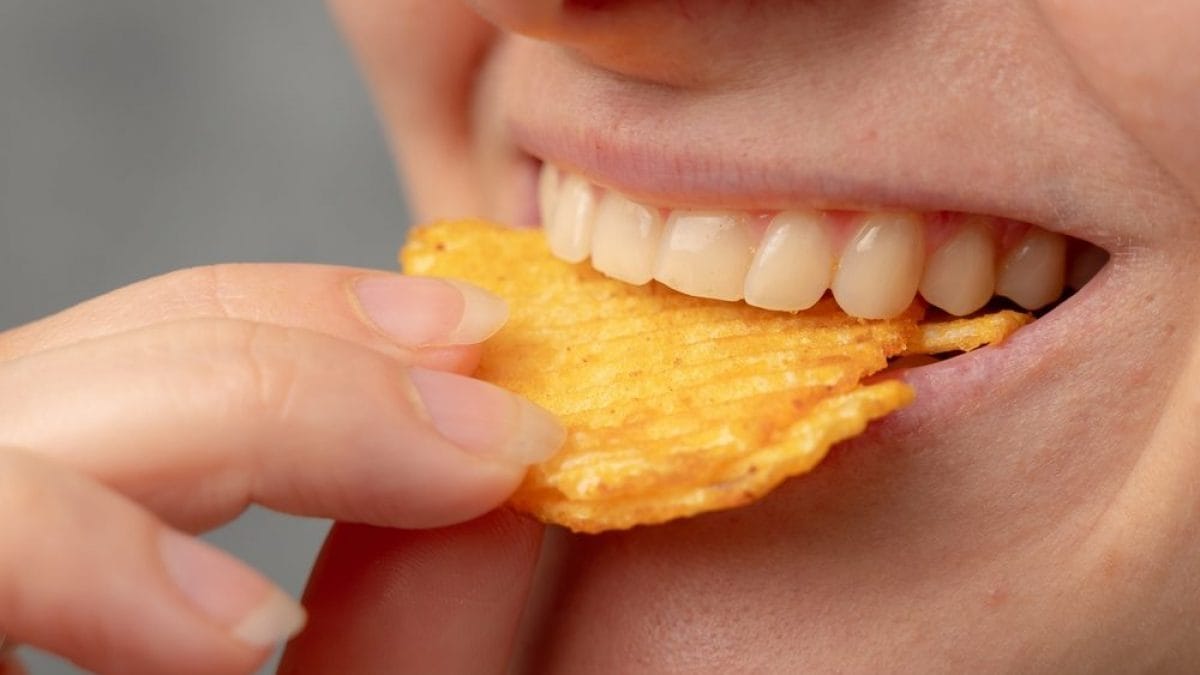
There's a precise, almost magical moment when a food conquers us: the bite. Even before the flavor, comes the sound, that crack, crunch, or snap that announces freshness, lightness, pleasure. It's a universal language, understandable across cultures and at all ages. It's no coincidence that food advertisements and commercials always amplify that sound: crunchiness isn't just a texture, but a multisensory experience that engages hearing, touch, and the brain.
Today we'll tell you why we love crunchy foods so much and what really happens when a food "crunches" under your teeth, in light of scientific research that has revealed the link between sound, texture, and pleasure.
The Sound of Taste
In 2004, neuroscientists Massimiliano Zampini and Charles Spence conducted a now-famous experiment: they had participants taste ordinary Pringles chips, manipulating the sound produced when biting into them through headphones. When the "crunch" was amplified at high frequencies, the chips were judged to be fresher and crispier, even though they were identical to the others.
This study proves that our brain "tastes" with our ears: the perception of crunchiness is influenced by both sound and taste. Essentially, the "sound" of biting activates the same brain areas that respond to stimuli of freshness and satisfaction. Since then, dozens of studies have confirmed that sound is a key component of the multisensory food experience.

When Science Explains Consistency To Us
Beyond hearing, crunchiness is a matter of physics and moisture. Every food, in fact, has an internal structure made of tiny air cells and rigid materials (starches, proteins, sugars) that fracture under the pressure of biting. The rapidity with which these fractures occur generates that "clean" and dry sound we associate with crunchiness.
A study conducted at Wageningen University has shown that the speed of biting affects the perception of crispiness: the faster the breaking, the more the brain interprets the signal as “crisp” and “fresh”. Conversely, the presence of moisture reduces this effect.
Water, in fact, is the invisible enemy of crunch. When the water activity (aw) in a food exceeds a critical threshold —often between 0.35 and 0.50, according to studies by Katz and Labuza of the University of Minnesota—the structure loses rigidity, the sound becomes muffled, and the perception of freshness fades. This is why a potato chip left open overnight becomes soft: its microscopic walls have absorbed moisture from the air, turning from rigid to plastic.

How The Food Industry Exploits Crunchiness
Crunchiness is a delicate balance, but also a powerful weapon of sensory seduction. The food industry knows this well: crunch is one of the most recognizable and gratifying sounds for the human brain, so much so that today it is designed as a true ingredient.
In sensory research laboratories, the term food sound design is used: frequencies, amplitudes, and fracture times are studied to achieve the "perfect bite sound." Foods are analyzed with precision instruments—such as texture analyzers and highly sensitive microphones —which record the acoustic profile of the breakage. This data generates graphs that show how many and how intense the microscopic fractures in the structure are. The closer the "sound peaks" are spaced, the crispier and fresher the food is perceived. Some companies even compare these sounds with digital models to ensure that each batch "sounds" as it should.
Behind every perfectly crunchy chip, cracker or breakfast cereal, there is a precise technological strategy:
- the formulation (the ratio of starches, sugars and fats) controls porosity and fragility;
- cooking or frying defines the water content and glass transition of the product;
- controlled cooling avoids condensation that would soften the surface;
- Finally, modified atmosphere packaging (MAP) —often with nitrogen—isolates the product from oxygen and moisture, preserving the "crack" sound until opened. And this is why packets of industrial chips appear "half empty."
But crunchiness isn't just technology: it's also sound marketing. Commercials and advertising campaigns deliberately amplify the sound of biting into a food to convey freshness, authenticity, and instant pleasure. The brain, in fact, interprets that sound as a confirmation of quality: a signal that the food is fresh and "alive."
In recent years, however, crunchiness has also become an area of sustainable innovation. Many companies are trying to reproduce the same sensorial effect while reducing frying, fat, and environmental impact. Technologies such as air frying, infrared drying, or controlled baking allow for crunchy products with less oil and energy. At the same time, alternative plant-based ingredients (legumes, ancient grains, fruit scraps, or peels) that maintain the same acoustic and tactile response are being experimented with. Packaging also comes into play: compostable materials or natural barriers must guarantee the same moisture protection as traditional plastic packaging, so as not to sacrifice the "crunch" on the altar of ecology.
;Resize,width=767;)
