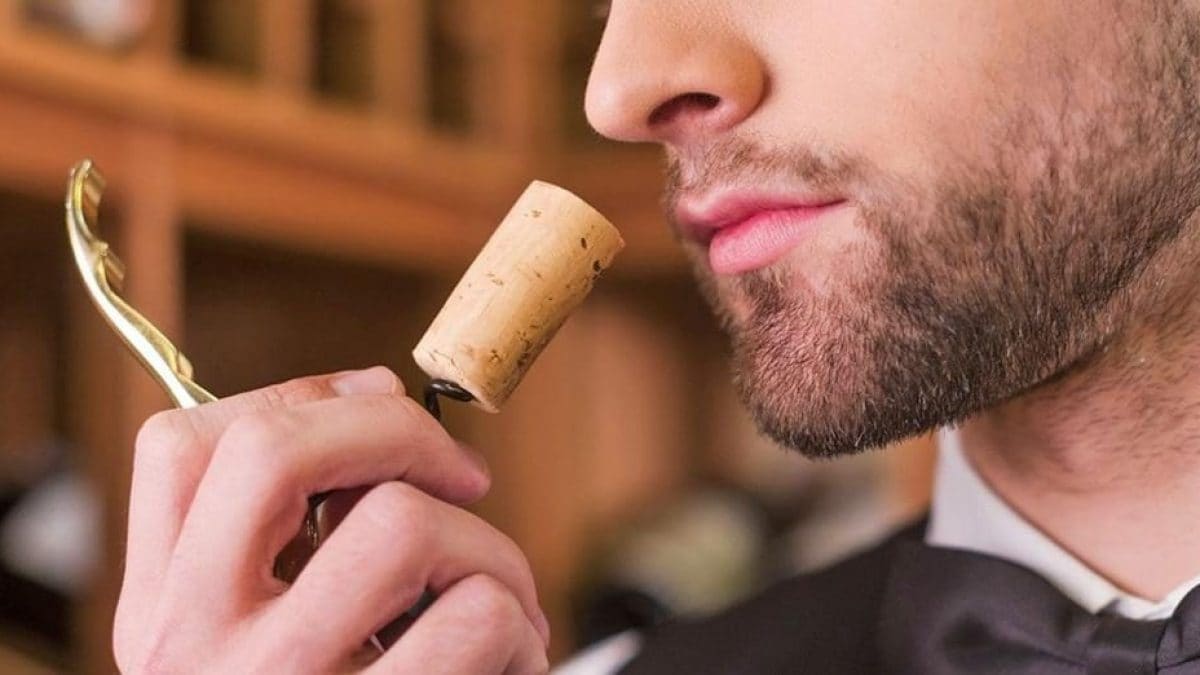
You've probably seen a sommelier or waiter sniff the cork of a wine bottle after uncorking it. Sometimes, the cork is then offered to the customer to do the same. Why is this done, and why is it so important? The cork should be sniffed after uncorking the bottle, and this task falls to the host (if it's a dinner party) or the sommelier on duty. The cork is sniffed primarily to verify that it hasn't been attacked by a parasitic fungus (Armillaria mellea), responsible for what we commonly call "cork taint." Officially, it's called TCA, and it can irreparably alter the aromatic profile of wine. Restaurant customers aren't required to do so, but many feel compelled. Let's try to unravel the confusion created by the rigid rules of wine service.
Wine Cap's Role in a Service
According to the most common rule, the sommelier smells the cork after uncorking the bottle, without touching it or detaching it from the corkscrew, thus avoiding any contact with his own hands. He then places it, using a napkin, on a small plate, which is then placed on the table to allow the customer to check it.
In reality, this isn't exactly the purpose of the cork on the saucer. It's a rather modern convention. The cork is offered to the customer to allow them to verify the bottle's authenticity thanks to the manufacturer's mark printed on the cork, and to verify the condition and integrity of the object, thus determining whether the bottle has been stored correctly.

The custom arose because, long ago, it was customary to cheat customers by serving wines different from those ordered. Thus, to protect citizens, this rule was created. Today, this is no longer the case, but unfortunately, a lack of knowledge on the subject leads many people to feel embarrassed when faced with this little dish. What should you do in these cases? Usually, if you don't know the answer, you tend to imitate others' behavior and sniff the cork. This custom has become so pervasive in customer habits that it's now commonplace.
Sniffing the cork is an accepted practice, but doing so is the restaurant sommelier's duty and responsibility: our advice is to trust him for two main reasons:
- You still have to taste the wine, that's the important step;
Smelling the "cork smell" is really difficult, it takes a lot of experience.
TCA contamination occurs when you smell like wet dog or wet newspaper: basically, you know it when you smell mold. In this case, the wine should not be served to the customer. Written like this, it seems like a simple operation, but it is not at all, which is why we recommend you rely on the restaurant's sommelier: it literally takes years of experience to distinguish the typical cork odor from that of a defective cork. In addition to experience, great olfactory sensitivity and training are required. Note: we're talking about a cork defect, not a wine defect, because cork taint is precisely that. Armillaria mellea is a parasite of the cork oak, so if it's present, it's been there from the beginning. There's little you can do, and it's no one's fault except the producer's: in this case, if the sommelier detects cork taint in the wine, he'll set the bottle aside and return it to the producer, who will refund him in full.
;Resize,width=767;)
