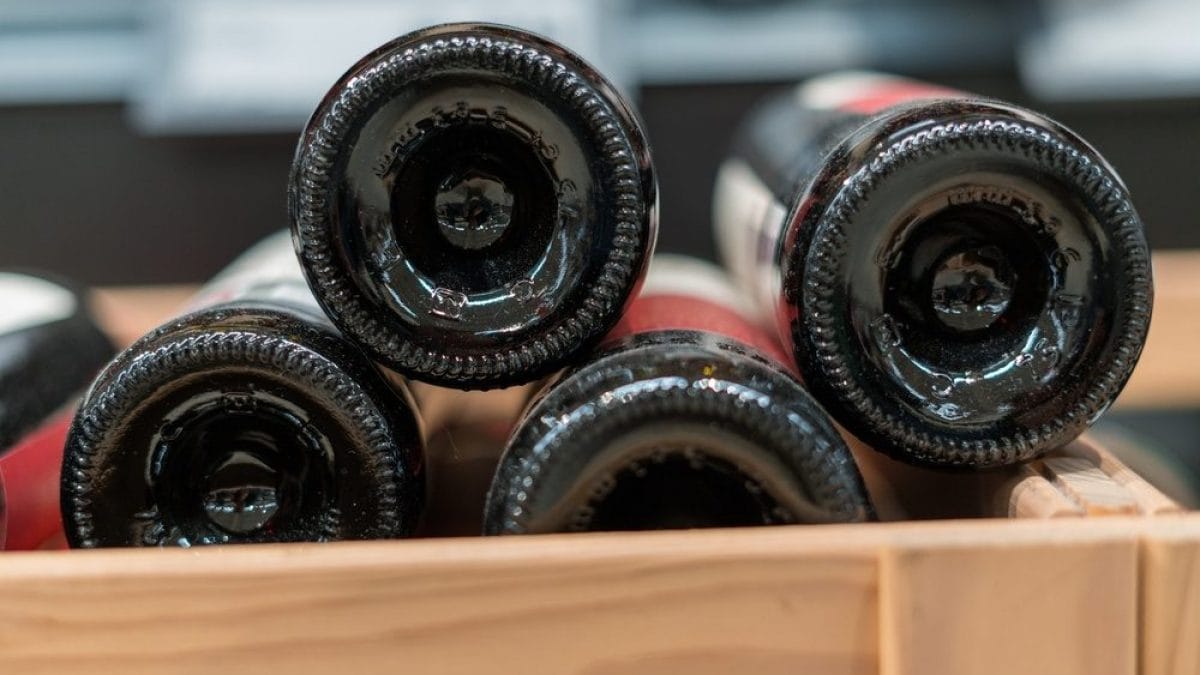
If you look at a wine bottle from below, that central indentation you see is called a punt, and it's much more than a decorative detail. It's an internal dome created by pushing the glass at the bottom upward, creating an external support ring and a depression in the center, more evident in some bottles like Champagne, Metodo Classico, and aged reds, much less so in others. A lot of misunderstanding has accumulated around that hollowed-out bottom, because at first glance it seems like a decorative feature of an "important" bottle, while its history stems from the concrete needs of glass and wine. Today, let's look together at where this shape comes from, what it's still used for today, and why it's not enough to tell you whether you'll find a great wine in your glass.
The Punt's Historical Origins
Punt is not an aesthetic affectation and is not created to impress at the table: it was born right in the workshop, amidst the heat of the ovens, the manual glassmaking, and the very practical limitations of the first bottles.
From Manual Blowing to The Pontil
The first bottles were hand-blown, and the glassmaker supported them with a metal rod called a pontil or punty while the glass was still hot. When this support was removed, an irregular, often sharp, scar was left on the bottom, the so-called pontil mark. To prevent this protrusion from making the bottle unstable or damaging the supporting surfaces, the master glassmakers began to push the bottom inward, encasing the mark in a recess. This gave rise to the punt we know today.
When Technique Becomes Form
Between the late 17th and the first half of the 18th century, with more efficient furnaces and thicker glass, the modern bottle began to take on a more robust profile, and the punt also consolidated as a useful choice for stability. At that time, achieving a perfectly flat bottom was difficult, because during cooling, the glass could swell in the center and cause the bottle to wobble. The hollow helped better relieve stress and freed the outer ring to rest on the table. With industrial production, this need diminished, but the punt remained a recognizable feature of many bottle families, from Bordeaux to Burgundy to Champagne.

What Is It For Today?
Today, the punt doesn't have a single purpose, and its purpose varies depending on the wine and the bottle. In some cases, it still relies on the technical aspect, in others, it weighs more heavily on service, tactile perception, and the way the wine is presented.
Bottle Resistance
For sparkling wines and wines subjected to internal pressure, the concave base still retains a concrete structural function. Its geometry distributes the internal pressure along the rim and walls more favorably than a completely flat base, reducing the risk of breakages and microfractures. This is especially true for bottles required to withstand high pressures, such as those for Classic Method sparkling wines. In still wines, however, the effect remains more secondary and is combined with other design factors, such as glass thickness, blend quality, and the overall bottle design.
Sediment Management
In unfiltered reds or those destined for long aging, the punt can help collect sediment in a peripheral layer of the bottom. When pouring carefully, this shape makes it easier to keep sediment away from the main flow of the wine. It's especially useful for decanting, although it's best not to burden it with benefits it doesn't have: much more important are the bottle's preservation, the absence of vibrations, and the gentleness with which you handle it.
Wine Service
In professional service, the punt also offers a comfortable place to rest the thumb, especially with heavy or large bottles. This grip helps better control the inclination and center of gravity during service, and has long been a staple of sommeliers and formal restaurants. There's also a perceptual component that weighs heavily: a bottle with thick glass and a pronounced punt appears more solid, more dramatic, and often even more expensive. For this very reason, some companies continue to use it as a positioning marker, while others choose lighter bottles with shallower bases to reduce weight and transportation emissions.

False Myths and Curiosities
The presence of the punt has always given rise to simplifications, half-truths, and somewhat romanticized tales. It's worth clearing things up, because this detail still attracts hasty interpretations.
Deep Punt Does Not Certify Quality
Among the most persistent ideas is that the deeper the puncture, the better the wine: but this isn't true. The depth of the puncture may, if anything, reflect a choice in packaging, cost, or image, not the intrinsic quality of the contents. A heavier bottle requires more glass and often costs more, so it's common to find it on high-end labels, but the connection remains indirect and full of exceptions. The most frequently cited case is that of Louis Roederer Cristal, a high-end Champagne bottled in puncture-free bottles.
Curiosities to Be Taken With Caution
Among the recurring myths is the one that claims the bottom of the bottle serves to better "retain" the bubbles. In reality, for sparkling wines, its primary function is to resist the container's internal pressure, while the seal and perceived effervescence depend on many other factors, from the wine to the temperature, to the glass. Then there are those who believe the hollow bottom makes the bottle appear larger: visually, this may be the case, but the nominal capacity of standard bottles remains regulated.
If you really want to understand what kind of wine you have in front of you, you should look at the producer, the origin, the vintage, the style and, above all, what happens in the glass and what you perceive in your mouth.
The punt tells the story of the bottle very well, but a little less so that of the wine it contains.
;Resize,width=767;)
