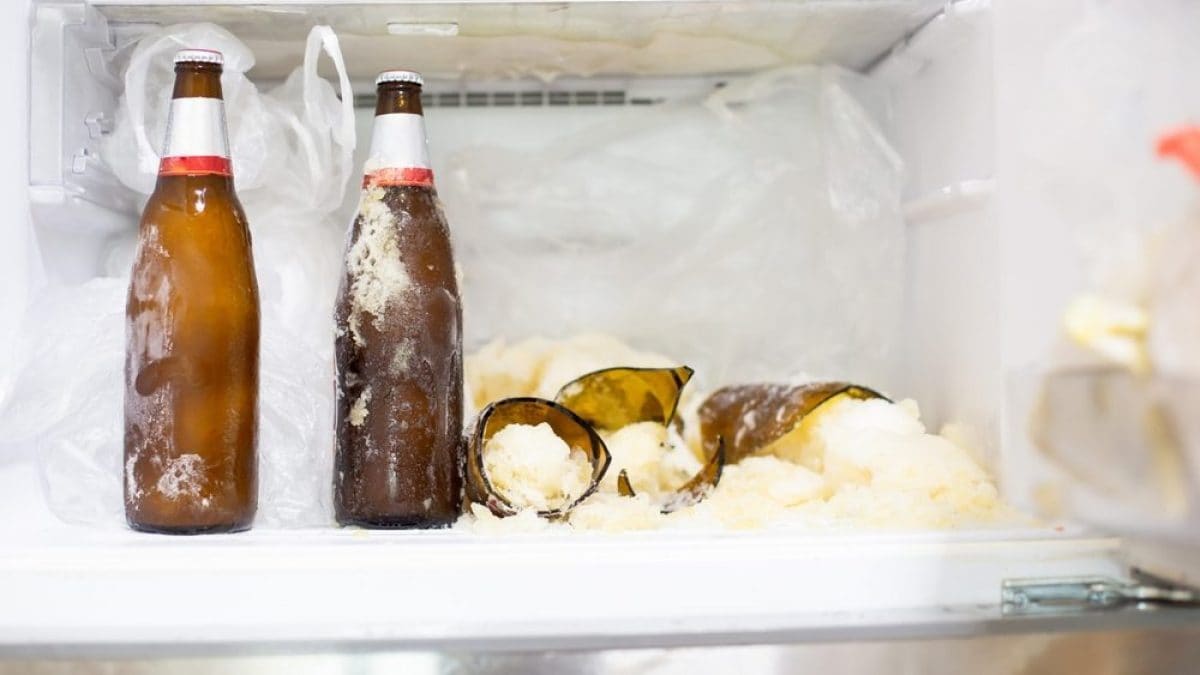
How many times have you resorted to the freezer to quickly chill drinks you'd forgotten to put in the refrigerator? Water, juice, and certainly even alcohol, like bottles of beer. We're sure you've also forgotten beer in the freezer just as often, only to find it shattered and exploded, with the double consequence of wasting it and having to clean it up. Today, we'll explain why this happens and, more importantly, how to avoid it: because yes, you can chill beer quickly using the cold air of the freezer, but you have to do it a certain way to avoid the potential explosion.
Why Beer Bottles Explode in The Freezer (And How to Avoid It)
If you leave a bottle of beer in the freezer for too long, it can explode. And be careful, it doesn't just happen to beer, but to almost all carbonated drinks and even bottles of wine. But what causes this phenomenon? There are two reasons, and in both cases, it's a question of chemistry. The first reason stems from the molecules of the liquid compound: when frozen, they convert to a solid state and, to do so, they expand, taking up more space, distancing themselves from each other. This applies to all liquids, and is why it's best, when freezing such a product, to leave some space between the liquid and the bottle cap—that is, not to fill it completely.

The second reason, however, is related to carbon dioxide: the CO2 contained in these drinks increases the pressure of the liquid. This phenomenon, linked to the first of the expansion of the molecules, causes such a high pressure that the bottle can no longer resist and explodes in the case of glass bottles, or the cap pops in the case of plastic bottles, which are more deformable.
Does this mean you should never put beer or other beverage bottles in the freezer? Not really: you can put beer in the freezer if you need to chill it quickly, but be sure to wrap it in a wet paper towel or a damp cloth and place it in the freezer for a few minutes (5-10 minutes). This step helps the bottles because there's a more efficient heat exchange between the water in the wet paper towel wrapping the bottle and the surrounding air: this method is very effective on warm bottles, but less so on those that are already a bit chilly.

Why Liqueurs, Grappas and Bitters Don't Explode
You may have already noticed this phenomenon, but it affects beer and wine bottles, but not other types of beverages like spirits. Why don't these explode? The reason is their different composition compared to beer, which is made almost entirely of water. The ethanol contained in beverages like bitters, grappa, and liqueurs, in fact, requires much lower temperatures to solidify, on average -148°F/-100°C: the higher the ethanol concentration, the lower the temperature will be needed to reach freezing point. Beer has a very unbalanced ethanol-water mix in favor of water, while these drinks contain a much higher level of ethanol, allowing them to last a long time even if you forget the bottle in the freezer.
;Resize,width=767;)
