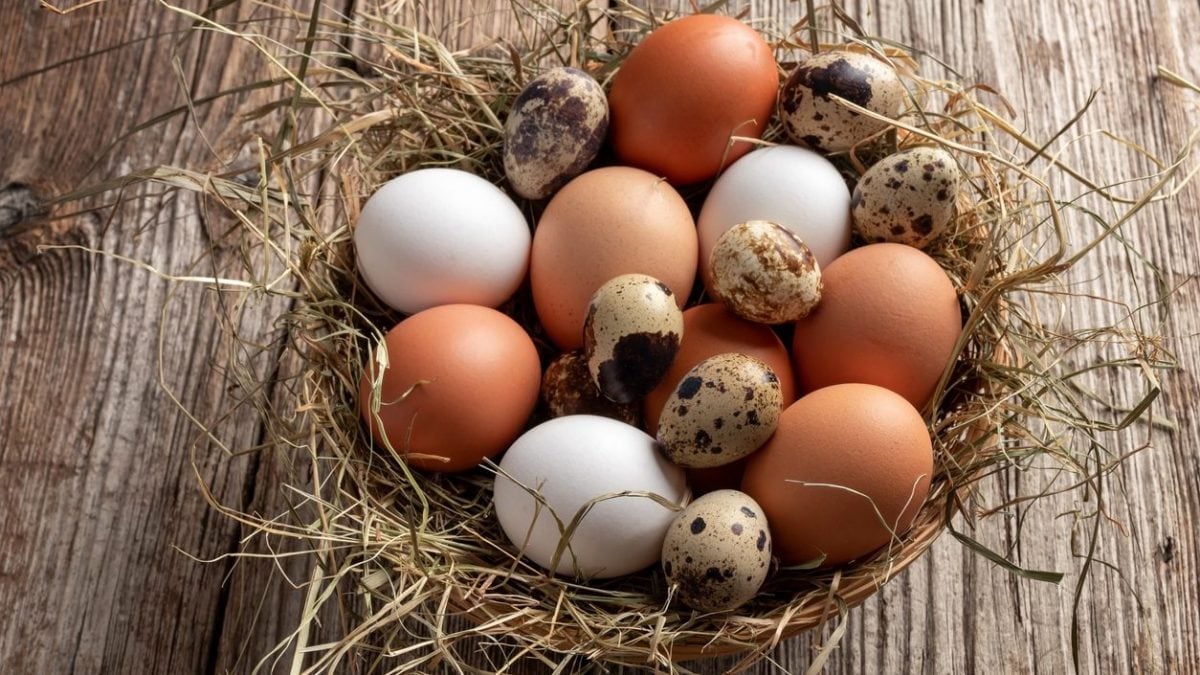
Eggs often evoke chickens, but not only that: in the collective imagination, this is the most immediate association, but when you stop to think, it's clear that they're not the only eggs we eat, and that birds aren't the only source of this food. What is bottarga if not a product derived from the processing of the ovary sacs of certain fish? Or the prized caviar: it's, in fact, sturgeon eggs, not to mention flying fish eggs, better known as tobiko, which have become a popular ingredient thanks to the spread of Japanese cuisine. Here, we review 15 varieties of edible eggs from different sources, some easy to find, and some difficult to find, finally dedicating a brief focus to the more unusual types, such as snail or turtle eggs.
Birds' Eggs
Chicken eggs, quail eggs, and goose eggs: these are just some of the varieties derived from poultry. Here's a short list to give you a broader overview: turkey eggs also exist, but their use is limited, if any, so much so that ostrich eggs are probably better known.
1. Chicken Eggs

Chicken eggs are the most common: highly versatile in the kitchen, they are available in large quantities, making them a rather economical food. Besides being easy to prepare, they also have several properties: they are low in calories, very nutritious, and rich in protein, perfect from breakfast to dinner. Shopping tips? Opt for organic ones, with code 0: according to the regulations, the feed must be free of GMOs and pesticides, and the animals must have ample living space to roam.
2. Quail Eggs

Among the most well-known after chicken eggs, quail eggs are eye-catching thanks to their small size (five equal one quail egg) and their speckled shells. Their flavor is delicate and their price is higher: they can be enjoyed raw or cooked, for example hard-boiled. Given their size, cooking time is relatively short. Choose them for gourmet recipes; they're perfect.
3. Ostrich Eggs

Unlike quail eggs, ostrich eggs are veritable giants: they measure between 15 and 20 cm, weighing around a kilo, even double that for the largest ones. A single egg is equivalent to 20-25 chicken eggs and is used in cooking in the same way: the yolk is thicker and more flavorful, almost creamy.
4. Goose Eggs

Especially prized in the traditional cuisine of certain states, such as Pennsylvania and Ohio, goose eggs are not easily found in large-scale retail outlets: it's easier to find them directly from the producer or at local markets. They are larger than chicken eggs and can weigh between 120 and 240 grams, depending on the bird that laid them. They are ovoid in shape, with a hard, opaque white shell. They are used like all other bird eggs.
5. Duck Eggs

Duck eggs are the same shape and size as chicken eggs: their shell color ranges from white to aquamarine, and like goose eggs, they are mostly purchased from local retailers. They are higher in calories and fattier than regular eggs, with a larger yolk that also has a stronger flavor. How best to use them? In omelettes, scrambled eggs, fried eggs, or in fresh pasta.
6. Turkey Eggs

Turkey eggs rarely make it onto our menus, but not because they're illegal: the bigger problem is that they're hard to find. The reason? The animal produces so few that their sale isn't considered profitable, not only in the U.S., but worldwide. Appearance-wise, they're larger than chicken eggs (weighing up to 100 grams), with a thicker, white shell dotted with light brown. Their flavor is said to be delicious, with a creamy, flavorful yolk.
7. Guinea Fowl Eggs

As with turkey, guinea fowl meat is easier to appreciate than its eggs. The latter are slightly smaller than chicken eggs, with a very similar flavor—so much so that they're used in the same recipes—but they have a higher cholesterol concentration. Externally, they're distinguished by their hard, shiny, creamy-white shell.
8. Pigeon Eggs

A bird highly esteemed by starred chefs, its eggs are not a particularly common food in the U.S.. In France, however, they are much more popular, as they are in the East: they are small (no longer than 4 cm) with a white shell that tends towards pearly, and are mainly used boiled or stewed to give a protein boost to soups or vegetable dishes.
Fishes' Eggs
From bottarga to caviar, to tobiko, roe comes not only from birds, but also from fish. More or less valuable, their primary function is as flavor enhancers: they are used to add an extra touch to recipes.
9. Bottarga

This term generally refers to the product obtained by salting and drying the egg sacs of various fish species, particularly grey mullet, tuna, and swordfish. It is sold in oil, vacuum-packed in amber-colored slices, or in powder form. Bottarga is easy to use: very flavorful, a little is enough to give spaghetti a delicious marine flavor.
10. Sturgeon Eggs

This is black caviar, a very expensive and valuable food that comes from the processing and salting of sturgeon eggs: the most renowned are those of the beluga sturgeon (Huso huso). They are mainly used in modest quantities on canapés, blinis and refined dishes: the flavor is delicate and the consistency creamy.
11. Salmon Eggs

Salmon roe is a widely used ingredient in Japanese cuisine, and can also be found in the U.S. in specialized shops. Known as ikura or red caviar, marinated in soy, it resembles a bright orange, transparent globe. Its flavor is salty and concentrated: it is mainly used as a garnish in sushi and sashimi dishes.
12. Flying Fish Eggs

They are often confused with the previous ones by non-experts as they have the same intended use, but flying fish eggs are slightly smaller and are called tobiko: they are crunchy in the mouth and can be of different colors, red, orange or black.
13. Lumpfish Roe

These roe come from the North Sea and are a substitute for caviar, as they are much cheaper: they are tiny black or red spheres obtained from the lumpfish (Cyclopterus lumpus) which are quite versatile: excellent for enriching canapés for aperitifs, but also as a condiment for elegant pasta dishes based on shellfish.
14. Herring Roe

Widespread in Eastern Europe, herring is a blue fish often eaten smoked or after being preserved for a long time in brine. Its roe is used in the same way as caviar, so much so that it shares its name, but not its prohibitive price. Its intense seafood flavor and black color make it a must-try, even in pasta dishes.
15. Carp Eggs

Medium-sized and yellowish in color, carp roe is typical of Greek, Turkish, Romanian and Bulgarian cuisine. The most famous dish featuring them is taramosalata, a pink-tinged spread made from pickled roe combined with lemon, onion, garlic, and olives. However, they can also be eaten around New York, Chicago and parts of the Midwest as a filling for crostini, first blanched with celery and onion and then seasoned with capers, oil, and white wine to form a sauce.
Special Eggs
We conclude our selection of edible eggs with varieties that we're unlikely to ever taste: some because they're banned in the U.S., others because they're incredibly expensive. In the UK, we're focusing on seagull eggs, which are legally available only in spring, and which can be used to make omelettes or Scotch eggs.

In Asia, in addition to turtle meat, its eggs are also cooked. These round, white eggs are considered an aphrodisiac and are especially served in soups. Also noteworthy are snail eggs or snail caviar, which resemble pearls, are very rare and sold at exorbitant prices, destined for haute cuisine. Also noteworthy is insect caviar, typical of Latin America: escamoles are ant eggs typical of Mexico, which have been consumed in traditional recipes since the time of the Aztecs.

;Resize,width=767;)
