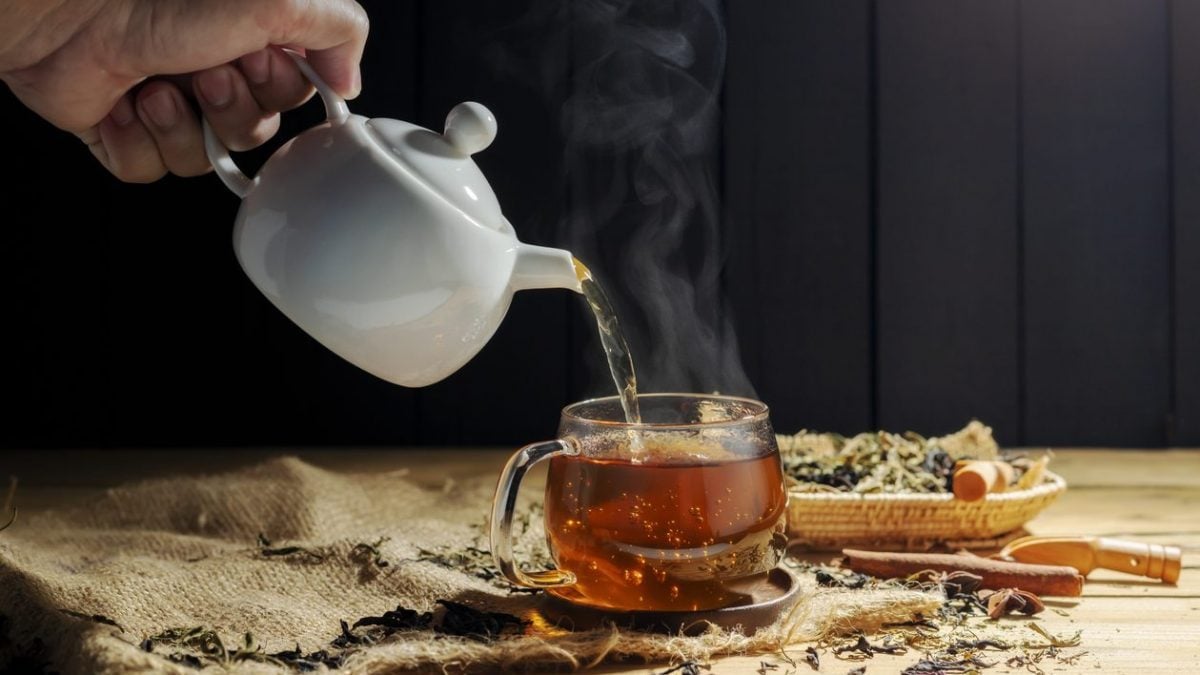
You might almost be tempted to say that there can be no mistakes when making tea, because you just take hot water, put a tea bag in it, and that's it. Nothing simpler, right? In reality, it's not quite that easy: even though preparing tea or herbal tea requires very little effort, there are some details to pay attention to. This is because it's a very delicate food, and even the slightest thing can compromise the final result, resulting in a drink with an unpleasant flavor rather than a delicate and fragrant one. Let's take a closer look at what you should never do.
1. Using Any Type of Water

We have two ingredients: water and leaves, and it's extremely important that both have certain characteristics. As for water, it's recommended to avoid tap water, which may contain limescale, resulting in a strong flavor that could affect the final taste of our infusion. The perfect water for tea and herbal teas is mineral water with a pH between 6.5 and 7 and a fixed residue of less than 50 mg/l.
In general, the water we use should be odorless and flavorless to allow the flavor of the tea to shine through: therefore, the best choice is bottled water. However, if you regularly drink tea and herbal teas, using only bottled water may not be sustainable, neither for you nor for the environment: the solution, therefore, could be to opt for a filter jug , capable of improving the characteristics of domestic water.
2. Bringing The Water to a Boil

No, absolutely not: water for tea should never reach 210°F/100°C. We know this is probably shocking news, but it's the truth, and the reason is easy to explain: when water boils, it loses oxygen, which prevents the aromatic notes of the leaves from developing as they should. Furthermore, water that's too hot risks producing a tea that's too bland and lacks any particular flavor, as the excessive temperature could burn some of the more delicate aromas.
However, there is no absolute temperature: it depends on the type of tea or herbal tea we want to consume. Generally speaking, green and white teas are the most delicate and therefore require a temperature between 140/60 and 175°F/80°C, while black tea, as well as herbal teas, require water at a temperature of around 195°F/90°C, therefore very hot but not boiling. In any case, to avoid any mistakes, the packaging always indicates the correct temperature for that type of tea or herbal tea.
It's therefore essential to monitor the temperature, and the most reliable way to do so is definitely with a thermometer. However, there are also electric kettles with built-in digital thermometers, so you can constantly and accurately monitor the temperature of your water. However, our advice is not to use the microwave, as it can heat the water unevenly, making it hotter at the top and colder at the bottom.
3. Placing an Indefinite Amount of Leaves

In the kitchen, as in life, too much is always bad. To achieve a perfect recipe—whether it's a dessert, a savory dish, or, as in this case, a beverage—the key is always knowing how to measure the ingredients, maintaining the right balance between all the elements. Even for teas and herbal teas, there's an ideal amount of leaves to add: generally, 2.5 grams of leaves per 200 ml of water is considered.
Using too many tea leaves would result in a drink with an excessively strong flavor that could tend toward bitterness. Furthermore, the leaves would not have enough space to open and hydrate, and the infusion could occur incorrectly. Too few leaves, on the other hand, would result in a poorly defined, dull, and flavorless result. Therefore, if you want to obtain a perfectly balanced tea, we recommend using a digital scale to weigh the leaves or even using a simple teaspoon that can hold between 2 and 2.5 grams.
4. Forgetting the Tea Steeping

In this case, more or less the same rule as the previous point applies: balance is needed. For this reason, teas, like herbal teas, should be steeped for the time necessary for proper flavor extraction, but no longer. Prolonged infusion, in fact, would lead to over-extraction, resulting in a tea with a flavor that is too strong, making it almost undrinkable. For this reason, we also recommend discarding the leaves once infused and not leaving them in the water while drinking your hot beverage: this is because the extraction would continue if left in contact with hot water, ruining the final flavor. Like the water temperature, the infusion times are also indicated on the packaging, and our advice is to follow them faithfully.
5. Choosing Low-Quality Raw Materials

If, as we said above, it's essential that water have certain characteristics, it goes without saying that tea or herbal tea must also necessarily be of quality. Supermarket– bought tea bags most likely contain scraps and fragments of tea leaves and, during infusion, could first release the substances that make the tea bitter and slightly unpleasant. Therefore, it's advisable to purchase the leaves or tea bags directly from a specialized shop. To determine whether a tea is of quality or not, it's important to check the appearance and color of the leaves: they must be whole, not fragmented, not give off any unpleasant odors, and have a bright, vibrant color.
6. Storing Tea and Herbal Teas Incorrectly

It has nothing to do with tea preparation in the strict sense, but incorrect storage can compromise the integrity and final flavor of the beverage. The fragrance and aromatic profile of the leaves tends to degrade easily if exposed to air, light, heat, or strong odors. For this reason, it's recommended to store tea in airtight, opaque containers, stored in cool, dry, dark places, away from spices and strong foods, as they could absorb external odors and thus lose its aromatic complexity.
;Resize,width=767;)
