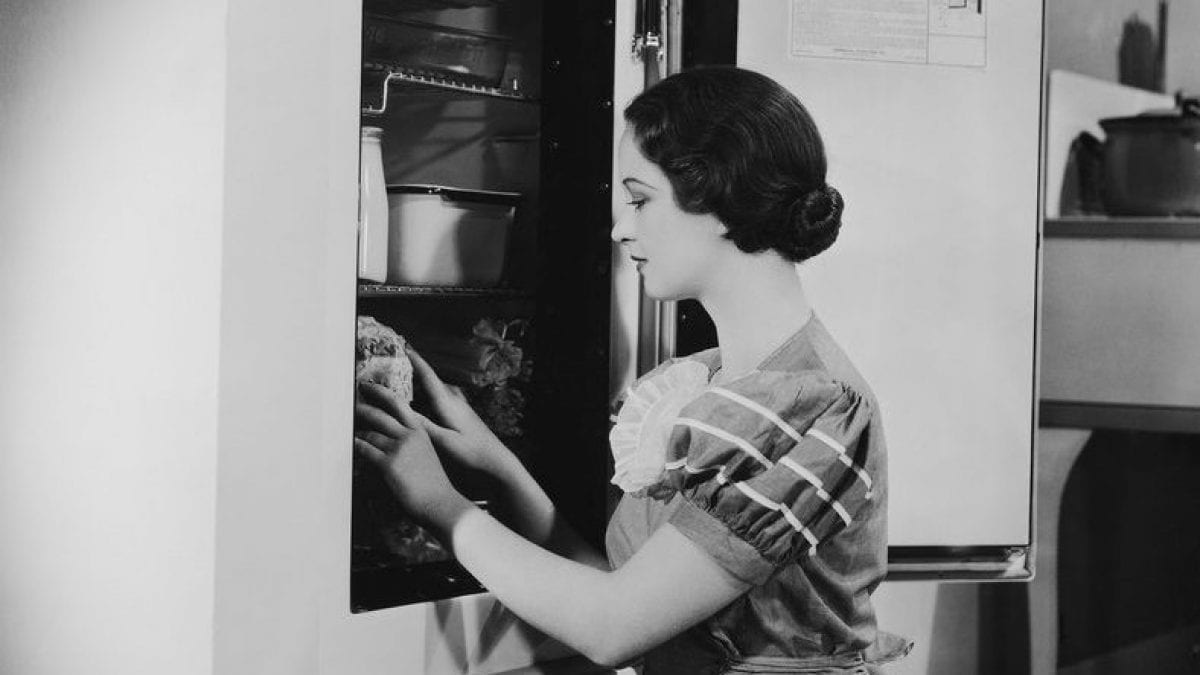
Cooking is female, but not just in the way you're used to thinking. The association between women and cooking is certainly ancestral, an image associated with mothers and grandmothers, with matriarchs intent on feeding their families not just out of physiological need but as an expression of love. But women and cooking are a much deeper connection than that: although often, too often, the great advances in the culinary world are associated with men—and, in general, the concept of "genius" is often construed as masculine—in reality, some of the most iconic and useful inventions in the culinary world have come from female minds. And no, we're not talking about recipes, although there are countless of those created by women, and we'll illustrate a few here. We're talking about inventions of objects, appliances, and utensils that we take for granted today, but which were actually revolutionary ideas that positively transformed our daily lives through their visionary approach.
Wit and brains are the special ingredients that have allowed unique women to have the right intuition to simplify everyday life, especially in the kitchen: many of the inventions that, even today, allow humanity to approach the daily routine of the home with greater ease are precisely those of women. Did you know, for example, that we have a woman to thank for keeping food fresh, for washing dishes with a machine instead of by hand, or, simply, for making filter coffee? Here are the many everyday objects, and a few recipes we are particularly fond of, born thanks to the genius of women who have improved our lives in the kitchen.
1. The Refrigerator

One of the greatest revolutions in the world of cooking and food preservation is the refrigerator, an appliance that allowed us to forget about iceboxes and salt, along with all the old methods of extending the shelf life of food. The domestic refrigerator wasn't the result of a single invention, but rather a series of milestones. This journey also included Florence Parpart, an American inventor who in 1914 filed a patent for a "refrigerating apparatus," a refrigeration system designed for home use.
The first patent for a refrigeration machine dates back to 1851 and was filed by American John Gorrie, later surpassed in the 1910s by the first domestic refrigerator created in 1915 by Alfred Mellowes. Even Albert Einstein, together with Leó Szilárd, took up the challenge, inventing a refrigerator with no moving parts in 1930. American inventor Florence Parpart patented the electric refrigerator model in 1914, which made the icebox obsolete for those with access to electricity and which, over the years, has become the only type of refrigerator we use. Not only that: in addition to designing the appliance, Florence successfully managed its marketing and promotion, including advertising campaigns and trade show participation, also demonstrating great entrepreneurial skills in the field of marketing.
2. The Dishwasher

Every day, when you don't wash dishes and crockery by hand but put them in the dishwasher and take advantage of this small domestic miracle, you have a woman to thank for patenting one of the first practical dishwashers. Her name is Josephine Cochrane, a late 19th-century noblewoman who regularly hosted lavish dinners at her home. Tired of porcelain breaking during hand washing, she decided to create a device that could "safeguard" the integrity of plates and glasses: in 1886, she had the idea for the dishwasher, initially consisting of a manually operated pump system. After about seven years of testing and improvements, the machine was exhibited at the World's Columbian Exposition in Chicago, achieving such success that it prompted the inventor to open her own factory, the Garis-Cochrane Dish-Washing Machine Company, which was later acquired by the Whirlpool Corporation. The rest is history.
3. The Electric Blender, the Fridge Shelves, The Pedal Bin

Lillian Gilbreth was the first woman to join the National Academy of Engineering and a pioneer in the application of engineering to everyday life. A mother of 12, she transformed the observation of domestic routines into a study of efficiency, aiming to make the home—and especially the kitchen—more functional. Her contribution is not tied to a single invention, but to a new way of designing spaces and appliances. She is credited with fundamental improvements such as the internal organization of the refrigerator with dedicated shelves and compartments, as well as practical solutions like the pedal-operated trash can. The evolution of small kitchen appliances also falls within her work on domestic ergonomics. More than inventing a specific object, Gilbreth contributed to making the modern kitchen more rational and efficient.
4. Flat-Bottomed Paper Bags

Sometimes there are everyday objects that we take for granted, just like paper bags: we are so accustomed to using them that we don't even ask ourselves when they were born or what life was like before their invention, but someone invented them, and in this case too, it was a woman. Paper bags, specifically the square-bottomed ones, were invented by Margaret Knight in the second half of the 19th century. She had the intuition to design a machine to cut and attach flat bottoms to paper bags, so that they could hold a larger quantity of food. Charles Annan (fore)saw the importance of the invention, rushing to file the patent before the original inventor, who was forced to sue. Annan, strengthened by the misogyny of the time, argued his case by claiming that no woman could have designed something so complex. Fortunately, Margaret Knight was able to prove that the prototype was hers through lawyers, tests, and sketches. She certainly hasn't stopped: there are 87 patents in her name in American patent registers and she has been inducted into the National Inventors Hall of Fame since 2006.
5. The Ice Cream Maker

If today you can enjoy creamy, smooth artisanal gelato that's easier for master gelato makers to prepare, it's all thanks to one woman, the first to design what became the prototype of modern ice cream makers. Nancy Johnson, a housewife from Philadelphia, patented a machine called the "Artificial Freezer" in 1843, a project that would revolutionize the world of gelato. Until then, making gelato required hours of painstaking manual labor, but Nancy's invention changed everything: she had the intuition to create a machine composed of an internal metal drum for the mixture, surrounded by a wooden bucket filled with ice and salt, with an external crank that operated paddles to churn the mixture. This idea, simple yet ingenious, made gelato creamier, smoother, and more accessible, drastically reducing production times and costs. Despite her invention, Nancy Johnson did not have the means to commercially develop the product and sold her patent for a few dollars to Thomas Sands, who then perfected it and patented it again in 1879. But it was Nancy Johnson's invention that revolutionized the sector: ice cream makers like the one invented by the ingenious American woman are still produced today, even if in current models the external crank is operated by a small electric motor.
6. Coffee Filter

Filtered coffee, so common in our kitchens today, owes its birth to the ingenuity of Melitta Bentz. At the end of the 19th century, preparation methods were laborious: the beans were boiled in linen or porcelain cloths, with results that were often bitter or full of residue. Frustrated by this routine, Melitta decided to find a cleaner, simpler solution. Her intuition was brilliant: she perforated the bottom of a small brass cup and inserted a sheet of blotting paper from her son's school notebook. By pouring hot water over the beans, the filtered liquid dripped into the cup, free of dust and with a more delicate aroma. The patent was filed on June 20, 1908, marking the beginning of the production of the first paper filters. From that simple domestic idea, Melitta built a family business that even survived the First World War, during which she had to adapt to material shortages and her husband's mobilization. The business expanded rapidly in the following years, with the sons taking over the helm: today it is still a lively company and owned by Melitta's heirs.
7. Floor Mop With a Bucket

Played by Jennifer Lawrence in the 2015 film dedicated to her, Joy Mangano is the perfect embodiment of the American dream. Born in 1956 in New York to Italian-American parents, a single mother of three, she became a successful entrepreneur thanks to her ingenuity and an intuition that changed not only her life, but ours as well. Thanks to her pragmatism (and her degree in business administration), in 1990 she invented the Miracle Mop, the floor mop with a bucket that allows you to wring it out without getting your hands wet. A brilliant intuition, fueled by enterprising activities like teleshopping, made Joy Mangano a millionaire but didn't stop her inventiveness: Mangano has invented several objects and currently holds over 100 patents, including several best-selling products.
8. The Toaster

For years, the entire world believed that the first electric toaster was created by Alan MacMasters, a supposed scientist born in Scotland in 1865 whose invention predated that of more advanced models developed in the twentieth century. In reality, however, both the story of the invention and that of its inventor were false and invented by the real Alan MacMasters, a twenty-year-old student who shared the news as a joke on Wikipedia in 2012 and then went on to see how far he could take it. According to many reconstructions, the first patent for an electric appliance that toasted bread was issued in 1909 in the United States to the technical designer Frank Shailor, but there are several historical sources that attribute the very first idea for a prototype toaster, albeit non-electric, to the Englishwoman Sarah Guppy: the nineteenth-century inventor was a very prolific mind, known above all for being the first woman to patent a suspension bridge in 1811. But her inventions actually embraced many fields, including that of the kitchen: it was she who designed a sort of very first kettle designed primarily for tea, but which at the same time allowed you to steam eggs and keep toast warm.
9. The Fork

Kitchen utensils have always existed, and tracing their inventor is no easy task: this is why the fork does not have a single inventor, and its origins are lost in the mists of time. The most widely accepted theory is that it evolved from a two-pronged, pin-like tool that was widespread in ancient Rome, the lingula, which later became commonly used in 10th-century Byzantium. What do women have to do with this? Perhaps the fork was not invented by women, but what is certain is that it was probably women who introduced it to modern use, that is, who popularized the fork as an individual tool for eating. Legend has it that around 1077, Princess Theodora, daughter of Emperor Constantine, refused to touch food with her hands and instead used a small, two-pronged gold fork: an unusual, exotic, and scandalous custom for the time. Maria Argyropoulaina, a Byzantine princess, brought golden forks to Venice around 1000, where they were initially viewed with suspicion by the Church as "tools of the devil." Then, in the 16th century, Catherine de' Medici helped popularize the same instrument in France. The four-pronged fork as we know it today was perfected in 1770 by Gennaro Spadaccini, chamberlain at the court of Ferdinand IV of Bourbon in Naples, but its diffusion as an eating tool was decidedly feminine.
Women's Genius in Countless Recipes
You may have guessed that women have been instrumental in making the kitchen functional and practical, incorporating tools and utensils that are now considered commonplace, but which were truly revolutionary at the time. But women's contribution to cooking doesn't stop there: there are countless recipes now considered iconic that were born from the ingenuity or intuition of a woman. A prime example of this are convent desserts, a whole series of recipes (for example, cannoli, frutta di Martorana, or pastiera) born within the walls of European convents by the hands of nuns, who were often just women forced by their families to take vows. Many of these girls sought an outlet and found it precisely in the kitchen: creating desserts, for many, was a way to fulfill themselves despite the constraints, often the only form of relaxation within the monastic rules precisely because it was considered, in some way, "sinful."

Traditional desserts are the best-known example of female culinary ingenuity, but recipe books are full of recipes invented by women. Another fascinating story is that of Baci Perugini, chocolates that all lovers have exchanged at least once. Famous for both their shape and the poetic message hidden in the wrapper, they were invented in 1922 by Luisa Spagnoli . The entrepreneur devised an original way to cleverly recycle hazelnuts and chocolate and created a bonbon with an irregular shape that was originally called "cazzotto." And what about chocolate chip cookies? They are among the most beloved biscuits, especially popular for breakfast, dipped in cold milk, but also as a quick and delicious snack. The idea, to meet a sudden need, came from Ruth Wakefield, an innkeeper who created them "by mistake" in 1930: while she was preparing some sweets for some of her guests, she realized she was out of cooking chocolate, so she decided to crumble a bar of chocolate into the dough, believing the cocoa pieces would melt during baking. Fortunately, this didn't happen, otherwise we would never have had cookies.
Let's stay on topic and talk about another chocolate-themed treat: brownies, delicious, fragrant, flat chocolate tiles with a soft center. Legend has it that they were created by a careless housewife from Maine who, while making a chocolate cake, forgot to add baking powder. The batter, therefore, didn't rise, and to make up for her oversight, she decided to cut the cake into rough squares, presenting her guests with a whole new specialty. This isn't the most widely accepted version of how brownies originated, but it's certainly the most fascinating.

Brownies aren't the only desserts born by chance: even the tarte tatin, one of the most famous French recipes, was born from a mistake. It was the late 19th century in a French hotel run by sisters Carolina and Stephanie Tatin. One of them, while making a classic apple tart, forgot to add the shortcrust pastry to the bottom, and in the oven the fruit caramelized with the butter and sugar. Only at the end of baking was the pastry added, and the cake was served to guests upside down. The cake was so popular that the recipe was systematically replicated, and from that small hotel it then spread throughout much of the country.
Even the history of a drink stereotypically considered "for men" like beer is closely linked to women. It seems that its invention, in Mesopotamia around 4500 BC, occurred by chance when a woman left a bowl full of barley outside as a propitiatory gift to the gods. The barley, nourished by the pouring rain and warmed by the sun, began to ferment, giving birth to the first beer in history. Regardless of this fascinating legend, in ancient times beer has always been linked to the female world: it was considered a food, like bread, and its production was entrusted to women. Associated with the concept of fertility, beer was also linked to the ritual of the harvest and to female deities such as Ninkasi, venerated by the Sumerians and considered the goddess of beer. In the 1st century BC, it was Queen Cleopatra, thanks to her diplomatic relations with the Romans, who facilitated the export of beer beyond the Mediterranean, where wine at the time reigned supreme. Over the centuries, beer gained such a foothold that it became associated with the goddess Ceres, the female counterpart of Bacchus. Even later, around 1100, the German nun Hildegard von Bingen was the first to systematically study hops and use them as a flavoring in place of spices. And by 1700, in the English countryside and villages, 80% of beer-brewing licenses were actually held by women, even though they still had to have the support of a man to obtain them. These are just a few of the countless examples the history of gastronomy offers us of how feminine genius has revolutionized the world of cuisine and how it continues to do so.
;Resize,width=767;)
