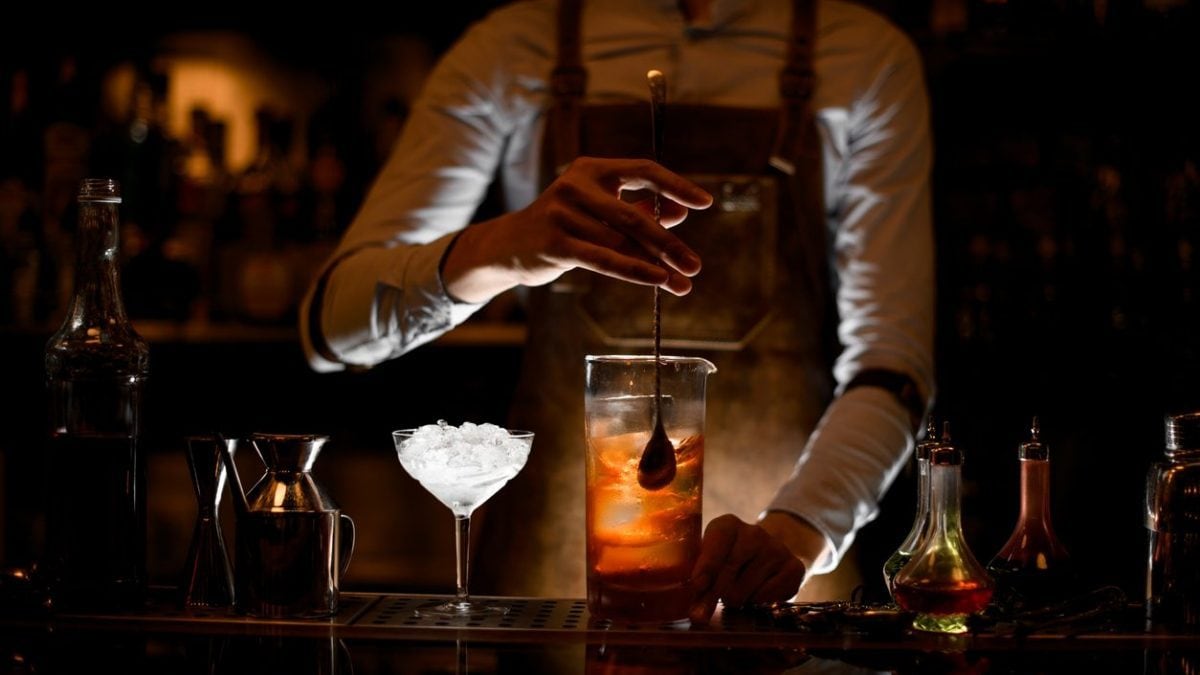
It's the customers' main "enemy" (even if it shouldn't be) but the bars' best friend: we're talking about ice. To non-experts, it might seem like a hindrance; many even think it's a gimmick to dilute the drink and save on ingredients. That's not the case, however: ice is a fundamental ingredient for cocktail bars, one of the most important there is. Ice for bartenders is what fire is for chefs: indispensable. You can bluff about spirits and sugars, but there's no escape when it comes to ice.
Ice's job is to keep the drink at the right temperature and provide the right degree of dilution. No one is stopping a customer from asking for a drink without ice, but it's important to understand that this negatively impacts the drink's flavor. Let's look at all the different types and why they're so important.
The History of Ice in Cocktails
Today, this association seems obvious, but in reality, things haven't always been so clear from the beginning in the world of alcoholic beverages. The history of ice in drinks is much more complex than one might imagine.
We've been using frozen water to refrigerate food and drinks since time immemorial. The Greeks and Romans collected the product in the mountains and stored it in iceboxes. Some of many countries' typical products are the result of this knowledge: artisanal ice cream, Sicilian granita, and even lemonade made with open legs, which still uses the underground "refrigerators" invented in Magna Graecia.
We've always used ice as a food preservative, but wealthy Roman aristocrats were already using it to cool their drinks. Curiously, however, this custom remained confined to Rome and didn't become widespread until the 19th century. Why all this? Because with the fall of the Roman Empire, the epicenter of Europe shifted from Southern to Northern Europe.
In Russia, Germany, Great Britain, France, and Austria, all alcoholic beverages are a way to warm up; ice is not only useless but actually harmful. A practical example: the word "iced" in some countries is often associated with "beer"; all the advertisements even show the icy film around the bottle, but in reality, the drink isn't made for these temperatures. In England, Scotland, and Ireland, beer is served at around 50-53°F/10-12°C, or their "room temperature."
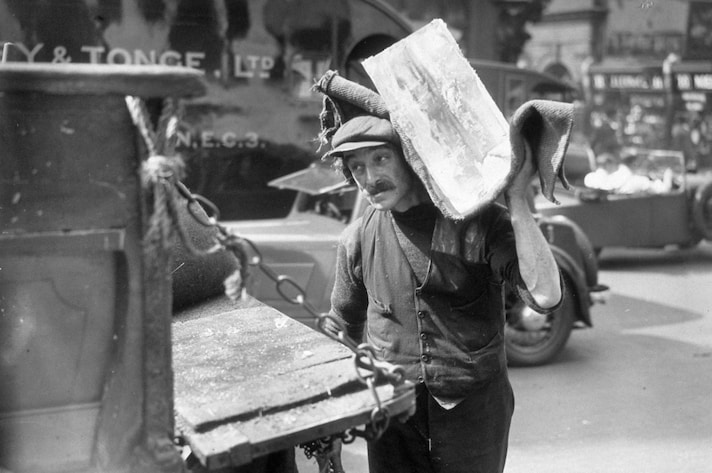
Ice in drinks came to be thanks to one man: Frederic Tudor, later known as the "Ice King." This entrepreneur, born in 1783 in Boston, exploited his family's wealthy holdings to transport enormous blocks of ice from the northern lakes to the Confederate States and the Caribbean. He was truly convinced he could pull off this feat, and in 1806 he bought a ship for $5,000 and transported the entire cargo of ice mined on the family farm to Martinique in an attempt to establish a monopoly. The plan failed miserably: the first shipment melted, while the second arrived in better condition, but he was unable to sell it.
Tudor refuses to give up and tries every way to convince Caribbean people to drink his drinks with ice, because they taste better. This persuasion effort takes years and is extremely costly. He tries to create demand with daring marketing campaigns: he offers free ice in bars and encourages bartenders to serve drinks with ice at the same price as those without (in America they would have cost double). With a lot of patience, the idea works, and Tudor finally creates demand where there was none before. The undertaking is arduous, however, and the beginning is disastrous: transportation difficulties and low demand leave him in debt, and he spends long periods in prison or hiding from creditors.
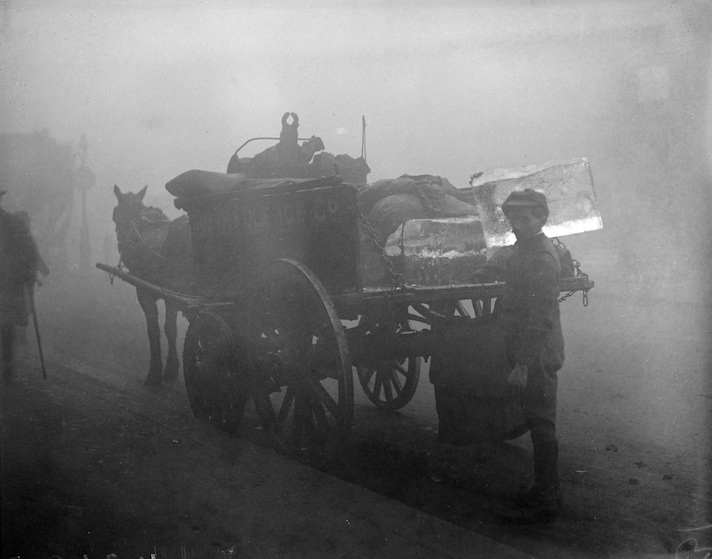
Despite everything, he believed in his idea and, step by step, made this venture very profitable. Tudor began what historians would later call the "ice trade," which developed between the Northern United States, Norway, and the tropical countries. He built icehouses along the route, eventually establishing them directly in Martinique, bribed all the local authorities to ensure his monopoly, and expanded his fleet by exploiting local labor.
The ice trade— the pinnacle of American capitalism —made Tudor a global magnate by 1850: he even shipped ice to India. The business was so extensive that Tudor held a monopoly only on the Caribbean: wealthy businessmen entered the European and American markets, making ice one of the world's most important industries. In the 19th century, it employed around 100,000 people and was a major driving force of the American economy until the mid-1900s.
The end of this era is marked by another very wealthy entrepreneur: Thaddeus Lowe, an inventor famous in America for being one of the nation's most important inventors. An aviation pioneer from a family of pioneers, he invented many chemical processes relating to cooling that we still use today: he is the inventor of the first ice machine.
This invention would revolutionize the mixology industry, bringing a leap forward to all cocktail bars. Spirits "on the rocks" were born, as were the first drinks prepared directly in the glass. Even the birth of the shaker is linked to this invention.
The ease of producing ice made adding it to drinks a habit, everywhere except in Italy. The first refrigerators and ice machines arrived in Rome, and the Romans, rather than improving their drinks, used this advancement to implement the carts that prepared the famous grattachecca (which has much older origins). Only large hotels, first in Rome and then in Florence and Venice, understood the direction this lucrative industry was taking and introduced the American bar style to Italy, which brought American cocktail recipes and with them the habit of filling them with ice cubes.
What is The Purpose of Ice in Cocktails?
The most obvious answer to this question would be "because it cools, making the cocktail easier to drink." That's not a bad answer, but it would be too simplistic. Ice serves to cool and dilute the drink. These seem like two distinct processes, but they're closely related: we think ice cools because it's low in temperature, but the situation is much more complicated than that. It's a question of thermodynamics, the branch of physics and chemistry that studies and describes heat-induced transformations. As the book Miscelare states, "the study of ice makes us understand that there is no cooling without dilution."
Diluting the drink limits the impact of alcohol on our palate, which in large doses can be unpleasant when drunk warm. Imagine drinking a Mojito at room temperature: you'd stop after the first sip. When the cocktail is chilled and diluted, the alcohol content drops below 20% ABV, and the lower temperature smoothes out the sensations of pseudo-heat we experience in the throat. Keep in mind: the amount of alcohol is the same whether cold or hot, but the bite is significantly reduced thanks to thermodynamics, making the drink more enjoyable.
The False Myths of Ice in Cocktails
At this point, we can say that no, ice is not a gimmick used by bars to dilute the drink and save money. On the contrary, ice is an ingredient that significantly impacts a bar's food costs. It's also not true that too much ice in the glass creates the iceberg effect and prevents it from melting too quickly, especially since we've seen that dilution isn't a negative effect at all: it's the right amount that's important. Filling the glass with ice ensures a uniform drink and better cooling, preserving the correct proportions of the other ingredients and keeping the drink colder for longer. Last, but not least, ice is a fundamental aesthetic factor. Drinks with too little ice appear less elegant and refined.
All The Types of Ice You Can Find at The Bar
Regardless of the type, ice must have some essential characteristics. Above all, transparency: the clearer the ice, the better the water used. Cloudy ice contains impurities, which can negatively impact its quality.
The shape of the ice is also crucial because, depending on the type, it dilutes drinks and chills them at different rates. The shape chosen by the bartender should not be influenced by personal taste but by the recipe he or she intends to prepare. For example, given the same volume, the surface area-to-volume ratio of a sphere is lower than that of a cube of the same size, causing the sphere to melt more quickly.
Every bartender must know the type of drink he wants to make and act accordingly.
For shaken drinks, for example, you need ice cubes that don't melt too much because they need to fill the shaker three-quarters full and need to be shaken until you feel the cold in your hands. It's also important for cooling the glass. This step is crucial: if we skip it, we'll experience a thermal shock that would alter the flavor.
Drinks on the rocks are a different story: they require hard ice to keep the temperature low and constant. For crushed cocktails, however, it's important to have softer, drier ice that's easier to crush.
1. Ice Cubes
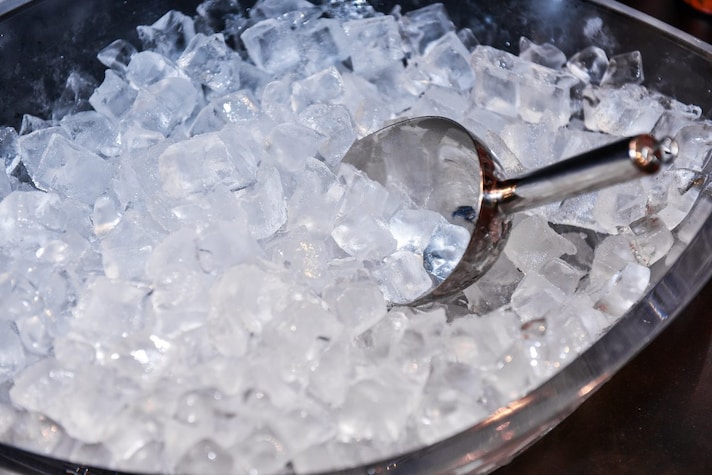
It is undoubtedly the quintessential type of ice. There are three "subtypes" of cubed ice:
- Square ice, usually crystalline, chills very quickly. It's commonly used in long drinks, shakers, mixing glasses, or for cocktails on the rocks. This type of ice enhances drinks without dampening their flavor.
- Empty ice cubes, usually of lower quality. They are cylindrical, hollow inside, have a larger cooling surface area, and dissolve more quickly. They are highly discouraged in soft drinks or fizzy beverages, where the carbon dioxide affects the "disintegration" of the ice cube and the dilution inhibits the formation of bubbles. They are also called "thimbles," given their characteristic shape.
- The square slab cube, for rapid cooling and slow melting. Larger than the other two, it is very versatile.
2. Crushed Ice
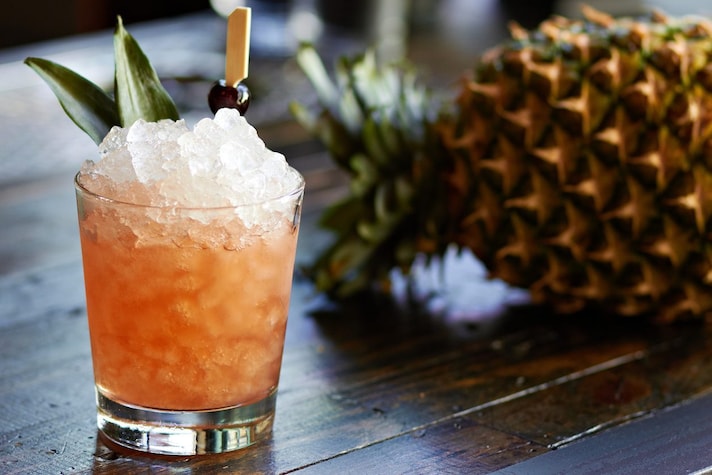
Also called shattered ice, and piled ice, it's the kind used to preserve products. It's not ideal for making cocktails, although we often see it in crushed drinks like the Margarita. It's one of the few exceptions to the use of a straw, according to cocktail bar etiquette. It's been enjoying a revival in recent years thanks to "gourmet" mixology: after falling into disuse at the beginning of the third millennium, some bartenders have revived frozen cocktails, taking this somewhat tacky style to a new, elegant and enjoyable dimension. It essentially creates a drinkable "alcoholic granita."
3. The Ice Sphere
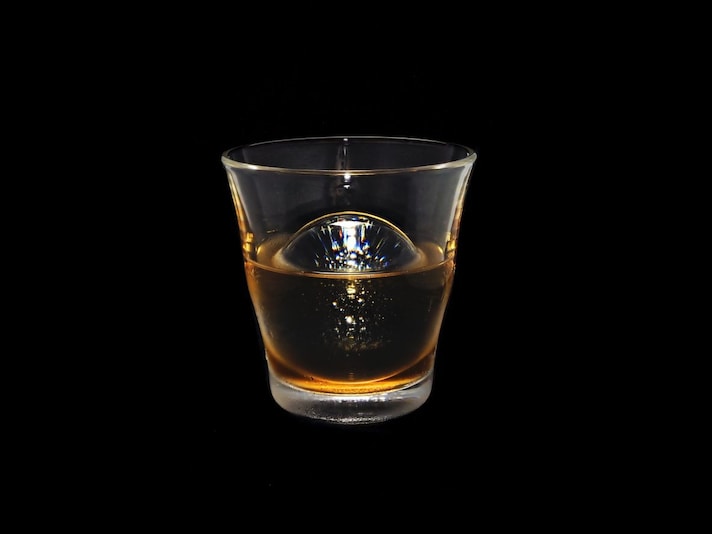
Also called chuck or ice ball, it is a type very similar to square cubes with the obvious aesthetic difference. Having no corners, the ice dilution process is compromised.
One problem can be the tendency to float, so it is important to mix well the drink you want to serve with this specific ice.
Ice carving, the art of shaping ice typical of Japanese culture, deserves a separate mention . Many Japanese bartenders sculpt the ice cubes by rounding off the edges until they obtain a spherical shape of the desired size. This shape follows the molecular structure of water and is very durable if done well. It can be used for two or three servings to the same customer.
4. The Ice Nugget
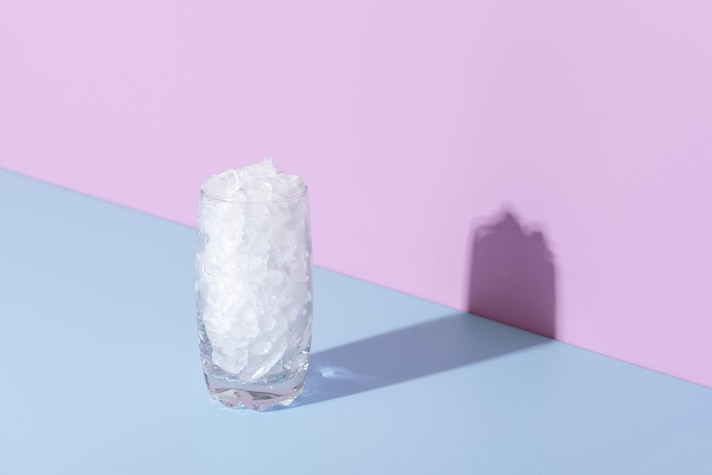
This is a dry granular ice often used in carbonated drinks because it forms a layer on the surface that prevents oxidation. Its softness makes cubelet ice the best choice for non-alcoholic drinks, such as iced coffee and milkshakes. It has a cylindrical shape and is easy to chew because it absorbs the flavor of the drink.
5. Granular Ice
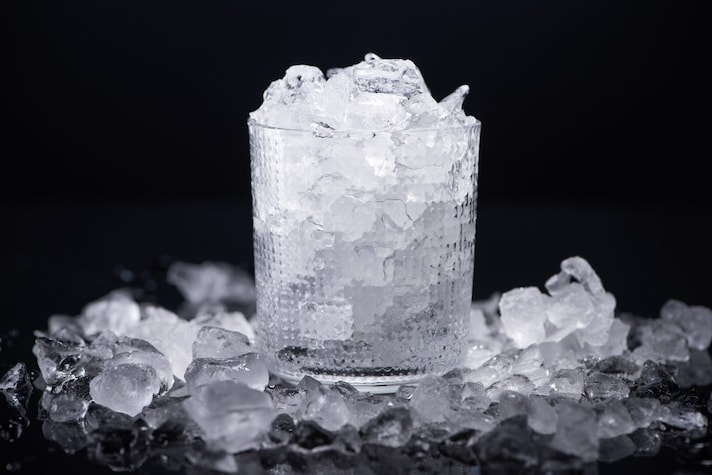
Also called flake (with a 25% water content) or superflake (with 15% water content), it is the "purest" form of ice because it is produced at a temperature very close to freezing. Extremely versatile, even in the culinary field, it is often used to chill bottles in restaurants and wine bars.
6. Ice Collins Spears
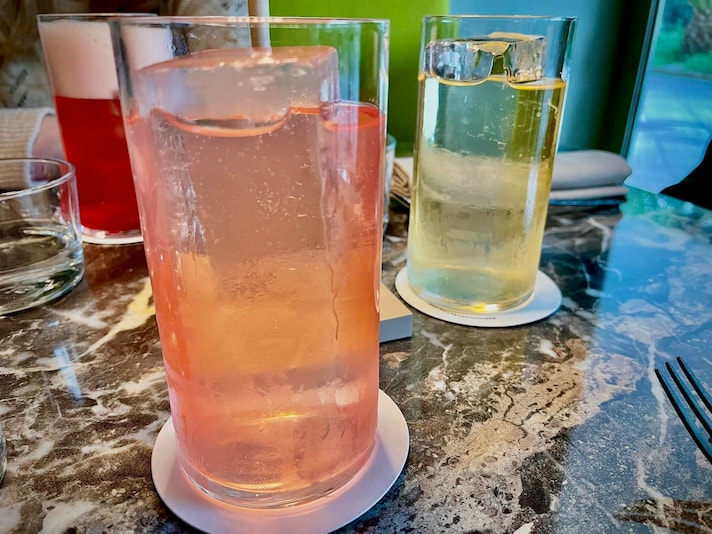
It is undoubtedly the most fashionable type of ice available. It has minimal contact surface and a very slow dilution. It occupies the entire central body of the drink. It is dense, very large and hard, with a higher ratio of ice to liquid in which it is immersed, for an exceptionally long duration. This ice was created to accompany fine spirits, also for its high visual impact that makes the service extremely exclusive; many large cocktail bars around the world now use it for the same reason. It can only be made by hand, starting with a very slow glaciation with constantly moving water. It is then cut by hand in a sterile environment into the desired shape.
7. Dry Ice
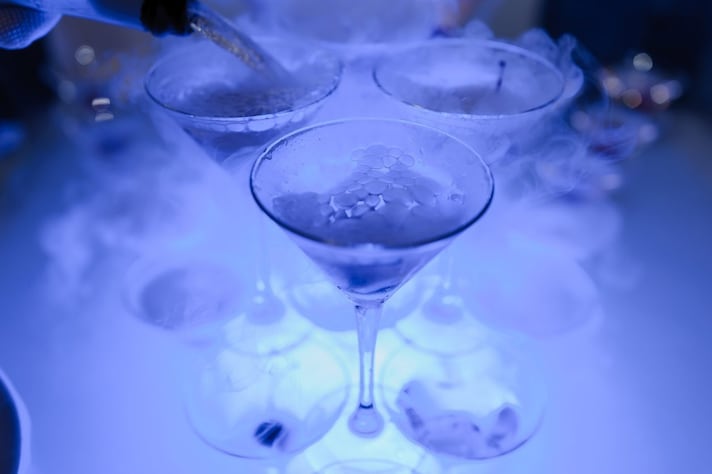
Widely used in recent years, both in the most exclusive cocktail bars and at ceremonies. It's spectacular thanks to all the smoke it spreads around it. It must be handled with great care because it has a temperature of around -112°F/-80°C and is easy to burn. Over the past 20 years, its use in bars has gradually decreased, but many venues still use it to preserve the flavor of the drink while still achieving the wow effect of the smoke. It's important to know, however, that once purchased, it must be used within 24 hours because standard freezers, no matter how professional, cannot keep it at the ideal temperature.
How Much Ice Should You Put in The Glass
This is a common question for novice bartenders, but there's no single answer. The amount of ice depends on the type of cocktail you're making, how you prepare it, and the type of glass you're using. Bars calculate the amount of ice to buy based on the volume of drinks they sell.
Generally speaking, we can say that on average you need between 100 and 200 grams per cocktail, but the peaks rise if the technique requires more cooling and/or dilution.
;Resize,width=767;)
