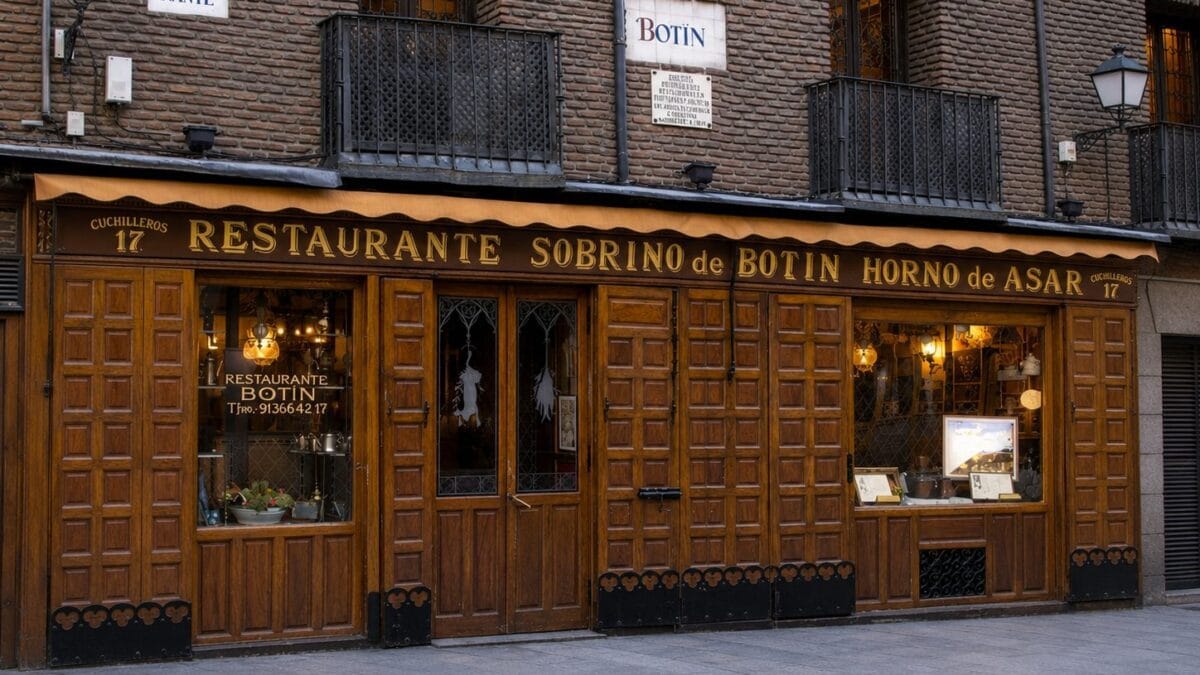
Madrid, the city that never sleeps, the luminous city with the brilliant sky, the capital of the "castizo" (authentic) lifestyle that blends the frenzy of a large European metropolis with a welcoming warmth. But also the city where, in some of its most hidden corners, time stands still. If you find yourself visiting the Spanish city, make time to go to Calle de Cuchilleros 17, just after the historic Plaza Mayor: here you can see with your own eyes the oldest restaurant in the world. It's called Sobrino de Botín – just Botín, as the locals affectionately call it – and was founded in 1725 as a simple inn, before becoming a true Madrid institution over the centuries, so much so that it became one of Ernest Hemingway ‘s favorite restaurants.
The restaurant occupies all four floors of the same building where it opened in the late 18th century: a place that still feels like an inn, with dim lighting and brick arches, stained glass windows, and an atmosphere rich in rustic, medieval charm. And the oven, the beating heart of Sobrino de Botín. It's wood-fired, the same one from 1725, and even today it roasts piglets and lamb Castilian-style, without ever being turned off: it has never cooled down, say the owners, the third generation of the Botín family, not even during the Spanish Civil War or the COVID-19 pandemic. During the pandemic, the restaurant closed to the rest of the world, but a cook who lived across the street kept it afloat by stoking it with oak firewood during the day. According to the owners, being over 300 years old, if it were to cool down and then heat up again, it could break.
Sobrino de Botín celebrated its 300th birthday in 2025, yet it doesn't seem to even notice: it's still beloved; in fact, it's so iconic that reservations are required weeks in advance to get a table. But what makes it so special? Here are all the secrets of Sobrino de Botín.
The History of Botín
The history of the Botín is woven into the fabric of Madrid. When King Philip II moved the royal court here in 1561, a construction boom ensued, including the 1590 building it still occupies, whose 16th-century underground cellar still stores wine today. It was also a few years later that the palace became a restaurant, specifically in the early 1700s. It was around this time that the French chef Jean Botín arrived in Madrid and, together with his wife, took over the building and transformed it into an inn, which he named Casa Botín. The couple, in fact, had great foresight in realizing that the presence of the court had significantly increased the city's population, especially in terms of tourism. So many travelers and foreigners were coming to Madrid, and the need to host them or to provide temporary lodging for those arriving in the city without yet having a home of their own was ever greater.

Thus, initially, Casa Botín was mostly a place to sleep and eat, but everything changed with the death of the couple, who were left without heirs. The couple's nephew took over the business, but he had very different plans for it: in 1725, he changed the name to Sobrino de Botín ("nephew of Botín") and increasingly transformed it into a restaurant in the strict sense. Legend has it that the new establishment was so famous that a young Goya worked there as a dishwasher, and that several poets, painters, writers, and prominent figures stopped by at least once to enjoy its delicious dishes. The only change of ownership in the history of Botín occurred at the beginning of the 20th century: it was during this period that the restaurant was sold to those who are still its owners today, the González. The change of management, however, did not entail any upheaval, because the new owners immediately wanted to keep the restaurant's identity intact, continuing to burn the original wood-fired oven from 1725 on Calle Cuchilleros.
This same enduring and authentic spirit captivated Ernest Hemingway, making the restaurant a true favorite: the writer considered Botín one of his favorite gastronomic temples, so much so that he became friends with the family that owned it. It is said that he loved spending hours on the restaurant's ground floor, trying to learn to play the guitar and enjoying wine and typical Castilian dishes, the same ones still on the menu today. Hemingway also mentioned Botín in several of his works, and this helped make it increasingly an institution: throughout the twentieth century, its tables hosted literary greats such as Truman Capote, F. Scott Fitzgerald and Graham Greene, the Spanish royal family and a whole host of public figures, from Jackie Kennedy to film and music stars.
What's On The Menu?
The current owners of Botín say that when the family took over the restaurant, the menu was already overly extensive, offering all sorts of dishes, including lobster, oysters, crab, and all kinds of seafood. The restaurant needed a more defined identity, so the Gonzálezes decided to focus on the more traditional side of the menu, offering only Castilian and Madrid classics. The formula was a success, and to this day, the menu remains almost entirely unchanged: fried or baked Cantabrian cod, morcilla y patatas (scrambled eggs with black sausage and potatoes), the ever-present Iberian acorn-fed ham, morcilla de Burgos (black sausage from Burgos), croquettes, and gambas al ajillo (garlic-crusted prawns).

Two dishes from that original menu still reign supreme: cordero asado (roast lamb) and cochinillo asado (roast suckling pig). The latter is not only pure Castilian heritage, but has become the most iconic dish at Sobrino de Botín: crispy, browned skin that shatters under the fork to reveal the tender, juicy meat of pigs raised in Segovia, arriving three or four times a week from farms in the neighboring provinces of Sepúlveda, Aranda, and Riaza. The meat is left to cure for 21 days, and each day a new batch is roasted for four hours until the skin is perfectly crispy in the famous 300-year-old oven. Its reputation has even entered literary history: Ernest Hemingway mentioned the dish in his 1926 novel The Sun Rises, which is partly set in Madrid.
Is Sobrino de Botín Really The Oldest Restaurant in The World?
Sobrino de Botín is officially certified by Guinness World Records as the oldest restaurant in the world, but is it really? Many have raised doubts about this: there are many older establishments, such as Hostaria dell'Orso in Rome (with documented origins dating back to 1400) or Ristorante La Campana, also in Rome (open since 1518). What makes Botín worthy of the record, in this case, is not so much its founding date, but its certified historical continuity: it has never stopped serving since 1725, has changed ownership only once, has maintained its original location, name, and much of its furnishings (including the oven) intact, and serves many of the same Castilian recipes as when it opened.

The title of "oldest restaurant in the world" isn't just a matter of seniority, but of cultural and family heritage. Despite the one change in ownership, the restaurant has been in the hands of the González family for a full one hundred years, having kept the tradition alive with passion, dedication, and a strong sense of belonging. The current owners and managers are brothers Antonio González and Emilio González, representing the third generation of the family to lead the iconic restaurant. They show no signs of changing tradition: on the occasion of the tricentenary, González ownership was confirmed, with the introduction of a new generation of family members ready to take up the mantle.
;Resize,width=767;)
