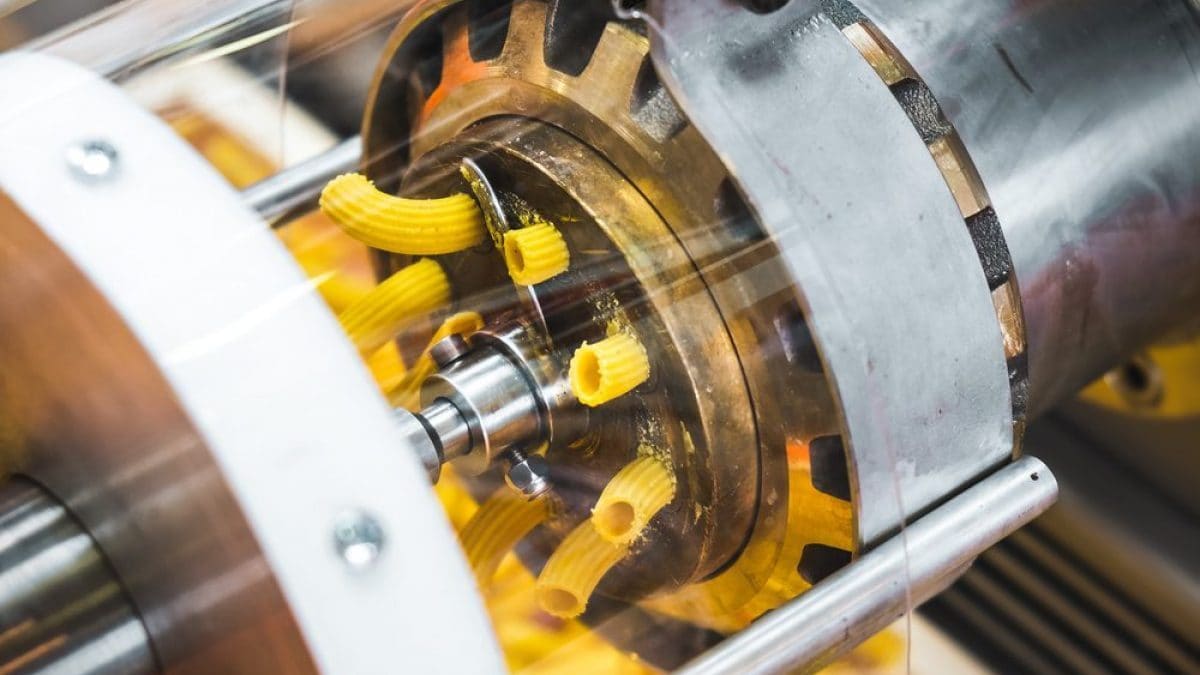
There's no doubt that Italians are huge pasta consumers, just as there's no doubt that in recent years there's also been a growing curiosity about how it's made and why, given the same recipe, different brands yield different results. One of the key moments in pasta making is the extrusion process, the stage in which the dough made from durum wheat semolina and water takes on the familiar shapes ( penne, fusilli, spaghetti ), effectively becoming pasta. This process is essentially done in two ways: bronze die-cutting or Teflon die-cutting. The former enhances the roughness of the finished product, perfect for capturing sauces, while the latter is the one most commonly used in the industry because it's cheaper and quicker. Let's see all the differences.
What is Pasta Drawing?
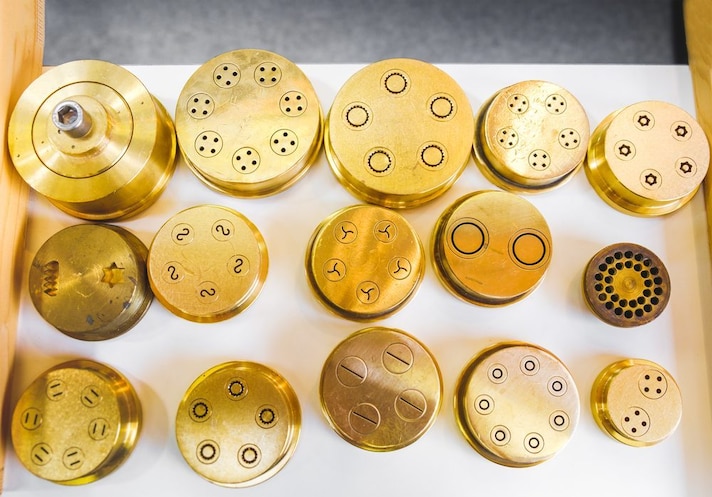
Drawing is one of the stages of pasta making: it involves passing the mixture of durum wheat semolina and water through inserts (called dies) that give it its shape. The process occurs through extrusion, where the dough slides through the perforated shapes under pressure and is pushed outward. The pasta is cut to the right length by rotating blades, which move more or less quickly depending on the chosen shape. Dies are not all the same: they have different shapes depending on the finished product, be it penne, rigatoni, bucatini, or linguine, but they are also made of different materials. The two most commonly used are, in fact, bronze and Teflon, which do not produce the same results.
Bronze-Drawn's Pasta Characteristics
Bronze drawing is the oldest method used to perform this operation. Bronze is a metal alloy composed of copper and tin, used because it offers several advantages, first and foremost that of ensuring excellent heat resistance: this eliminates the risk of deformation of the die during extrusion, ensuring a uniform product. This means that the inserts that shape the pasta can be made of bronze or coated with bronze. What are the characteristics of a product that comes out of these dies? Generally, to use this type of process, you need good starting semolina: a quality initial raw material can be the basis for an equally high-quality final product, with a better nutritional profile and that holds up well to cooking. The pasta appears a dull yellow color, is porous and rough, as it encounters a certain resistance during the passage, given that the surface of the bronze is abrasive: characteristics that allow it to retain sauces and condiments better. All this also implies a higher cost compared to Teflon-drawn pasta.
What is Teflon-Drawn Pasta?
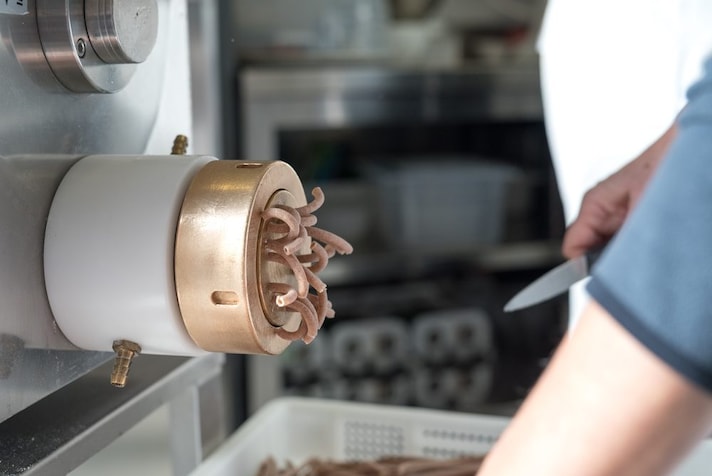
Let's start by understanding what Teflon is, which is used in the same way as bronze, to create matrices through which the dough takes the chosen shape. Its scientific name is polytetrafluoroethylene (PTFE), and one of its most common uses is in the kitchen, as a coating for non-stick pans to prevent food from sticking. This already leads us to understand that Teflon has a much smoother surface than bronze, that the semolina and water mixture will therefore pass through at a greater speed, and that the final pasta will be smooth, therefore not as rough to the touch as the previous one, and of a more intense straw yellow. This material has been popular since the 1970s onwards, when pasta production reached high volumes and speed and cost were required: Teflon templates cost less than bronze ones and, what's more, they don't require a high-quality raw material. Precisely for this reason, Teflon processing is often associated with drying at high temperatures, while bronze processing is associated with slow drying, two details that together can determine the quality of the pasta: the first pair is synonymous with a medium-low quality, the second, however, recalls artisanal production, ready to supply even starred restaurants.
Which One Should You Choose?
Is the distinction between bronze-drawn pasta and Teflon-drawn pasta so clear-cut? Actually, no, because despite the claims on packaging, it doesn't necessarily mean that bronze molds are synonymous with quality throughout the entire production chain, or that rapid drying is worse than slow drying. Furthermore, there are Teflon-drawn pastas that don't necessarily undergo rapid drying and therefore better preserve the organoleptic properties of the durum wheat semolina. What would be important is to have clear and non-misleading information described, as with every commercial product, so that consumers can make their purchases as transparently as possible.

