The air fryer is one of the must-have appliances of recent years, increasingly popular and with a growth that seems unstoppable. An excellent marketing strategy, and the appliance's undeniable practicality, have made the air fryer a staple in many of our kitchens: it's a sort of mini oven that uses hot air as a heat source, allowing you to cook using less oil and, overall, serving as a good substitute for both the traditional fryer and the oven.
With the evolution of models, in fact, now in the air fryer you can prepare an (almost) endless number of sweet and savory dishes, from cakes to muffins, including vegetables, omelettes, burgers and even pizza. This doesn't mean, however, that the appliance is suitable for any type of cooking. Take popcorn, for example: munching on it as a snack, perhaps in front of a movie or while reading a book, is a real treat, especially if you make it at home. But can you really cook it in the air fryer? Some industry experts suggest that it's not a good idea, both because the popcorn won't turn out perfectly and for safety reasons: the risk of breaking the appliance is, in fact, very high.
Is It Safe to Make Popcorn in an Air Fryer?
In theory, it's perfectly possible to make popcorn in an air fryer: the corn kernels need a high temperature to pop, 355-365°F/180–185°C, and the fryer reaches this temperature. But does this mean it's safe? Let's dispel any doubts: cooking popcorn in an air fryer is strongly discouraged for several reasons. The main problem is the very nature of the corn kernels, which, being very small and light, can be easily displaced by the powerful airflow inside the appliance before they even pop, ending up in contact with the heating element, with the risk of burns, smoke, or even minor damage to the appliance.
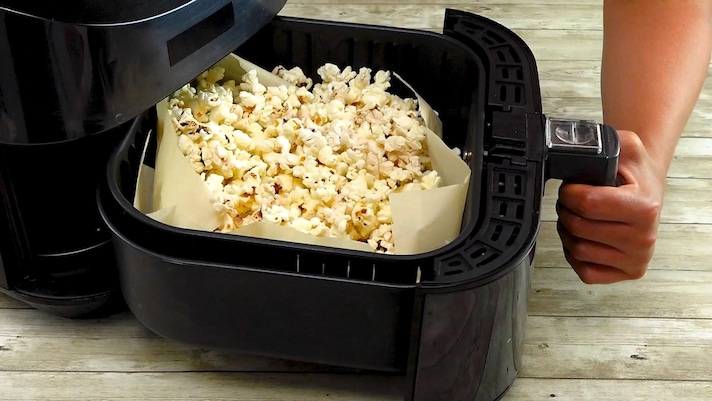
Cooking popcorn in an air fryer is also not recommended for efficiency reasons: the appliance, due to its technical nature, can have uneven heat distribution, especially when compared to traditional cooking methods or using an oven, resulting in uneven cooking or the popcorn not having the right consistency. This issue creates so much controversy because it stems from an apparent contradiction: on the one hand, we know that popcorn forms simply thanks to high heat, and the air fryer is perfectly capable of reaching similar temperatures. On the other hand, however, its operation relies on a flow of moving hot air, very different from the static heat of a pan or popcorn maker.
This similarity leads many people to think the two methods are equivalent, when in reality they are not. Confusing matters further are online videos and conflicting testimonials: some show successful experiments, while others highlight problems or poor results. The result is a classic case where intuition seems to suggest a simple solution, but practice reveals technical limitations and potential risks that are not immediately obvious.
Here's Why Corn Kernels Don't Pop Properly
Air fryer technology isn't designed to pop popcorn evenly and safely. The appliance reaches the required temperature, as mentioned, but doesn't effectively build the internal pressure needed to pop the corn properly. This is because the heat is transported by moving air, less evenly than direct contact, but it isn't retained for the necessary time. This is because the air flows very quickly inside the appliance, causing the corn to move. This can cause some kernels to cool more quickly without popping, or the airflow can cause them to shift, pop, or pile up in the corners of the basket.
As a result, many kernels don't evenly reach the temperature needed to pop: some heat up too slowly, others are pushed away from the heat source just at the crucial moment. Furthermore, without a closed container or stable heat distribution, the steam inside the kernel —responsible for popping—may not develop properly. The result is uneven cooking, with few well-formed popcorn kernels and many that remain hard or only partially opened.
Even in a pan, where conditions are more favorable, not all popcorn kernels pop. Science explains that this depends on many factors, particularly the aforementioned humidity needed to create pressure and the "pop." Damage to the kernel's outer shell, an insufficiently high or uniform temperature, and practical factors such as uneven heat distribution, insufficient oil, or overcrowding in the pan can prevent some kernels from heating properly. In short, a small percentage of "unexploded" kernels is perfectly normal even with proper preparation, but preparing them in an air fryer results in a higher percentage of missed kernels.
The Risks of Cooking Popcorn in an Air Fryer
Besides being ineffective, as it doesn't guarantee that all the kernels will pop, cooking popcorn in an air fryer can be dangerous for your safety and that of the appliance itself. The biggest risk is that the kernels come into contact with the heating element: popcorn is light and is moved by the hot air flow, so it can come into direct contact with the heating element and cause damage to the appliance, burns, and intense smoke that can also pose a fire risk.
Additionally, air fryers don't ensure even heat distribution, so some beans may pop too early or too late, increasing the likelihood of hot splashes and burns when opening the basket. Finally, residual oil or fat used to season the beans can heat up quickly and create additional fire or smoke risks, and any charred residue can scratch and ruin the non-stick coating of the basket.
Why The Resulting Popcorn May be Sparse, Irregular or Burnt
Popcorn only pops when heat quickly reaches the kernel's interior, causing the starch within it to rapidly expand. In an air fryer, good popcorn often comes in smaller quantities than uneven or burnt popcorn, and the problem lies precisely in how the hot air flow works. The mechanism constantly moves the kernels, preventing many from uniformly reaching the critical temperature of around 355°F/180°C needed for popping. As a result, some kernels remain too cold and therefore don't pop, while others, in more direct contact with the hot air or with the parts closest to the heating element, can burn.
The Best Ways to Make Popcorn at Home
You've probably realized that when it's time to make popcorn, it's best to leave the air fryer aside. But what are the best methods for making perfect popcorn? The best way to cook popcorn is the classic one: a pan with a drizzle of oil to transfer heat directly and evenly, and always with a lid to retain heat and pressure. The microwave can also produce good results if you use specific popcorn containers, which hold the kernels in place and allow for quick cooking without burning. Popcorn machines are useful if you love popcorn and make it often, also because they are a real decorative element, often with a very charming vintage style; they are designed to cook the kernels at the optimal temperature and guarantee light and crispy popcorn with few "unexploded" pieces. There are even actual "popcorn makers" equipped with a crank, to move the kernels continuously while they are heated, so as to obtain perfect, golden-brown popcorn.
;Resize,width=767;)
