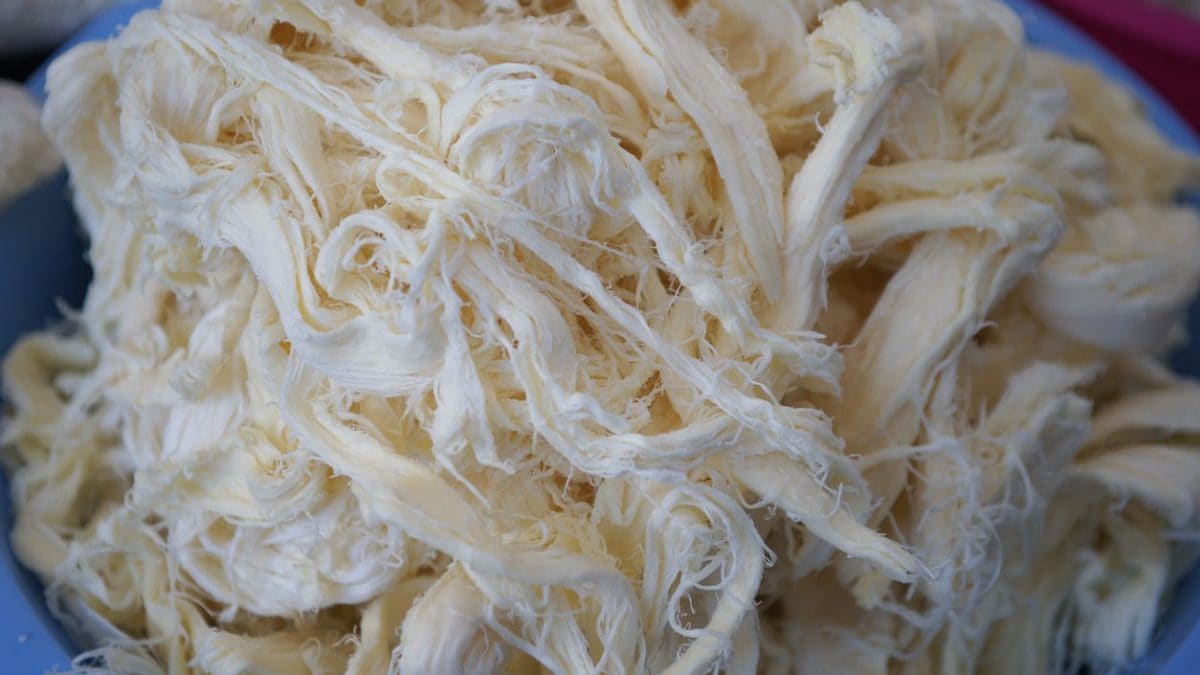
There are products so delicious and so popular that they end up causing different countries to argue over their origins. In this case, we're talking about çeçil, a salted, smoked, stretched-curd cheese that has practically ended up in the middle of an international dispute. Originally from the Caucasus and Anatolia regions —Armenia, Georgia, Turkey, and Azerbaijan—it's a product eaten by pulling it apart by hand, and since everyone makes and loves it, they classify it as their own. Some call it chechil, others çecil peyniri, but the result is always the same: a cheese with a history as intertwined as its threads.
A Product That Divides People But Unites Everyone at The Table
Cesil is a product with ancient roots, spanning the Caucasus Mountains and the steppes of eastern Anatolia. We're not just talking about an excellent cheese, but, as we mentioned earlier, a culturally contested food at the center of a silent rivalry between several countries. If we must discuss its origins, you should know that they cannot be precisely attributed to a single country with certainty, although the vast majority maintain they are primarily traced back to Armenia.
Its production takes place in vast mountainous areas between Armenia, Georgia, eastern Turkey, and Azerbaijan, and it is precisely in the first two countries that it enjoys immense popularity. Its origins are linked to transhumant pastoralism, where it was ideal given its excellent long-term preservation and the ability to be smoked or salted. Chesil is therefore a food that is adapted to the cold and long journeys, perfect for local shepherds and merchants. In addition to the four countries mentioned above, it is also produced in Syria, so much so that, in the Western world, it is known as pleasant or Syrian cheese. Armenian refugees who settled in Syria after the 1915 genocide introduced it to the country. With the Armenian diaspora, chesil has traveled, finding its way into communities in Russia, Iran, the United States, and France, where it is considered an element of identity and nostalgia.

Its production is as fascinating as it is laborious. It begins with cow's milk (sometimes mixed with sheep's milk) which is curdled. The curd is then left to acidify naturally, heated in hot whey, and then kneaded and stretched until the desired pliable consistency is achieved. It is then pulled by hand into long strands, much like modeling clay. As a further process, the strands are then rolled, braided, or knotted, thus achieving the characteristic appearance of çeçil. The result is a fibrous, elastic, and flavorful cheese that keeps well and can be used in a variety of ways, even outside the refrigerator.

Armenians consider it part of their gastronomic identity and a product tied to the country's rural origins. Similarly, in Georgia, it is labeled as Georgian cheese, and many locals criticize those who attribute its origins to anything other than Tbilisi and its surroundings. The same is true in Turkey, where çeçil is produced on a large scale and in multiple regions, so much so that it has been registered as a traditional geographical product. In short, a complex history that speaks of culinary disjunctures between peoples but, at the same time, also of unions given the deliciousness of this cheese. A phenomenon that, however, is not unique to çeçil but also to other dishes such as dolma, baklava, or hummus: beloved and produced in multiple countries, but without a specific country claiming to be its "owner."
How to Eat Çeçil
One of the best things about çeçil is that it doesn't need to be cut: it's eaten by tearing it by hand, separating the strands like a snack. It can be enjoyed plain as a savory snack with bread and vegetables; smoked and served with beer or wine, perfect as an aperitif; with a salad; cut into strips with tomatoes, cucumbers, and olive oil; or in hot sandwiches, where it partially melts and adds a unique texture.

In the United States, çeçil is still relatively unknown and not widely available, though it can occasionally be found in specialty cheese shops, Middle Eastern or Caucasian markets, and well-stocked international grocery stores. For American consumers interested in artisan cheeses or global flavors, it represents a niche discovery — a lesser-known variety that offers a unique texture and taste compared to more familiar cheeses like mozzarella or string cheese.
;Resize,width=767;)
