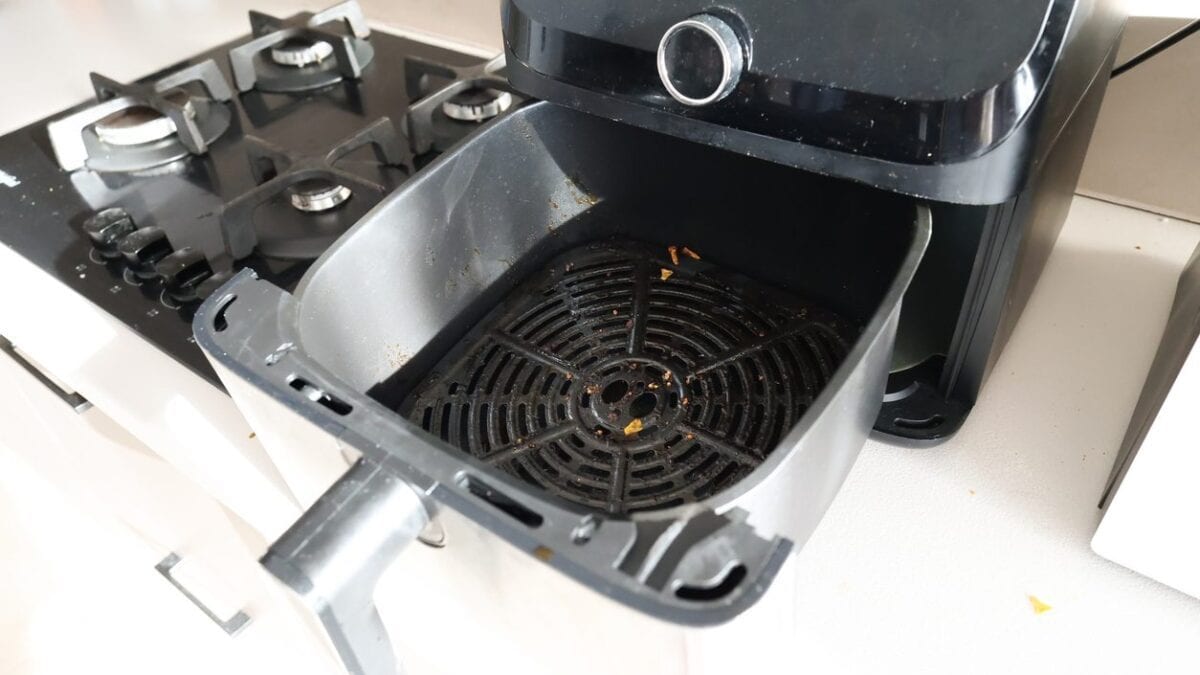
Air fryers have become one of the most common appliances in our kitchens. Alongside the practical benefits, however, recent attention has been drawn to the materials used to make the baskets, especially non-stick ones. Concerns surround PTFE (polytetrafluoroethylene), a fluorinated plastic used for decades to make pots and pans non-stick and also found in the lining of some air fryer baskets.
The question is: if the coating gets scratched or worn, can it release microplastics into food? In principle, yes. Some studies have shown that abrasion on PTFE nonstick surfaces can release microscopic particles of the material. But there's an important caveat: the available research focuses primarily on pots and pans, not specifically on air fryers. We can therefore say that the phenomenon is possible for a PTFE coating, but we don't yet know how significant it is during normal use of a fryer.
What Happens When a Non-Stick Surface Gets Scratched
PTFE is a polymer, and its microscopic fragments can be called microplastics; even smaller ones are called nanoplastics. One of the most cited studies on the subject, published in 2022 in Science of the Total Environment, analyzed non-stick coatings subjected to experimental abrasion and observed the release of PTFE micro- and nanoparticles.
The researchers estimated approximately 9,100 particles in a scratched area, while in the case of a more extensively damaged coating, the estimate could be as high as 2.3 million particles. These are impressive numbers, but they must be read in context: they don't mean that a scratched air fryer automatically releases millions of particles into our lunch. The study involved nonstick utensils subjected to experimental conditions, and counting particles also doesn't establish how much plastic is actually ingested or what the health risk is.
From Pans to Food
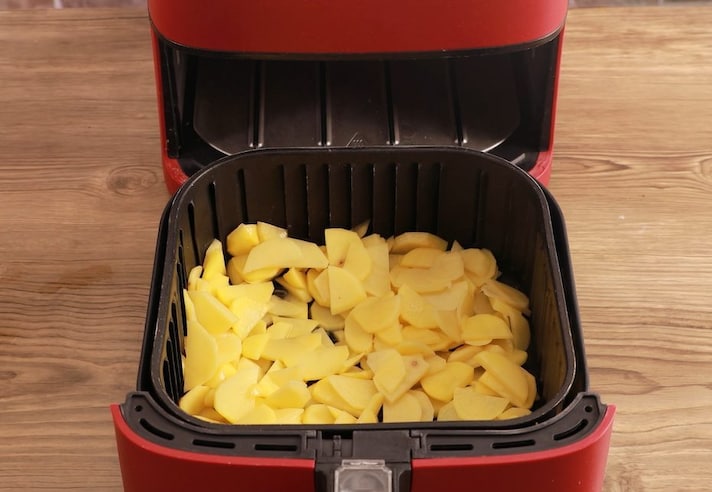
It's a plausible hypothesis that particles could actually reach food. A 2024 study simulated several common kitchen tasks—heating, mixing, cutting, cooling, and storing—using new and used utensils. Particles from various plastics, including PTFE, were found in the food simulant, and older utensils tended to produce more contamination overall.
Again, however, this wasn't a test on air fryers, so transferring these numbers directly to their baskets would be incorrect. The established fact is simpler: a PTFE coating can shed particles when it deteriorates, and wear increases the likelihood of this happening. The specific contribution of air fryers to our exposure to microplastics remains to be determined.
Microplastics and PFAS Are Not The Same Thing
It's easy to get confused here. PTFE is a fluoropolymer and falls under the very broad definition of PFAS used by the OECD. However, this doesn't mean that a PTFE particle has the same effects as PFAS such as PFOA or PFOS, substances that have been studied much more closely for their health effects and ability to accumulate in the body.
In other words, the fact that some PFAS are associated with significant health problems doesn't mean that accidentally ingesting a PTFE microplastic will produce the same effects: these are substances with very different characteristics. This distinction is particularly important when it comes to non-stick coatings, because labeling everything "PFAS" risks making risks appear equivalent when they aren't.
But Are These Particles Dangerous?
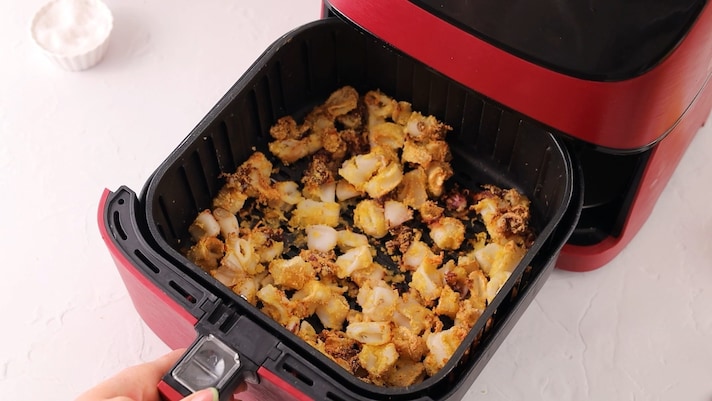
This is precisely where certainty diminishes, because proving that a coating releases particles doesn't mean those particles cause harm to health. To determine the risk, we would need to know how many we actually ingest, their size, how long they remain in the body, and what long-term effects they may have.
The BfR, the German Federal Institute for Risk Assessment, offers rather reassuring advice on PTFE. According to the institute, accidental ingestion of small particles from a scratched non-stick coating should not cause negative health effects: PTFE is highly inert, and ingested particles should pass through the digestive system without being absorbed. This doesn't mean that every possible effect of micro- and nanoplastics has been definitively clarified, but at present there is no reason to consider a fryer dangerous simply because it uses a PTFE coating.
What to Do With a Scratched Basket
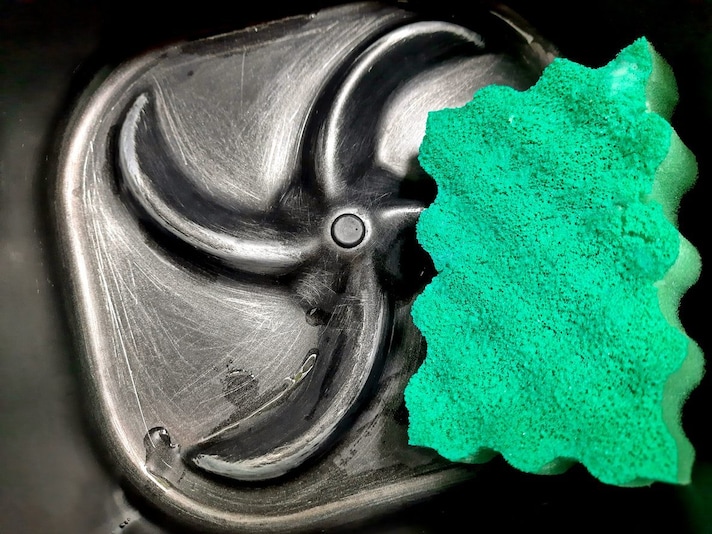
There's no need to ban the air fryer. However, it's wise to preserve the non-stick coating by avoiding metal utensils, abrasive sponges, and washing methods not recommended by the manufacturer. If the basket has a few small scratches, there's no need to worry; however, if the coating is very worn, chipped, or peeling, it's wise to replace it.
Those purchasing a new fryer and preferring to avoid PTFE entirely can opt for stainless steel or glass baskets, or other coatings declared PTFE-free, carefully checking the manufacturer's information. Even terms like "PFOA-free" should not be confused with "PTFE-free": PFOA is already severely restricted by American regulations, and its absence does not necessarily mean the basket is free of fluoropolymers.
In conclusion, yes, a damaged PTFE nonstick coating can release microplastics, but currently we don't have enough data to say how much an air fryer releases during normal use, nor is there evidence demonstrating a health risk based on the quantities realistically ingested. The most useful rule in the kitchen therefore remains very simple: treat the basket well and, when the coating is visibly deteriorated, replace it.
;Resize,width=767;)
