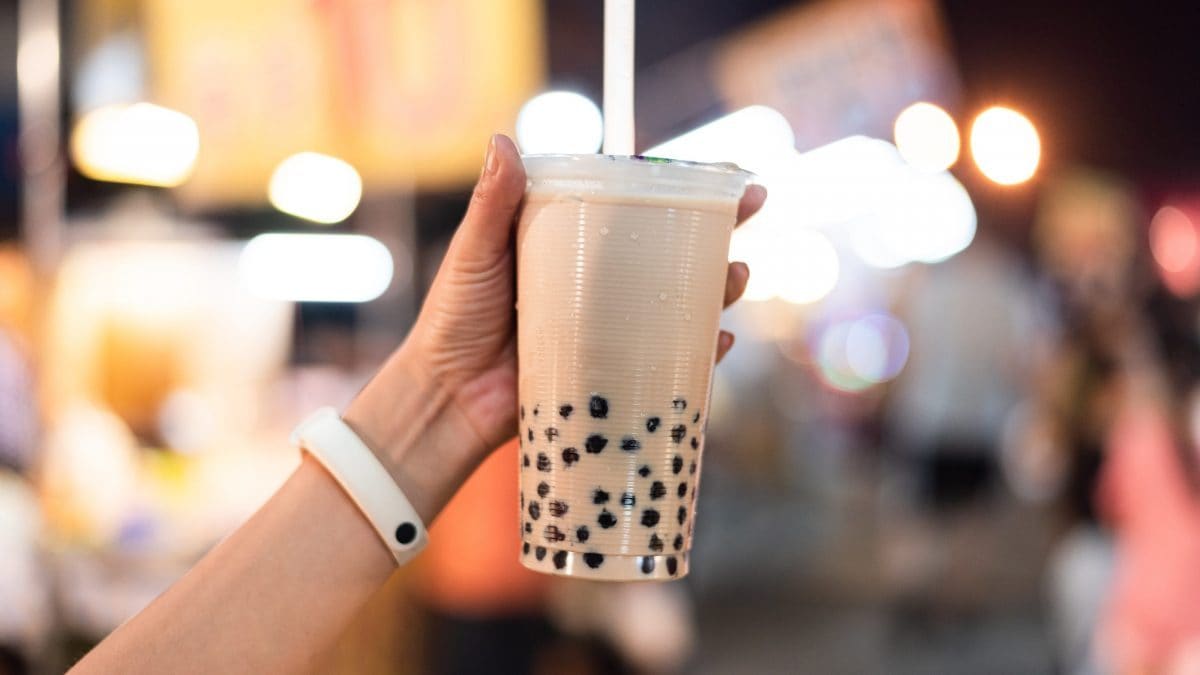
What connects a sexy Hong Kong cinema icon, a self-defeating entrepreneur, and the art of cocktails? The answer lies in the drink that's taking the world by storm: bubble tea. Also known as "boba" for reasons we'll explain shortly, bubble tea is a global phenomenon that everyone is in love with—especially Generation Z, who pairs the large, colorful glass with an equally colorful poke. But how did we get from a teahouse in Taiwan to a product that's now worth billions of dollars?
Bubble Tea's History, From Simple Experiments to a Lawsuit
In the late 1980s and early 1990s, entrepreneur Tu Tsong He was surfing waves of debt: he needed a miracle, or at least an idea that had never occurred to anyone since his hot pot shop closed. As Tu himself recounted, the epiphany came during a stroll through the Yamuliao market in Tainan: "I saw fenyuan (tapioca balls) and thought about adding them to my green tea. The white fenyuan, when infused in golden green tea, appears almost translucent with a white center, just like my mother's pearl necklace." Continuing to experiment, Tu found the perfect formula, adding larger, black tapioca balls to the milk —the very ones found in the bubble milk tea we all know today.
As local tales go, however, Lin Hsiu Hui, during a boring work meeting, poured some tapioca balls she had brought from home into Assam tea. Enthralled by the taste and the contrasting colors, Lin decided that something greater would emerge from that simple gesture. Thus, on the other side of the island, in Taichung, another bubble tea was born at the same time. In the following years, Tu and Lin argued a great deal about the product's ownership, even resulting in a lawsuit that lasted 10 years and was only concluded in 2019. The outcome? Bubble tea is now a drink for everyone and anyone can make it, making it superfluous to know who was the first to create it. "We are old friends in the industry," Tu commented. "The lawsuit is a necessary battle for the truth, but it's nothing personal. People will be the judges," he concluded.
Why is Bubble Tea Also Called "Boba"?
While the paternity remains a mystery, the origin of the nickname "boba" is much clearer. The term was coined on the street, specifically by a street vendor in Tainan. Wanting to distinguish the new, larger black pearls from the traditional smaller ones, the vendor sought a striking comparison and took inspiration from Amy Yip, the exuberant Hong Kong movie star known by the nickname "Boba" (which literally translates to ‘breast champion'). Originally intended as a playful nickname, it has now become a term for a drink that has conquered the world one sip at a time.
Why Does Gen Z Love Bubble Tea so Much?
To understand why bubble tea has become an unstoppable phenomenon, we need to look at the world through the eyes of Generation Z. Those born between 1997 and 2012 are consuming less and less alcohol, have budgets that are limited, and seek "micro-experiences" that break up their routine without breaking the bank. Bubble tea and its associated surge in popularity are part of this context, largely due to its flavor, affordability, and the growing reinterpretation of the basic tea recipe. Bubble tea is also successful because it can be customized with different tea bases and toppings such as jellies, fruit pieces, syrups, and tapioca pearls. Furthermore, from Taiwan to the United States, bubble tea establishments have established themselves as youth gathering places, within aesthetically curated and "Instagrammable" spaces.
But despite its "fresh" aura, from a nutritional standpoint, bubble tea is, for all intents and purposes, a liquid dessert. As reported in the scientific journal Food Science & Nutrition, these preparations fall squarely into the category of sugar-sweetened beverages. For this reason, despite some of the benefits it can provide, it's always best not to overdo it. The numbers speak for themselves: an average 470 ml serving can contain between 20 and 50 grams of sugar, covering (or exceeding) the recommended daily intake in one go. If we add the calories from tapioca starch, the total ranges between 300 and 500 calories.
Why Are Bubble Tea and Poke Paired Together?
The association between poke and bubble tea in our cities is no coincidence. Although the Hawaiian tradition differs (and is geographically distant) from the Taiwanese one, the secret to this winning combination lies in the format. Both are based on maximum customization. While you choose the bases, proteins, and sauces in the bowl, in the glass you can opt for different tea bases, milk types, and toppings. This "psychological continuity" is key: those who love having total control over their meal find bubble tea the natural liquid complement to their bowl.
But there's also a practical side that's tempting for entrepreneurs. This duo speaks the language of social media thanks to a vibrant aesthetic, but it's behind the scenes where the magic happens: both products don't require chimneys or large restaurant kitchens. They're based on quick assembly, a simplicity that translates into lightning-fast service, perfect for delivery and for fitting two businesses into small spaces, maximizing every inch of counter space. Finally, the "Pacific & Asian Fusion" label has done the rest, creating an irresistible consumer bubble. The Western market has fused these two distant worlds under the concept of exotic freshness, offering an authentic journey through dishes ideally distant from our own culture.
The explosion of bubble tea illustrates how consumer habits are changing: between the pursuit of "wellness," the pleasure of an extra-large dessert, and an unparalleled aesthetic, boba is poised to become a pop icon of the twenty-first century.
;Resize,width=767;)
