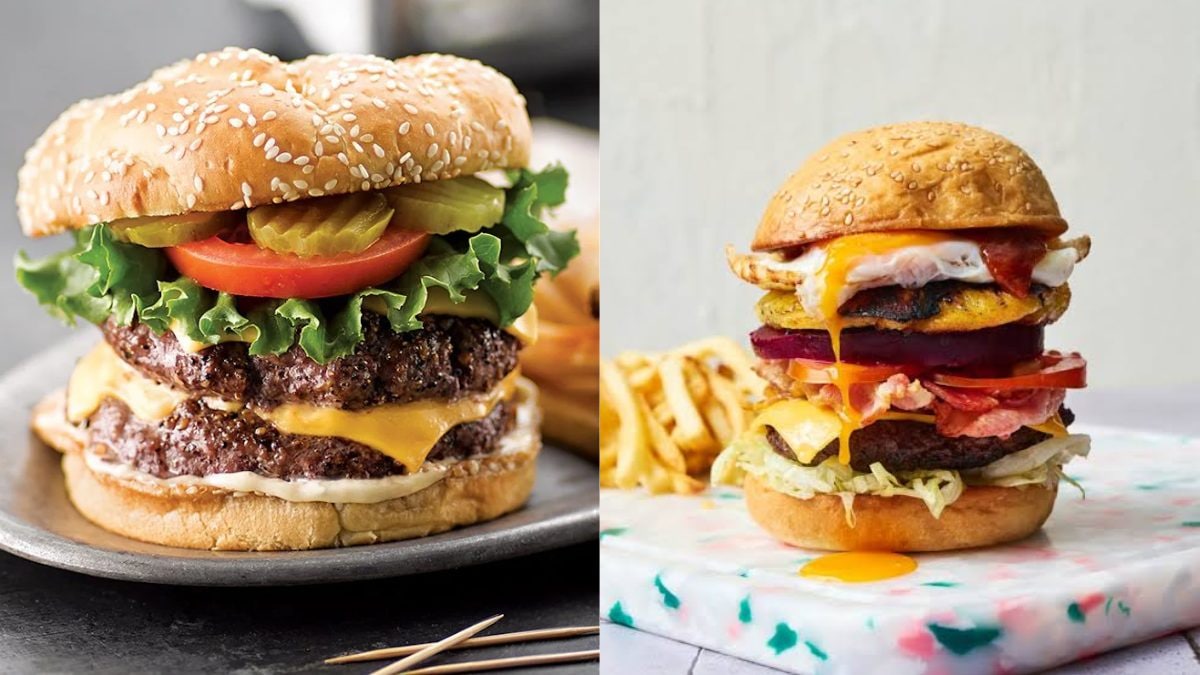
For an American traveler landing in Sydney or Melbourne, walking into a local milk bar or pub and ordering a classic hamburger feels like safe, familiar territory. The burger is, after all, the quintessential symbol of American fast-food hegemony. You expect a soft bun, a grilled beef patty, a melted slice of cheese, and maybe some pickles and ketchup.
But when the plate arrives, the familiarity vanishes. Squinting at the towering stack, you will find a bright neon-purple slice of pickled root vegetable bleeding into the bun, a ring of yellow fruit, and a fried egg with a perfectly runny yolk ready to burst over your hands. Welcome to the Australian burger.
While the American burger has spent decades obsessing over minimalist execution—focusing heavily on meat-to-cheese ratios, Maillard crusts on smash patties, and streamlined toppings—the Australian counterpart evolved in relative isolation. The result is a glorious, maximalist architectural feat that flips the script on what a hamburger can be.
The Legend of "The Lot"
In the United States, if you want everything on your burger, you ask for it "with everything" or "loaded." In Australia, the magic phrase is "with the lot." An American burger with everything usually just means extra condiments, lettuce, tomato, and maybe a few strips of crispy bacon. An Aussie burger "with the lot" is a completely different beast, introducing a standard checklist of ingredients that would make a purist American grillmaster gasp.
The Non-Negotiable Beetroot
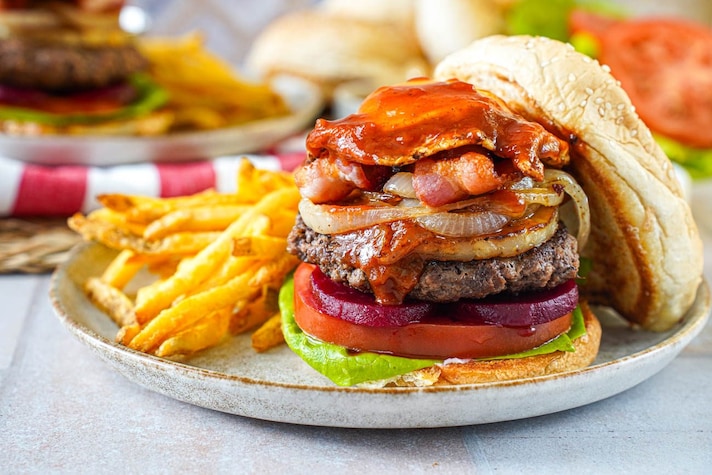
If there is one ingredient that defines the Australian burger, it is canned, pickled beetroot. Slipping a few cold, sweet, earthy slices of beets into a hot savory burger is a cultural mandate Down Under. It adds a distinct juiciness and a sweet-tangy crunch that cuts through the heavy fat of the beef patty. It also guarantees that your hands, wrapper, and plate will be stained a bright shade of magenta by the time you finish eating.
Grilled Pineapple
While the internet routinely wages war over whether pineapple belongs on pizza, Australians long ago decided that a ring of sweet, slightly charred pineapple absolutely belongs on a beef burger. The natural sugars in the pineapple caramelize on the flat-top grill, providing an acidic brightness that pairs beautifully with the rich meat.
The Fried Egg and "Middle Bacon"
While bacon is a common upgrade in both countries, the style of bacon differs significantly. American burgers rely on strips of crispy, smoked belly bacon. Australian burgers typically utilize middle bacon, which includes both the lean loin and a bit of the fatty belly (similar to a cross between Canadian bacon and American bacon). To top it off, a fried egg—usually cooked sunny-side-up so the yolk acts as a rich, built-in sauce—is slid over the patty.
Meat, Buns, and Sauces
Beyond the eccentric toppings, the structural components of the burger are built entirely differently on opposite sides of the Pacific. In the United States, ground beef is treated with a purist's reverence. American burgers focus heavily on seasoned smash patties with a crispy edge or thick patties cooked to a juicy medium-rare, tucked inside squishy potato rolls or sweet brioche buns designed to melt into the meat and soak up grease, accented by ketchup, yellow mustard, or a mayo-based special sauce.
In contrast, traditional Australian milk bars craft a sturdier, more robust experience. The patty is often treated like a flattened rissole (meatball), utilizing lean beef mixed with minced onions and binders to ensure it holds together into a wide, well-done disk. This heavy patty requires a much more resilient, lightly toasted sesame seed bun or artisanal roll capable of holding wet toppings without disintegrating. Finally, instead of sweet American-style ketchup, Aussies dress their creation with "tomato sauce"—a less sweet, spicier version of the condiment—or a rich, smoky barbecue sauce.
The Structural Engineering Challenge
Because of the sheer volume of wet, slippery ingredients—the bleeding beetroot, the juicy pineapple, the runny egg yolk, and the crisp lettuce—the Australian burger presents a serious physics problem. It is significantly wider and taller than a standard American cheeseburger. You cannot eat an authentic Aussie burger lazily with one hand while driving. It requires a firm, two-handed grip, a slight forward lean to protect your clothing from rogue egg yolk and beet juice, and a steady, rhythmic chewing pace to ensure the entire structural tower doesn't slide apart mid-bite.
It is chaotic, messy, and fiercely defended by locals—a sweet, savory, and smoky masterpiece that proves a burger doesn't always have to play by American rules to be elite.
;Resize,width=767;)
