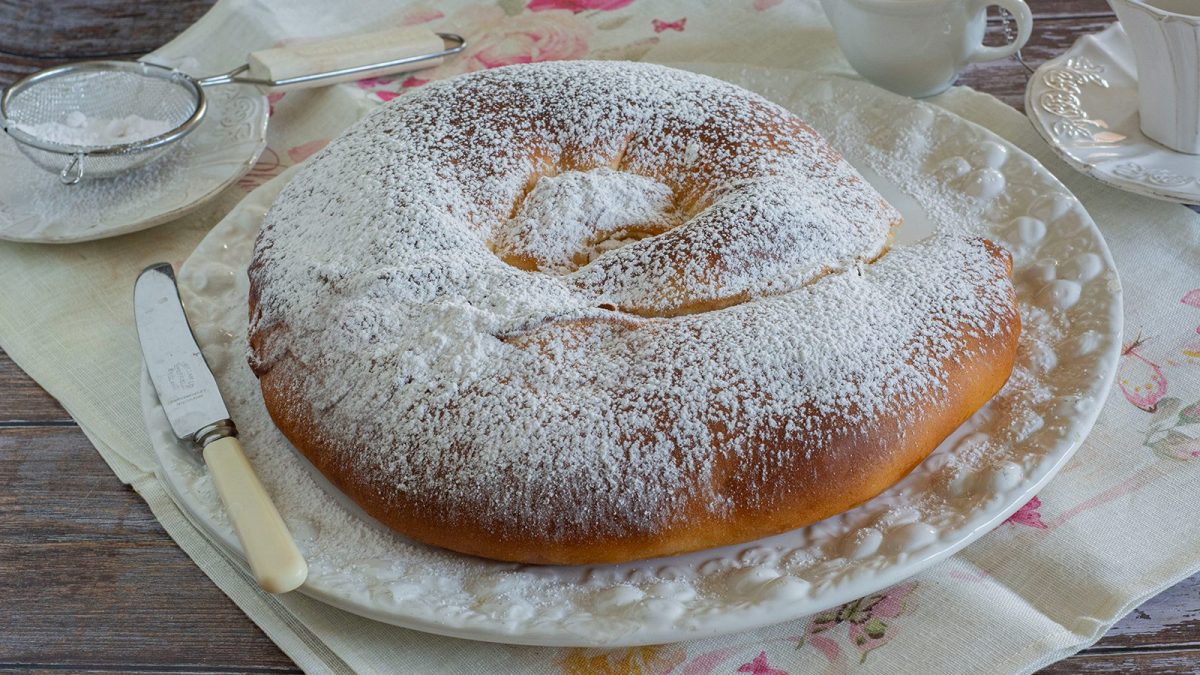
Ensaimada de Mallorca is a sweet leavened pastry with a distinctive spiral shape, typical of the Balearic Islands, particularly the island of Mallorca. It's made with a dough made of water, eggs, flour, sugar, and dried brewer's yeast. Rolled out into a very thin sheet, it's then filled with plenty of lard, which, once baked, gives the brioche a fragrant, perfectly flaky texture.
Dusted generously with powdered sugar, Ensaimada de Mallorca is excellent for breakfast or as a snack with a cup of coffee or fruit tea, but it's also perfect as a dessert after a dinner with guests.
Ensaimada de Mallorca's History
Ensaimada de Mallorca is a traditional pastry from the Spanish island of Mallorca, with origins that date back several centuries. Its name comes from the Catalan word saïm, meaning lard, one of the key ingredients traditionally used in the dough. Historians believe the pastry developed during the period of cultural exchange between Christian, Jewish, and Arab communities in the Balearic Islands, with some theories linking it to older Middle Eastern spiral pastries. By the 17th century, ensaimadas were already documented in Mallorca as celebratory baked goods often prepared for festivals and special occasions. Over time, the pastry became one of the island’s most iconic foods, recognized for its soft, airy texture and signature spiral shape dusted with powdered sugar. Today, ensaimada de Mallorca is protected with a Protected Geographical Indication (PGI) status in Europe, underscoring its cultural and culinary importance, and can be enjoyed in local restaurants and pastry shops both plain, as in the version offered here, and filled with a variety of fillings; among the most famous is cabell d'àngel, a traditional Majorcan pumpkin jam.
Ensaimada's Variations
There are several popular variations of ensaimada across Mallorca and other parts of the Spanish-speaking world. The classic Mallorcan version is usually plain and dusted generously with powdered sugar, but many ensaimadas are filled with ingredients such as pumpkin jam (cabello de ángel), chocolate, pastry cream, or whipped cream. In Mallorca, larger celebratory versions may also include savory fillings like sobrasada sausage. As the pastry spread internationally, especially to the Philippines and parts of Latin America, new regional adaptations emerged: Filipino ensaimadas, for example, are typically softer, richer, and topped with butter, sugar, and grated cheese. Despite the differences, all variations preserve the pastry’s characteristic spiral shape and soft, airy texture.
What Does Enasaimada de Mallorca Taste Like?
Ensaimada de Mallorca has a light, buttery, and slightly sweet flavor with a texture that’s soft, airy, and almost feathery inside. Despite its rich appearance, it’s surprisingly delicate rather than heavy, thanks to the long fermentation that gives the dough its signature fluffiness. The traditional use of lard adds a subtle richness and tenderness, while the powdered sugar on top provides a gentle sweetness without making the pastry overly sugary.
Ingredients
How to Make Ensaimada de Mallorca
;Resize,width=712;)
To make the Ensaimada de Mallorca at home, first prepare the yeast: sift the flour with the dehydrated yeast into a bowl and pour in the lukewarm water.
To make the Ensaimada de Mallorca at home, first prepare the yeast: sift the flour with the dehydrated yeast into a bowl and pour in the lukewarm water.
;Resize,width=712;)
Mix everything well until you get a smooth and homogeneous dough, then cover with a clean cotton cloth and let it rise for about 1 hour.
Mix everything well until you get a smooth and homogeneous dough, then cover with a clean cotton cloth and let it rise for about 1 hour.

Once the resting time has elapsed, collect the flour, egg, water, salt and the yeast, now doubled in volume, in the mixer bowl.
Once the resting time has elapsed, collect the flour, egg, water, salt and the yeast, now doubled in volume, in the mixer bowl.

Work for a long time with the hook until the mixture comes away completely from the sides of the mixer: It will take about 20-25 minutes.
Work for a long time with the hook until the mixture comes away completely from the sides of the mixer: It will take about 20-25 minutes.

Take the smooth and well-kneaded dough and transfer it to a work surface lightly greased with lard, then roll it out with a rolling pin into a very thin square sheet of about 60 cm on each side.
Take the smooth and well-kneaded dough and transfer it to a work surface lightly greased with lard, then roll it out with a rolling pin into a very thin square sheet of about 60 cm on each side.

Using a brush, spread the soft lard evenly over the entire surface.
Using a brush, spread the soft lard evenly over the entire surface.

Then gently roll the pastry on itself until it forms a small loaf.
Then gently roll the pastry on itself until it forms a small loaf.

Transfer the loaf onto a baking tray lined with baking paper and form a spiral, making sure to leave about 2 cm of space between each round of dough.
Transfer the loaf onto a baking tray lined with baking paper and form a spiral, making sure to leave about 2 cm of space between each round of dough.

Cover with a sheet of cling film and let it rise at room temperature for 3-4 hours.
Cover with a sheet of cling film and let it rise at room temperature for 3-4 hours.

Once doubled in volume, cook the cake in a hot oven at 355°F/180°C for about 15 minutes; then remove it from the oven and let it cool.
Once doubled in volume, cook the cake in a hot oven at 355°F/180°C for about 15 minutes; then remove it from the oven and let it cool.
;Resize,width=712;)
Transfer the Ensaimada de Mallorca to a serving plate and sprinkle the surface with plenty of icing sugar.
Transfer the Ensaimada de Mallorca to a serving plate and sprinkle the surface with plenty of icing sugar.

Bring the Ensaimada de Mallorca to the table, cut it into slices and serve. Enjoy!
Bring the Ensaimada de Mallorca to the table, cut it into slices and serve. Enjoy!
Storage Instructions
Ensaimada de Mallorca can be stored at room temperature, under a cake dome, for 2-3 days maximum.
;Resize,width=767;)
