
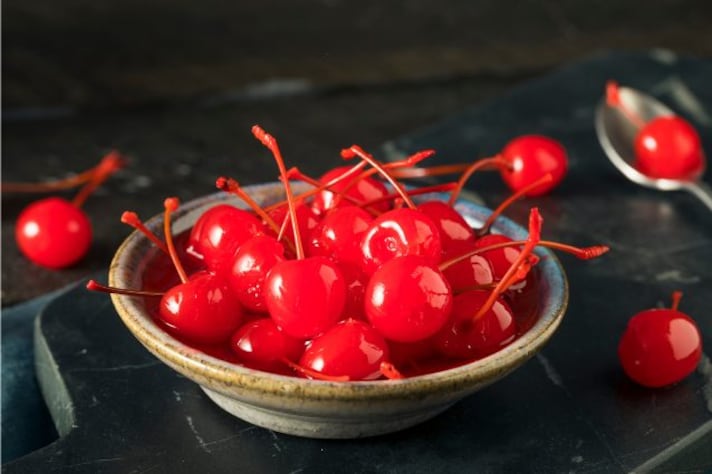
If you have ever stared at the top of an ice cream sundae or pulled a glowing ruby sphere out of a Shirley Temple, you have probably realized something obvious: nature does not produce a fruit that color.
Real ripe cherries range from deep burgundy to soft golden-pink. Yet, the classic American maraschino cherry glows with a uniform, almost radioactive red hue that looks more like synthetic plastic than agricultural produce.
That electric color isn't the result of a special tree variety or a gentle poaching process. To achieve that iconic look, maraschino cherries undergo a multi-week chemical transformation that involves completely erasing the fruit's natural identity before painting it back on from scratch.
The Chemical "Reset" (Erasing Nature)
The process actually begins with cherries that aren't dark red at all. Manufacturers typically use light-colored sweet cherry varieties, such as Royal Ann, Rainier, or Gold. Before these cherries can become bright red, their original color, flavor, and texture must be destroyed.
- The Brine Solution: The freshly harvested fruit is submerged in an aqueous brine containing sulfur dioxide and calcium chloride for four to six weeks.
- The Bleaching Effect: Sulfur dioxide acts as a powerful bleaching agent. It breaks down the cherry's natural anthocyanin pigments, stripping the fruit of all its color until it turns a pale, ghost-white ivory.
- Firming the Fruit: Simultaneously, the calcium ions in the solution bind to the fruit's natural pectin. This solidifies the cell walls, ensuring the cherry stays remarkably firm, plump, and crisp rather than turning into a mushy pulp during processing.
By the end of the brining phase, the cherry is essentially a blank, flavorless, rubbery canvas consisting almost entirely of raw cellulose and pectin.

The Neon Resurrection
Once the fruit is completely bleached and hardened, it is thoroughly rinsed with water to leach out the residual sulfur dioxide. Now, it is ready to absorb its new identity.
- The Dye Bath: The bleached cherries are transferred into giant vats of high-fructose corn syrup or sugar liquid mixed with concentrated food dye—most commonly FD&C Red No. 40 (or historically Red No. 3). Because the bleaching process removed the fruit's original cellular contents, the porous structure acts like a sponge, absorbing the artificial dye deep into its core over several weeks.
Because natural fruit juice isn't present to dull or alter the pigment, the synthetic red dye shines with unobstructed, glowing intensity. To complete the transformation, manufacturers infuse the syrup with oil of bitter almonds (or benzaldehyde). This gives the cherry its characteristic aromatic, candy-like flavor—a taste that mimics classic European liqueur flavorings rather than an actual fresh cherry.
Why Do We Do This?
This elaborate process wasn't invented just to make cocktails look flashy; it was born out of necessity and Prohibition. In the 19th century, luxury European "maraschino cherries" were sour Dalmatian Marasca cherries preserved in a dark, boozy Italian liqueur called Maraschino. When these expensive imported treats became a wild hit in America, local producers wanted a cheaper way to copy them.
When Prohibition banned alcohol in the 1920s, Oregon State University professor Ernest Wiegand spent years perfecting a non-alcoholic, brine-based method to preserve local sweet cherries without them spoiling. His scientific technique created the firm, bright red, alcohol-free icon sitting on your sundae today.
;Resize,width=767;)
