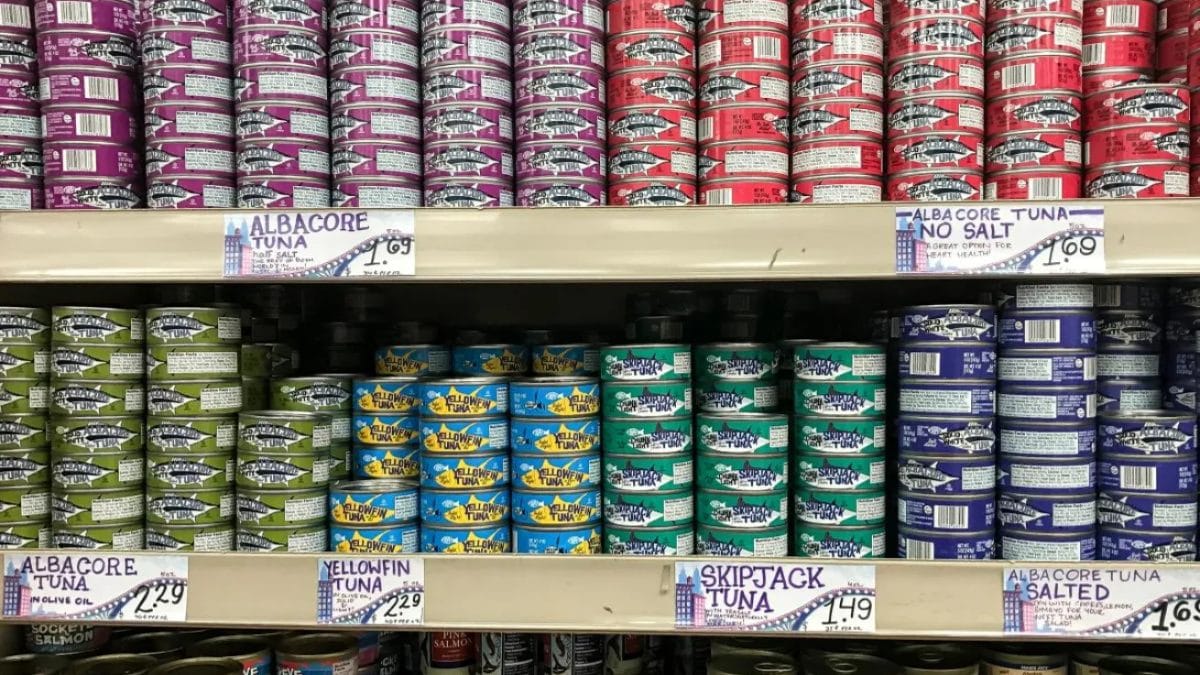
Canned tuna is easy to find and convenient to use in the kitchen, but have you ever carefully read the label when you buy it at the supermarket? Can you tell skipjack tuna from yellowfin tuna? And what does "FAO zone" really mean? Nutrition biologist Simone Gabrielli guides us through tins and glass jars to understand how to choose tuna at the supermarket, reading the label, but also paying attention to its provenance and sustainable fishing. Here's how to choose quality tuna.
Yellowfin or Skipjack Tuna?
The first thing to understand when buying canned tuna is that not all tuna is the same. Under FDA regulations, producers are not required to list the scientific name of the species on the packaging. Instead, they must use standardized commercial names, such as “white tuna” (which must be albacore) or “light tuna” (which can include species like skipjack, yellowfin, or bigeye). This system ensures consistency for consumers, even if it doesn’t always specify the exact species.
Between the two, skipjack tuna is cheaper, has lighter flesh and a less intense flavor, while yellowfin tuna is usually more valuable and expensive.
Should You Choose Tuna Stored in Glass or Tin Cans?
We often find whole tuna fillets in glass jars, which are therefore leaner and more valuable than the mixed pieces in the can.
But at the same time, we can't make it a rule; on the contrary, it's possible to find tuna in glass jars with nutritional values equal to canned tuna. Why? This is because it's not the glass itself that makes the product more valuable, but what you put inside it. Precisely because in the collective imagination, glass equals quality, producers often take advantage of this to put skipjack tuna, the cheaper type, in it, while we rarely find it in cans, but that's not a rule. So, is glass better or worse? The answer is: it depends on the product; the important thing is to read the label. Unfortunately, however, it's not always so easy to find the tuna species on the label, because not all producers use completely transparent wording.
How to Read the FAO Fishing Zone Code
But the species isn't everything when it comes to tuna. It also depends on where the tuna was caught. And how do I know? Products typically include an establishment number (EST.), which identifies the processing facility approved by the USDA or FDA. This number indicates where the tuna was processed or packaged, not where it was caught. Information about origin is usually given more generally, such as “Product of…” or “Caught in…”, but the exact fishing area is not always specified with FAO codes on consumer packaging. Some brands voluntarily include more details—like catch method or ocean area (e.g., Pacific or Atlantic)—but this is not standardized in the same way as in the European system.
The Safest FAO Areas and Those to Avoid
Unfortunately, answering this question isn't so easy. There are countless studies and rankings, often conflicting.
This varies based on the data being examined; for example, one ranking may pay close attention to the sustainability of the catch, while other studies may focus more on the pollution of the seas in which they swim. Not to mention that things change over the years and that fish move from one sea to another during their lives. However, we tried to analyze a few studies and cross-reference the data, making an average, and for now, these should be some fairly safe areas: 27-71-77-81. While these here would appear to be among the most overexploited and polluted: 51-57 34.
In some cases, however, you may not find the FAO code. The reason is the same as before: not all the wording is completely transparent. In fact, it is not uncommon to find writing like "Fishing Ocean: Indian, Atlantic, or Pacific." So, practically all seas.
What Ingredients Should Quality Tuna Have?
As for composition, the same rule applies to tuna: the fewer ingredients, the better. A good canned tuna contains only tuna, oil (or water if in oil), and salt. For example, if we read: "tuna in olive oil," what quality is it? Is it extra virgin? Is it refined? Regulations do not require indicating the percentage or quality of the oil, and this can be a problem. Therefore, to be on the safe side, it's better to choose tuna in oil or products that specify "EVOO" among the ingredients. It's definitely best to avoid tuna in vegetable oil, such as that in sunflower oil.
And what about salt? Since salt isn't added to tuna to preserve it but only to add flavor, the less we use, the better. Our advice? Look for products with less than 1 gram of salt per 100 grams. In short, these are all ingredients we can easily do without because they tend to mask the product's authentic flavor and alter its nutritional values.
How Much Fat? How Much Protein?
However, salt aside, a good tuna should have at least 20 grams of protein per 100 grams and little saturated fat, especially if it's natural. Furthermore, as we've already mentioned, it's also worth considering that glass-packed fillets are generally leaner and higher in protein.
Which Stamps and Certifications Are Reliable?
But what are those stickers we so often find on tuna? These are certifications that help guide consumers toward more informed purchases regarding issues like the sustainability of the catch.
For example, a common icon is a blue circle with a dolphin inside: this is Dolphin Safe, and it indicates that the tuna was caught using methods that reduce (but do not exclude) the accidental capture of dolphins. Purse seines often pose a risk of other species, such as dolphins, becoming entangled in the same nets as tuna. To be reliable, a certification must be issued by third-party bodies and not applied, as is often the case, by the manufacturing company. Some brands, in fact, apply these stickers that mimic existing certifications.
Then there's Friend of the Sea: a highly reliable international certification that guarantees traceability and reduced environmental impact. MSC certification is also highly reliable, guaranteeing sustainable fishing and minimal environmental impact. But there are many others.
Why is Pole Fishing Better?
Finally, where indicated, the fishing method can also be important in order to buy the most sustainable tuna possible. The advice is to choose pole-and-line caught tuna rather than packaging that says, for example, "purse seiner" or "seine nets," which would be the same thing but in English. In any case, it's always better to find the words "selectively caught" or " FAD-free," which therefore indicate a fishing method that limits the risk of accidentally catching other fish species.
;Resize,width=767;)
