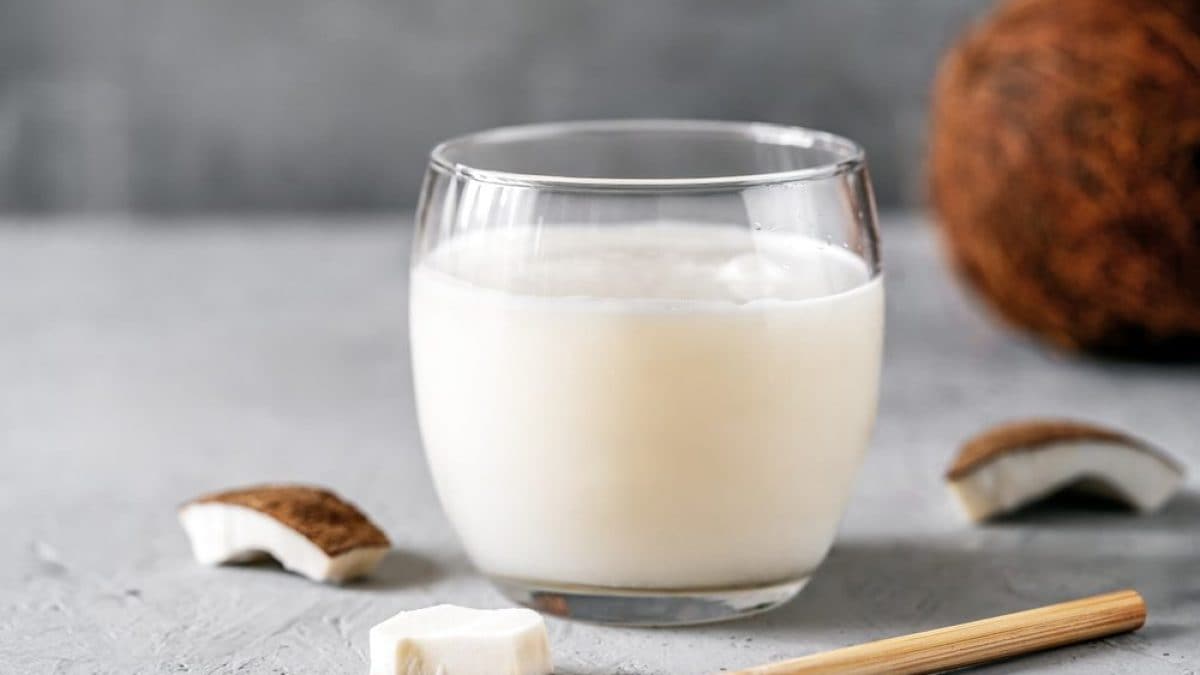
Delicious and fragrant: when we think of coconut, our minds wander to preparations with an unmistakable aroma, transporting us to faraway lands. A food that has conquered our latitudes is not only the fruit, but also coconut milk, perfect for adding an exotic touch to countless recipes, both sweet and savory, to be used as a versatile ingredient in the kitchen and not just as a plant-based drink.
What is Coconut Milk?
Coconut milk is a popular ingredient in tropical and Southeast Asian cuisines, where it's a key ingredient in curries, soups, sauces, and desserts. It's made from ground coconut meat, which is mixed with hot water and then filtered, resulting in a consistency of varying thickness depending on the ratio of the two ingredients. It's available commercially in two main versions.
The first is commercial coconut milk, a more diluted and liquid version, similar to rice, oat, or soy plant-based drinks. It's used primarily for breakfast, in smoothies, or in desserts, often as an alternative to cow's milk for vegans or those who are lactose intolerant. It's generally available in cartons or bottles, in the same formats as UHT milk.
The second is coconut milk itself, intended for cooking: it is packaged in a can or box, has a richer and creamier consistency and is perfect for enriching savory recipes such as curries, soups and sauces, to which it gives roundness and a characteristic aromatic note.

Nutritionally, coconut milk has a high fat content, mostly made up of medium-chain saturated fatty acids, which contribute to its creamy consistency and energy supply (for example, around 170–200 kcal per 100 grams, depending on the concentration). It also contains B vitamins and minerals such as calcium, iron, and magnesium. Be careful not to confuse it with coconut cream: this is a more concentrated version of coconut milk, obtained with a higher percentage of pulp and therefore much thicker and richer. It is mainly used to add creaminess to desserts, custards, and sweet preparations, or to give curries and sauces more body. There is also coconut butter, which is different from cream: it is made from finely blended coconut pulp and is used as a plant-based alternative to butter or oil in some recipes.
How to Choose a Good Coconut Milk for Cooking
When purchasing coconut milk for cooking, it's important to pay attention to certain details that help you distinguish a good-quality product: obviously, the label comes into play immediately. The first thing to look for is the percentage of coconut, which comes first. In the best products, the amount of coconut extract can reach 60–70%, while in cheaper versions it drops significantly, leaving room for a greater presence of water. Ideally, coconut milk should contain only these two components: they can be found pure on the market, especially in organic brands, but it's more common to find packages containing xanthan gum or guar gum on the shelves of large retailers, which act as thickeners, stabilizers, and emulsifiers. These aren't necessarily a problem as they are natural thickeners, but if the percentage of coconut is low and you find the presence of food additives, you're looking at an industrially produced product.
How to Use Coconut Milk in Sweet and Savory Recipes
Thanks to its velvety consistency and its sweet, delicate aroma, coconut milk is an extremely versatile ingredient. It can be used in numerous recipes. In Asian cuisine, it is one of the basic elements of many curries and spicy dishes. In these preparations, coconut milk serves to balance the spiciness of the spices and create a soft, enveloping sauce. It is perfect, for example, with chicken, shrimp, white fish and tofu, combined with ginger, lemongrass, chili pepper and lime. Another very common use is in soups and cream soups. Coconut milk can be added to vegetable or fish broths to give a more rounded flavor and obtain a silkier texture, similar to fresh cream or sour cream. It works particularly well with pumpkin, potatoes and carrots. In desserts, the plant-based drink is more commonly used, replacing cow's milk: try it in puddings, custards, panna cotta and spoon desserts in general. It pairs particularly well with fruits such as mango, pineapple, banana and papaya, but also with dark chocolate.

How to Store It After Opening and What to Do If It Separates
Once opened, coconut milk should be treated as a fresh product: it can be stored in the refrigerator, where it generally lasts for 3-4 days. If you plan to consume it later, don't worry, because you can also freeze it: the trick is to portion it out into ice cube trays, so you have the quantities you need ready for subsequent preparations. A very common phenomenon you'll witness is the separation of the solid part from the liquid part. This happens because the natural fats in coconut tend to solidify at lower temperatures, forming a more compact part that settles on the surface or bottom of the container. This is not a defect in the product: to restore coconut milk to its original appearance, simply stir it vigorously or blend it.
;Resize,width=767;)
