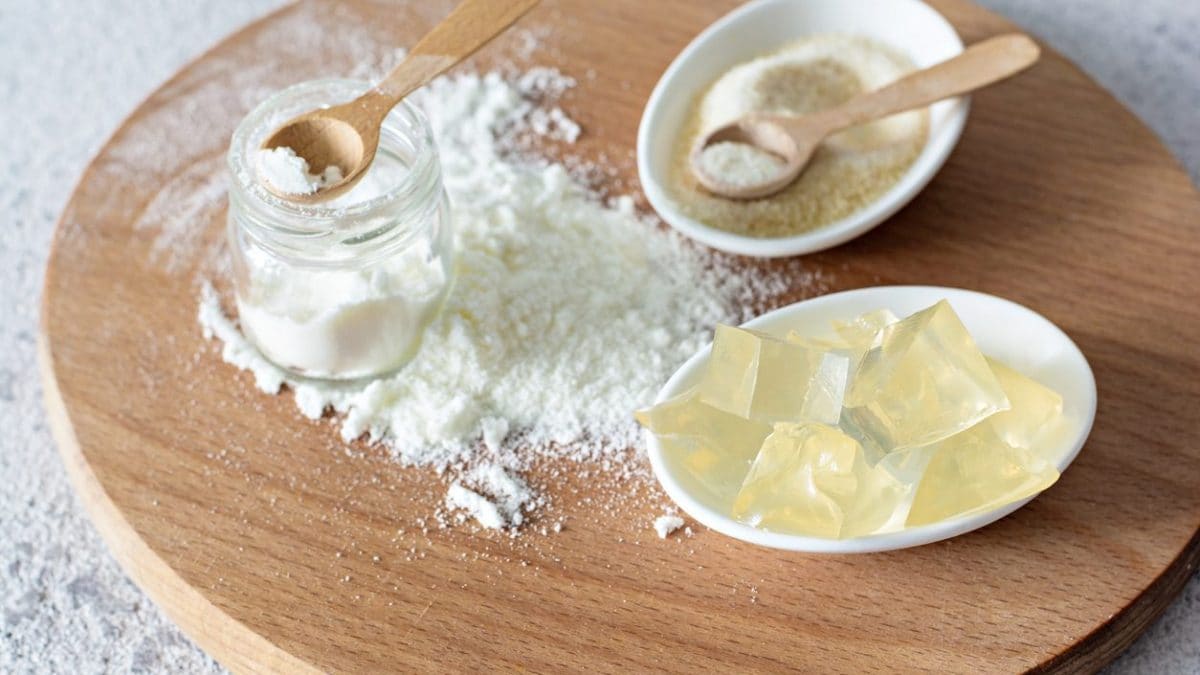
Anyone who loves baking cakes, puddings, and cheesecakes knows how essential gelatin sheets are to a successful recipe: an animal-based ingredient capable of gelling, upon rehydration, any type of liquid or semi-liquid mixture. In the kitchen, however, nothing is truly necessary or irreplaceable, and whether by choice or necessity, it's important to know the possible alternatives for gelatin and, above all, the correct method for converting its weight. How? Today we'll see how to replace gelatin with agar agar, a natural gelling agent obtained from red algae. The gelling power of these substances, known in technical jargon as Bloom, is clearly different, which is why, if we choose to use one product over another, we need to know the exact proportions to achieve a perfect result and a delicious dessert. Let's see how.
What Are Gelatin Sheets and Agar Agar And How to Use Them
Before looking in detail at how to replace gelatin sheets with agar agar, it's important to understand these two products so you can use them correctly and without making mistakes. In detail:
- Gelatin sheets: A gelling agent of animal origin, also known as "isinglass," gelatin is completely colorless, tasteless, and odorless and can thicken any liquid in which it is immersed. The name "isinglass" comes from the fact that it was once extracted from the bladders of certain fish, while today it is mainly obtained from the stomachs and rinds of cattle and sheep. Commercially, gelatin is available in sheets weighing approximately two grams (the amount needed to solidify approximately 100 ml of liquid). Being an animal product, gelatin sheets are not suitable for vegetarians or vegans.
- Agar agar: Also known as kanten, agar agar is a plant-based gelling agent obtained from the processing of the red algae Gelidium. Easily found in supermarkets in powder, flake, or bar form, agar agar is grayish in color and is odorless and tasteless. Used primarily in jellies, puddings, and aspics, agar agar is a key ingredient in vegetarian and cruelty-free baking. Unlike gelatin, agar agar is thermoreversible: it melts at a temperature of 90°C (194°F), and the gelled mixture can be reheated and melted multiple times.

How to Replace Gelatin Sheets With Agar Agar
Having made the necessary specifications, let's see how to replace sheet gelatin with agar agar.
Gelatin is differentiated based on its "gelling power," that is, its ability to thicken liquid compounds. Gelling power is calculated in Bloom degrees, assigned to gelatin based on the weight in grams it can thicken. Based on this distinction, we find three types of gelatin on the market: 130 Bloom degrees (bronze), 160 Bloom degrees (silver), 200 Bloom degrees (gold), and 240 Bloom degrees. It's clear that the higher the Bloom degrees, the less gelatin you'll need and the faster the gelling process.
Agar agar, regardless of its consistency, always has a gelling power equal to 650 Bloom degrees.
Considering these factors, how do you calculate the proportions for replacing gelatin? What if the recipe calls for a certain weight of gelatin sheets with a specific Bloom level, but you want to use agar agar with a different gelling level? Here's how:
- Multiply the amount of gelatin indicated in the recipe by the indicated Bloom levels. Example: 10 grams of gelatin sheets x 200 Bloom = 2000 Bloom.
- Divide the resulting product by the Bloom strength of the gelling agent you want to use (in this case, 650). We will therefore have: 2000 / 650 = 3.7. According to this calculation, 10 grams of gelatin sheets can be replaced with 3.7 grams of agar agar.
With this foolproof method, even those who are less good at math can easily replace gelatine and bring simply perfect desserts to the table.

;Resize,width=767;)
