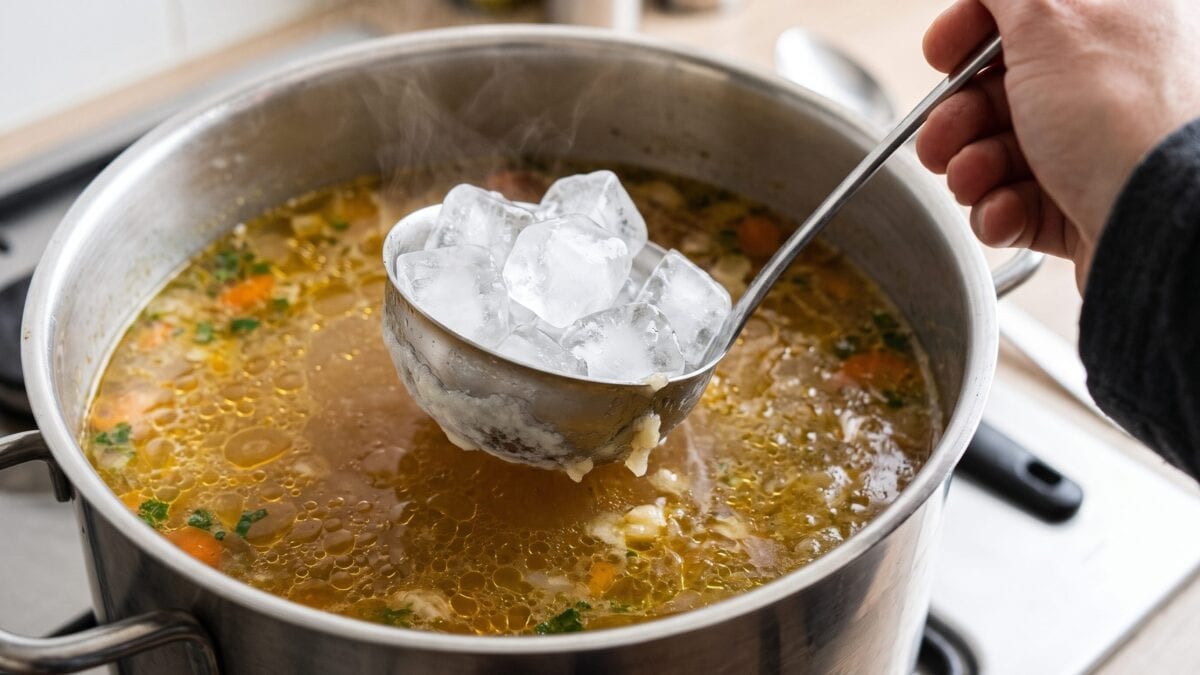
Removing excess fat that rises to the surface of the pan isn't a mandatory rule in the kitchen, but a simple trick to lighten an already rich dish. Deciding to degrease broth —whether beef, chicken, or capon—allows for a cleaner, less greasy flavor and lower saturated fat content, ideal for enjoying plain or pairing with tortellini and passatelli. The problem is that the traditional method requires at least 12 hours in the refrigerator for the fat to solidify on the surface.
There's a trick, however, that allows you to achieve the same result in just a few seconds: use ice to quickly solidify the fat that rises to the surface. The sudden, localized cold causes the fat to thicken, which sticks to the cold surface and can be easily removed. But you have to do it right to prevent the ice from melting into the broth, which would ultimately water it down. Here's everything you need to know about the ice trick for quickly degreasing broth.
How to Degrease Broth With Ice
How can simple ice cubes degrease hot broth? The principle is heat exchange by conduction: the ice rapidly removes heat from the surface fat, causing it to thicken upon contact with the cold surface. To do this safely without ruining the broth, you have two options:
- Using a steel ladle (or a fine-mesh strainer): fill it with a few ice cubes and gently place the bottom of the ladle on the surface of the broth, barely touching it. The fat will solidify by sticking to the cold metal, preventing the ice from entering the liquid.
- Using cheesecloth (or a clean dishcloth): wrap the ice cubes in the cloth and quickly pass them over the surface of the broth without submerging them, allowing the solidified fat to remain trapped in the fibers.
In both cases, clean the ladle or cloth with absorbent paper after each pass to avoid returning the collected fat to the pan.

Why Ice Works (And The Mistake to Avoid)
Contact with a very cold surface causes the animal fat on the surface to thicken and solidify in a matter of moments, making it easier to collect. The result is a solidification of the surface fat, making it easier to collect and remove. However, be careful of a mistake that can compromise the quality of the broth: never throw ice cubes directly into the pot, because they will melt immediately, adding water to the broth. This inevitably alters the concentration of the broth, ultimately watering it down and ruining its flavor, aroma, and saltiness.
How to Degrease Broth Without Ice
If you don't have ice on hand, there are other methods to remove excess fat from the surface of the broth. These are all tricks that exploit, as with ice, its lower density compared to the liquid in the broth, its tendency to float, and its ability to solidify upon cooling. Among the most effective methods you can use are:
- Refrigerate or chill. This is the most effective traditional method for thorough defatting: leave the broth in the refrigerator for at least 12 hours until the fat forms a compact layer on the surface, easy to remove with a slotted spoon. To cool it safely, divide it into shallow containers and avoid leaving it at room temperature for more than two hours (without using the balcony as an alternative to the refrigerator).
- Paper towels. While the broth is still hot, gently place a sheet of paper towels on the surface of the broth, leaving it in contact for a moment and then immediately lifting it away. The paper, thanks to its porous structure, absorbs some of the surface fat through capillary action, but it's important not to immerse or agitate it in the liquid to avoid needlessly absorbing the broth as well.
- Spouted degreaser (fat separator). This is a special container, generally with a spout at the bottom, which exploits the different densities of broth and fat. By pouring the broth into it and letting it settle, the fat collects at the top, while the watery component remains at the bottom. It is particularly practical for large quantities of broth.

