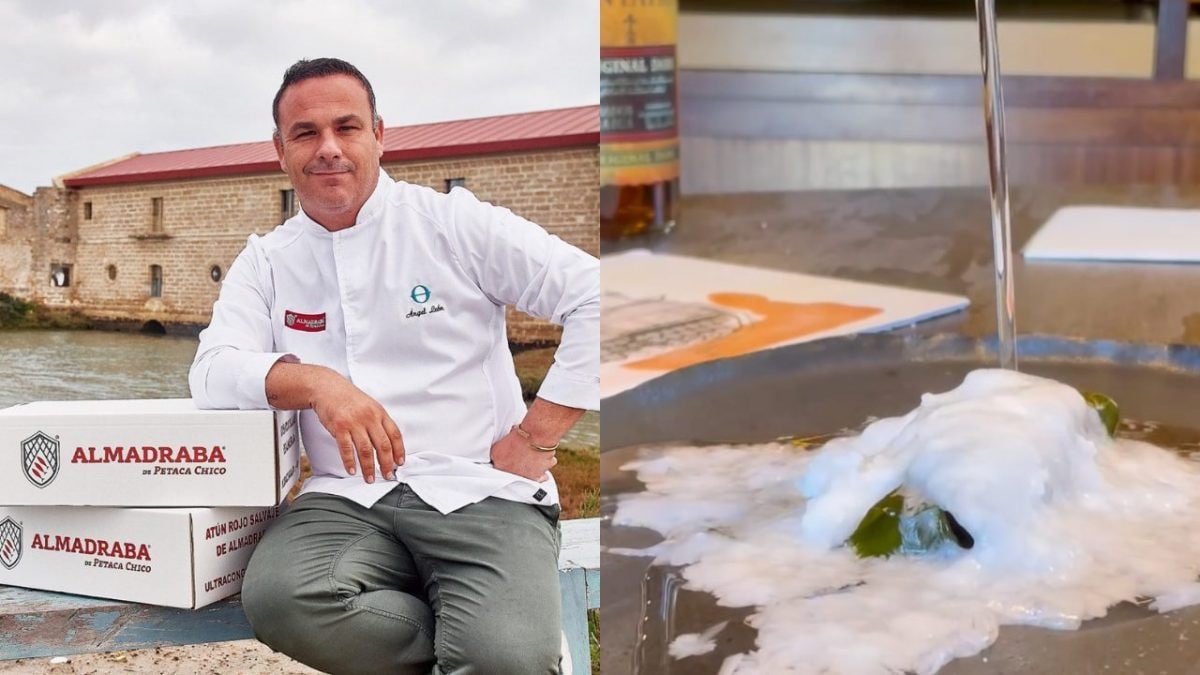
Angel León brought not only extraordinary seafood ingredients, but one of the most incredible technical breakthroughs of the culinary world: the "live salt" technique. It's not a simple variation on boiling or cooking with salt, but an approach that uses chemistry and matter to do what traditional cooking cannot: create heat where there is no flame.
Angel León, Andalusian chef at Aponiente, a three-Michelin-starred restaurant renowned for its innovation in seafood and environmental sustainability, has turned the sea beyond a supplier: it becomes a source of gastronomic discovery. This spirit of exploration leads him to rethink techniques and materials, as in the case of Sale Vivo, where cuisine meets the physics of materials and the most elegant thermodynamics.
How The "Live Salt" Technique Works
At the heart of the live salt technique— sal viva in Spanish — is a solution of sodium acetate (the same compound also used in the food industry as the additive E262i) prepared to become supersaturated, meaning "loaded" with much more salt than water could normally contain at room temperature. The principle is simple but powerful: when water is heated, the sodium acetate dissolves in enormous quantities, creating a clear liquid that appears stable, but is actually in precarious equilibrium. When the solution is then carefully cooled, without shaking or disturbing it, it remains liquid even though, chemically speaking, it would already be ready to transform into a solid.
It's a state defined as metastable where everything remains still until a "trigger" is present. A shock, an uneven surface, or contact with food is enough to break that equilibrium and trigger sudden crystallization: the salt rapidly passes from dissolved to solid form and, in doing so, releases energy in the form of heat, giving rise to an exothermic reaction that can raise the temperature to around 140°F/60°C, ideal for delicately cooking fish and shellfish without stressing the proteins. In a few seconds, the liquid transforms into a warm white crust that envelops the ingredient, creating a uniform and surprising cooking experience, where chemistry literally becomes an invisible source of fire.
When that solution comes into contact with a food—such as fish or shellfish—the equilibrium is disrupted. The supersaturation collapses and the salt begins to crystallize, releasing energy in the form of heat as it does so: an exothermic reaction that can slowly raise the temperature of the food to around 140°F/60°C, allowing for gentle, even cooking without setting anything on fire.
The scenic gesture of pouring the solution onto the plate was a way to demonstrate how salt and water can literally “cook” an ingredient at the table, transforming the preparation into a moment of culinary theater as well as pure cuisine.
How Safe is This Technique and When is It Applied?
The salt technique is directly linked to the name of Ángel León, who developed it and brought it to the forefront of contemporary haute cuisine, integrating it into the research of his restaurant Aponiente. However, it is not a chemical discovery in the strict sense: the principle on which it is based, namely the exothermic crystallization of sodium acetate from a supersaturated solution, has long been known in scientific and industrial circles. León had the intuition to transfer this mechanism from the laboratory to the kitchen, transforming it into a gastronomic technique applied to the cooking of fish and shellfish. In this sense, the invention is not about the chemical reaction, but rather the culinary and creative use made of it. Outside of Aponiente, the methodology is not yet widespread and remains primarily associated with his signature and experimental approach, rather than with a consolidated practice in traditional catering.
Regarding safety, live salt is considered a reliable technique when used correctly and responsibly. The sodium acetate used is a substance approved for use in the food industry and presents no particular critical issues, but the crystallization reaction generates heat and must therefore be managed carefully. In a professional context, this means preparing the solution with precision, avoiding improvised handling, and adopting normal precautions when working with hot liquids. It is not a dangerous practice in itself, but it requires technical expertise and control, as with any unconventional cooking method.

