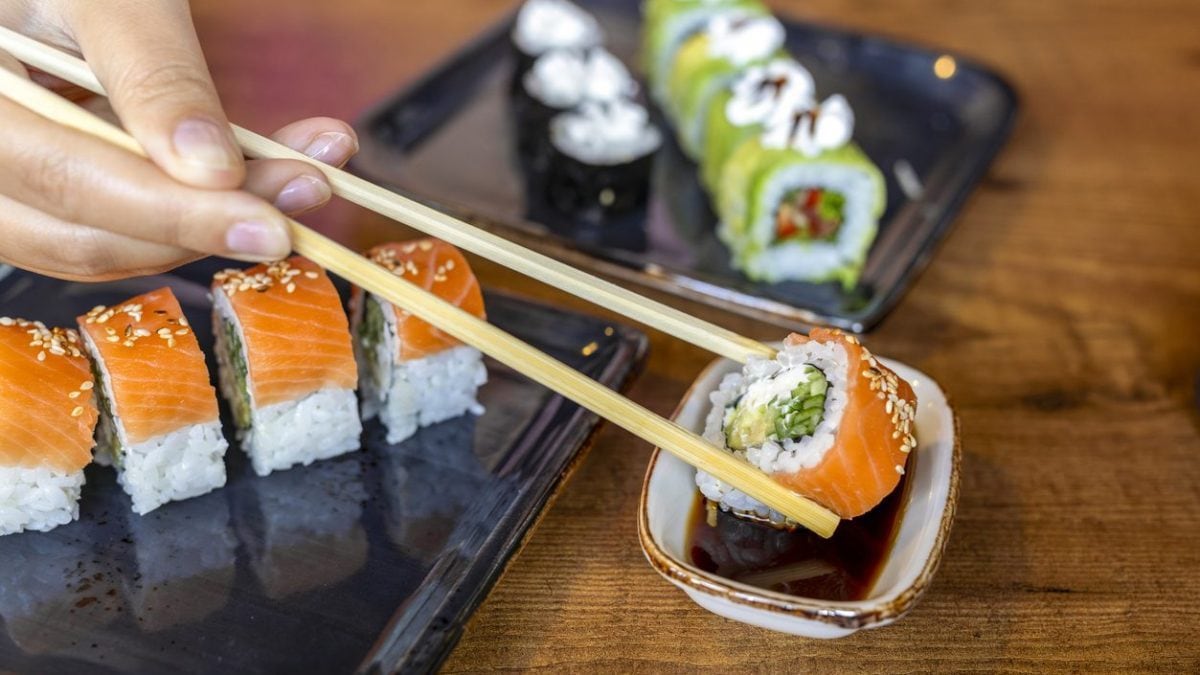
Every now and then, it recurs cyclically: a social media post that talks about sushi and salmon as if they were Russian roulette. This time, the focus has fallen on farmed salmon, accused of being "full of contaminants," "treated with antibiotics," and therefore potentially dangerous to health. The problem is that this type of narrative mixes together different things: food safety, nutritional quality, and environmental impact. And when you put them all in the same blender, the result is panic. To clarify, we asked nutrition biologist Simone Gabrielli for his opinion, who helps us distinguish what's true, what's biased, and what's simply alarmism.
Is Farmed Fish Riskier Than Wild-Caught?
The answer, if we're talking about food safety, is clear: no. "No, from a food safety standpoint, there are no longer any risks. Fish, both farmed and wild-caught, is subjected to very rigorous controls: any contaminants (heavy metals, drug residues, dioxins, and so on) must not exceed specific thresholds, set well below the dose considered potentially harmful even if consumed over a lifetime." So: just because a fish is farmed doesn't automatically mean it's dangerous.
The real point, if anything, is another: "The real issue isn't so much safety as nutritional quality. We may end up serving fish that we imagine to be ‘super healthy,' but in reality, especially in the case of some intensively farmed fish, it has a less interesting nutritional profile than expected." In other words: it's not "poisonous," but it may be less nutritionally beneficial than we imagine.
Is Salmon Really "Full on Antibiotics" and At Risk of Contamination?
A fundamental distinction must be made here: how a farm operates versus what ends up on our plates. "Salmon isn't ‘dangerous' in itself, but a distinction must be made. In farms, as with any animal, keeping many individuals in close proximity increases the risk of spreading viruses, bacteria, and parasites. This may require the use of antibiotics or other treatments."
It's true, then, that on farms, you meant the health risk is higher for the animals and, consequently, the frequency of interventions is also greater. But the conclusion often suggested—"you eat it and you're harmed" —is incorrect. "That said," Gabriellli emphasizes, "in the final product that reaches the consumer, residues must not exceed legal limits, therefore they don't pose a direct health risk. The major problem concerns the nutritional quality of salmon and the environmental impact of intensive farming."

Farmed Salmon Vs. Wild Salmon
When it comes to salmon, we often end up thinking in black and white: wild-caught salmon is "good and natural," while farmed salmon is "bad and full of bad things." In reality, if the goal is to understand whether salmon is safe to eat, the distinction isn't so clear-cut. The real difference isn't so much "farmed or wild," but where it comes from and how controlled the supply chain is. From a safety perspective, if you buy from controlled channels, it doesn't make much of a difference. "From a food safety standpoint, both are safe if purchased through controlled channels."
The most interesting differences, if any, concern the nutritional composition: how much fat it contains, how much protein, and above all the presence of omega-3s. "Nutritionally, however, there are some differences: farmed salmon tends to be fattier. It often contains less omega-3s than wild salmon: the differences in micronutrients exist but are less marked. It may have a slightly lower protein density, also because farmed fish move less."
"And why is everyone talking so much about omega-3s?" Omega-3s are important because they contribute to cardiovascular health, have an anti-inflammatory role, and support the functioning of the nervous system." So be careful: this doesn't mean that farmed salmon is "bad." It means that it's not nutritionally equivalent to wild-caught salmon. "This doesn't mean that farmed salmon is ‘bad,' but that it's not always nutritionally equivalent to wild-caught salmon."
Is Sushi Riskier Than Tartare and Carpaccio?
It's one of the most automatic reflexes when it comes to raw fish: as soon as you hear "sushi," you immediately think of something riskier, as if it were a category separate from carpaccio and tartare. Also because over the years, sushi has become the pop culture symbol of "raw" and therefore, for better or worse, the perfect target for alarmist headlines.
But the truth is that the risk doesn't depend on whether it's sushi or how it's served. It depends on something much more concrete: how the raw fish is treated and preserved. "No, there's no difference in risk between sushi, tartare, or carpaccio, if the fish is treated correctly," Gabrielli clarifies. So the right question isn't "is sushi dangerous?" but: was the fish handled properly?

What Does It Really Take to Be Safe?
When it comes to raw fish, the key issue is preventing the risk of parasites (particularly Anisakis) and complying with hygiene standards. "All fish intended for raw consumption must meet strict hygiene standards and be frozen to eliminate the risk of Anisakis." Indeed, "Safety therefore depends not on the type of preparation, but on whether the establishment complies with the standards and the fish has been properly frozen and stored. If these conditions are met, the risk is comparable for all raw fish-based preparations." In other words: sushi, tartare, or carpaccio don't change the substance. What changes is the seriousness of the supply chain and the establishment.
So: should I stop eating salmon? No, and that's not the point. However, it makes sense not to make it the "standard fish" in your diet, especially if you frequently eat it in sushi or poké. "From a nutritional standpoint, as a nutritionist, I recommend eating salmon occasionally, not as the only fish in your diet. It's a rather fatty food, and especially farmed salmon, its omega-3 content can be lower than other fish that are often overlooked."
The simplest and most useful advice, therefore, isn't "avoid sushi," but rather, vary it. "Alternating salmon with other species, both blue and white fish, and other types of seafood such as mollusks and crustaceans, is a good strategy not only to better balance your fat intake, but also to increase the variety of micronutrients you consume and make your diet more complete and balanced in the long term."
Sushi scaremongering often confuses two different levels: what could be problematic (such as sustainability, intensive farming, and supply chains) and what constitutes an immediate health risk. Farmed salmon isn't automatically dangerous: if it comes from controlled sources, it's subject to regulations and inspections. But it's true that in some cases it can be less nutritionally valuable, and intensive farming poses environmental concerns.
So what's the best strategy for peace of mind? Zero panic and more informed choices: remember to always vary the fish you choose as much as possible, choose reliable restaurants when consuming it raw, and avoid turning a reel into a verdict.

