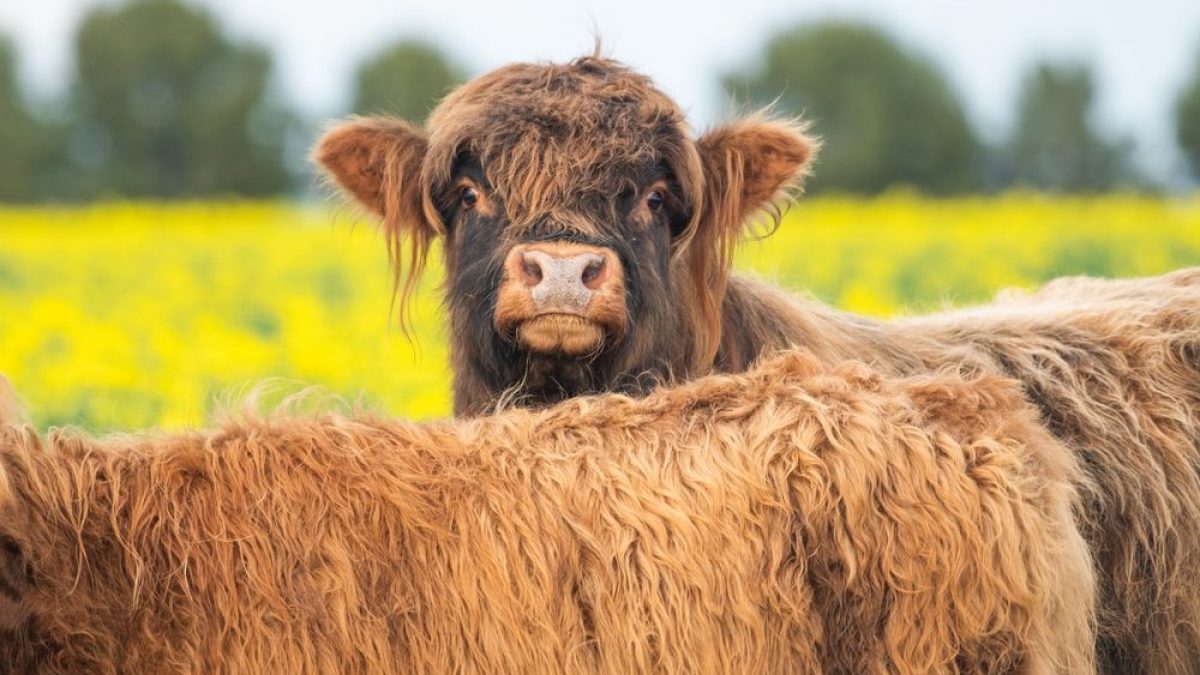
You don't have to be a panda or a baby otter to go viral: in Kent, in southeast England, a herd of Highland cows was enough. Thanks to a few TikTok videos —cuddles, close-ups, and that horned-teddy-dog look— the animals became a minor local celebrity. The problem is that, unlike influencers, they had no intention of managing their fame.
Within a few days, according to The Telegraph, the Hothfield Heathlands nature reserve filled up with visitors who had come with one specific goal: to film the cows that had become famous online. The rest of the reserve faded into the background. As reported by the Kent Wildlife Trust, the body that manages the area, the pressure on the animals increased rapidly: constant approaching, people wandering off the trails, and the cows struggling even to rest without being disturbed.
Too Close, Too Often
The problem wasn't so much the number of visitors, but their behavior. The instructions were clear: keep at least 10 meters away; in practice, however, the distance was often reduced just enough to fit comfortably in the frame.
According to Alison Ruyter, the Trust's natural grazing manager, who told the Telegraph, many visitors were unfamiliar with the rural environment and tended to treat the cows like pets. In some cases, children were even approached, while others ventured off the marked paths to look for the animals, eventually getting lost and requiring emergency assistance, even at night.
Highland cattle, an ancient Scottish breed, are known for their photogenic appearance —long coats, imposing horns—and generally docile temperament. But "docile" doesn't mean available for constant photo sessions: and above all, it doesn't mean immune to stress.
The Temporary Removal Decision
Faced with this situation, the Kent Wildlife Trust has decided to temporarily remove the cows from the reserve, "due to increasing pressure on them," as stated on the official website and reiterated on the organization's social media channels. The measure serves to restore the animals' tranquility and restore some measure of balance in the area's management. The case is clear: all it takes is a single viral post to transform a pasture into a film set. And when that happens, the only ones who don't gain anything are those in front of the camera.
A Breed for Meat, Rather Than Milk
Highland cattle are raised almost exclusively for the production of meat, considered among the most prized in the so-called specialty beef segment. Their meat is naturally lean, but at the same time flavorful and well-marbled, thanks to slow growth and a diet often based on extensive grazing. It is used for high-quality cuts – steaks, roasts, gourmet burgers – and promoted through short supply chains or artisanal production. Milk, however, plays a secondary role: produced in limited quantities, it is primarily used as feed for calves and only occasionally used for small-scale local dairy production.
;Resize,width=767;)
