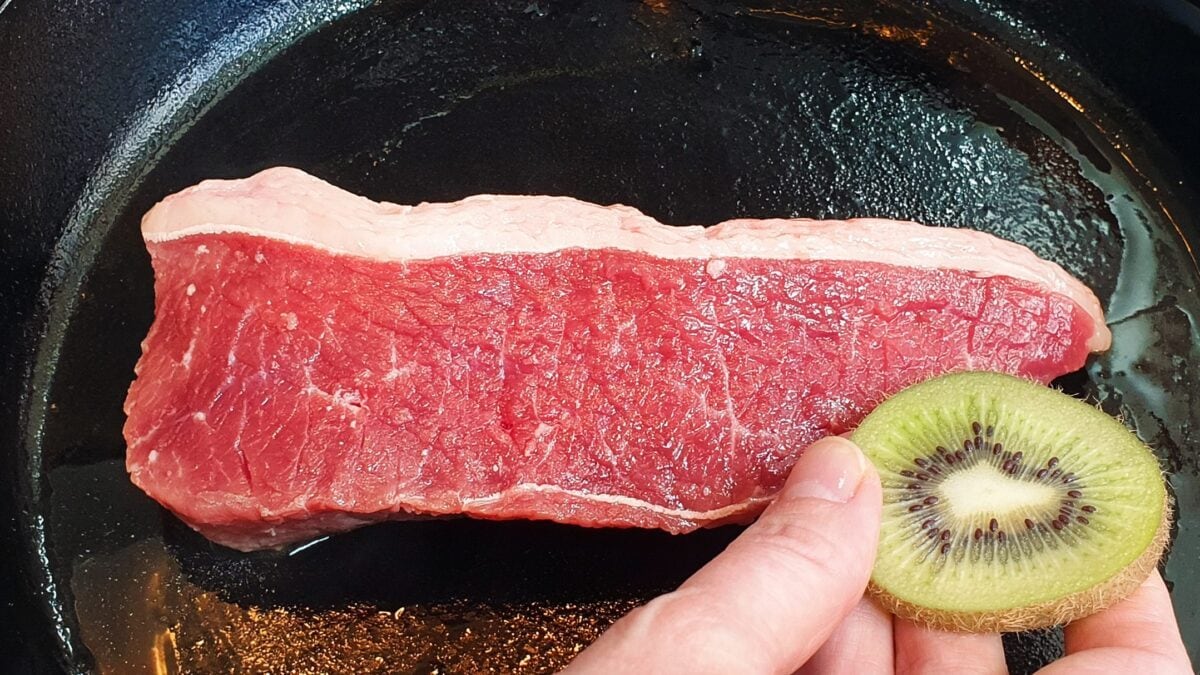
You know that tingling sensation you feel on your tongue after chewing a few slices of pineapple? It's the small revenge of a fruit rich in enzymes that tenderize flesh, and as you eat it, it's almost trying to digest you. Yes, the culprit behind that more or less pleasant tingle is bromelain, an enzyme used by the plant to defend itself from external agents, capable of breaking down the proteins in your taste buds with the same ease it would reserve for a steak.

But it is not the only substance to possess these characteristics: the enzymes in papaya, kiwi, figs and ginger are equally aggressive and capable of tenderizing meat in a few hours, a result that other procedures such as aging would require weeks.
These compounds, however, must be used with caution, because leaving the meat to marinate for a couple of hours too long is enough to end up with a slice on your plate with the consistency of baby food.
The Enzymes That Tenderize Meat
When observed closely, a muscle resembles a package of raw spaghetti bundled together and wrapped in very thin sheaths of collagen, the protein that holds everything together. Fibers and sheaths are made of proteins, similar to long necklaces in which each bead corresponds to an amino acid. The tenderness of a morsel of meat depends largely on the strength of those necklaces. Proteases, the enzymes that break down proteins, "break" the strands of these necklaces at multiple points, shortening them and allowing the teeth to exert less effort because they encounter less resistance when biting.
Enzymes of this type are already present in the meat and come into action after slaughter, gradually softening the stiffened fibers. Their work is the basis of aging, that is, the period in which the meat rests in a cold storage room between 35/2 and 41°F/5°C, usually for 7-21 days.

Fruit extracts perform the same function externally and in a much shorter time. This is precisely why researchers consider them a promising tool for shortening the ripening process of meat and tenderizing less valuable cuts.
The Fruits That Can Tenderize Meat
In pineapple, bromelain is concentrated above all in the stem and core, the fibrous part that is usually discarded in cooking and which the industry recovers precisely to extract the enzyme.
In papaya, papain is found in the latex that oozes from the peel of the unripe fruit when it is cut, and is more active the greener the fruit. In China, papain is sold in preparations called nènròufěn (嫩肉粉), literally "tender meat powder," which some professional kitchens use in the marinade for velveting, the Chinese velveting technique.

Kiwifruit owes its effectiveness to actinidin, present in variable quantities depending on the cultivar, so much so that in some it is not even detectable.
In figs, ficin is found in the thick white latex that flows from the twigs and peel of unripe figs: in addition to tenderizing the flesh, this enzyme helps the flesh retain internal moisture. For this reason, scientists consider the enzyme valuable in the production of cured meats such as mortadella.
Figs contain ficin. In addition to softening muscle fibers, this enzyme helps the meat retain internal moisture: for this reason, scientists consider it a valuable ally in the production of highly hydrated cured meats, such as mortadella.
Closing the list is ginger, a rhizome, that is, an underground stem that has very little to do with fruit, which hides in its juice zingibain, the most selective enzyme of the group.
Papain Vs. Bromelain Vs. Actinidin Vs. Zingibain: Which One to Choose?
Vegetable enzymes have different temperaments, which are revealed especially when marinating is prolonged beyond its necessary duration.
Papain is the most powerful: it cuts through proteins without choosing which ones, with the grace of a brush cutter. Too much of the dose or too much of the wait is enough for the meat to turn into a sticky mush.
Bromelain, which attacks both fiber and collagen, has a slightly more limited range of action, but in generous doses it causes the same disaster.

Kiwi's actinidin and ginger's zingibain, on the other hand, work more gently and tenderize the meat without compromising its flavor or juiciness. Actinidin also has the benefit of activating one of the natural aging enzymes, enhancing its effect. Zingibain, for its part, favors collagen, like those tailors who pay more attention to the stitching than the fabric.
How Long to Marinate Meat With Fruit Enzymes
At the University of Lisbon, a group of researchers conducted an experiment on slices of round and silverside about 2 cm thick, two notoriously tough and cheap cuts.

The slices were marinated in a 1% salt-water solution enriched with pineapple core powder. After 12–24 hours in the refrigerator, the slices' firmness decreased by 41%, although the cold had significantly slowed the action of the bromelain. The most curious result emerged from the control solution (salt water only): the brine, thanks to its osmotic effect, caused the fibers to swell and retain moisture, increasing the perception of tenderness without breaking down the proteins. Under the microscope, the fibers appeared more damaged by the duration of the treatment than by the dose of enzyme. Finally, after 12 hours of immersion, the cooked meat lost some of its color, with or without the addition of pineapple.
Quantifying the enzyme dose at home is practically impossible, because its concentration in fruit varies with ripeness and variety.
It's therefore a good idea to blend or grate some fruit, spread it over the meat, let it sit in the refrigerator under close supervision for 15-30 minutes, and remove it before cooking. After just half an hour, the surface begins to flake, even with kiwi, which is more delicate than pineapple and papaya.

These techniques are perfect for working with thin slices and morsels, such as strips and cubes for skewers, because the enzymes advance slowly and only act on the surface. However, we do not recommend using them on steak, which is too thick to benefit from the action of these substances.
At What Temperature Do Fruit Enzymes Work?
The cold of the refrigerator slows down enzymes, which reach their peak activity between 113/45 and 149°F/65°C, depending on the type. They therefore do their most intense work during cooking, as the meat heats up, until the heat completely deactivates them.
Papain is the most heat-resistant and works efficiently up to 158-167°F/70-75°C before becoming inactivated at higher temperatures. For the same reason, canned pineapple and pasteurized juices, already heated during processing, have no effect on meat, which should always be treated with raw fruit.

Temperature was also crucial in a second study, conducted on the silverside of six- to seven-year-old Angus cattle, a particularly tough meat. Researchers injected a powdered ginger solution into the muscle and then cooked it sous vide, sealed in a bag, and immersed in water at 149/65 or 167°F/75°C. The meat's toughness decreased as the ginger dose increased, especially at 149°F/65°C, the temperature at which zingibain works best.
The treatment also increased the amount of collagen dissolved during cooking, a sign that the enzyme is attacking the sheaths surrounding the fibers. If you cook sous vide at home, after a ginger marinade, it's a good idea to set the thermocirculator that heats the water to between 140/60 and 149°F/65°C, so the enzyme can work under ideal conditions before deactivating.
On Which Cuts Is It Best to Use Fruit Enzymes?
Pineapple, kiwi and the like give the best results on the meat of adult animals, which are naturally tougher, and on lean, fibrous cuts intended for short cooking, such as slices of topside and silverside.

On fillet, which is already tender, they're superfluous and only risk ruining its texture. The same goes for braising cuts, since on a whole block of meat, they would only affect the surface: in that case, a long, low-temperature cooking will be more than sufficient to tenderize the meat.
Why Enzyme-Treated Meat Might Not Be Sold as Fresh Meat
In the industry, enzymes can be applied to meat in three different ways: through marinating, which consists of immersing the cuts in a solution containing them, through infusion into the animal's blood vessels immediately after slaughter, and finally through injection into the muscle through a series of needles.
Each method, however, has its limitations, since marinating only affects the surface layers, and the needles, if not properly cleaned, risk contaminating the meat deeper down.
Here in the U.S., whether enzyme-treated meat can be sold as fresh meat depends on the treatment used and how the product is labeled. The USDA’s Food Safety and Inspection Service (FSIS) regulates most meat and poultry products, while the FDA oversees certain other food ingredients and processing aids. Enzymes such as papain and bromelain may be used to tenderize meat, but the product must comply with applicable food-safety and labeling requirements. If the treatment changes the product in a way that requires disclosure, the label must identify it appropriately; enzyme treatment does not automatically make meat ineligible to be sold as fresh. For specific products, the relevant USDA or FDA rules depend on the enzyme, its intended use, and the processing method.
At home, however, things necessarily become simpler: just choose the right meat, cut into small pieces or thin slices and pay attention to the time that passes, never more than half an hour.
Ultimately, these enzymes behave like visiting relatives: pleasant for an hour and unbearable if they stay for dinner.

