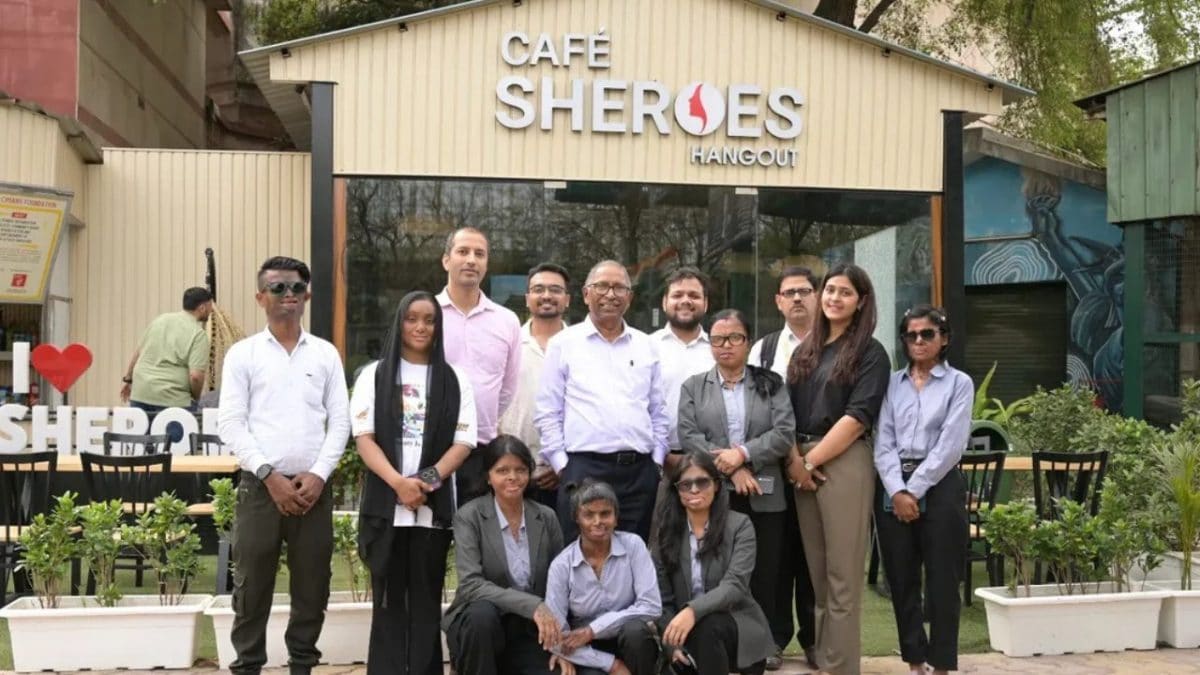
There are many reasons to decide to turn your life around, but among them should never be the experience of violence at the hands of someone else. Yet the risk is there, and if you're a woman, it's even greater. But often, there's something even more powerful than violence: the ability to not let a tragic event end your life. And Sheroes Hangout Coffee is concrete proof of this: an organization that gives a second chance —or, better yet, a second life—to all those women who have survived acid attacks.
How "Sheroes" Coffee is Made
If we were to be dreamers who still believe the world is a wonderful place, just like the people who inhabit it, we would have to say that news like this shouldn't even exist. But even the purest human being on the face of the Earth must admit that reality is much more disappointing than we would like to believe. Fortunately, however, amidst the pettiness and violence we witness every day, every now and then stories emerge that restore a little hope. In this case, they are the women of Sheroes Hangout, a coffee shop that provides jobs to acid attack survivors. Born as a small crowdfunding project, the place took shape in 2014 in Agra, a few steps from the Taj Mahal, from an idea by Alok Dixit, a Stop Acid Attacks activist and former journalist, together with Ashish Shukla: the two are also the founders of the Chhanv Foundation, created specifically to support acid attack survivors.

The underlying idea was as simple as it was powerful: to create a space where these women could return to work, be in public without feeling observed or judged, and regain a certain level of personal and financial autonomy. Initially, none of the women involved had experience in the restaurant industry, which is why a pay-as-you-wish formula was adopted, giving customers the freedom to pay what they deemed appropriate or, in the event of a mistake, even not to pay. Today, the project has five locations —in Agra, Lucknow, Noida, Delhi, and Pune—where approximately 40 women survivors work.
Work as An Indispensable Tool
It's difficult to even imagine the consequences of an acid attack, because in addition to the necessary interventions and medical care, there is (even if it shouldn't be) an enormous social burden: isolation, discrimination, difficulty finding work and achieving economic independence, as if all the suffering caused by the attack weren't enough. For many, returning to study, work, or simply being seen in public represented an almost insurmountable obstacle, fueled by the gaze of those who struggle to accept a body and face changed forever. But in Sheroes, these women regain their freedom and, above all, their self-confidence: they no longer cover their faces, they don't hide, but they put on makeup, smile, and show a strength that not even the most cowardly gesture has managed to break. And this is precisely the goal of the project, in which coffee represents only a tool to achieve something greater: to offer these women a new life, without fear and without shame.

Violence is Still Widespread in The Country
There's a reason why a project like Sheroes Hangout was born in India: here, in fact, acid attacks are much more frequent than one might think. According to official data, in 2023 – the last year for which data is available – 207 cases of acid attacks were reported, up from 202 in 2022 and 176 in 2021. This figure, in itself, would be alarming but probably doesn't tell the whole story: according to the Acid Survivors Trust International, a UK-based organization that monitors the phenomenon globally, incidents in the country could even exceed a thousand attacks each year. The official numbers are lower because many women don't report out of fear, shame, or family pressure. This dramatic reality affects women and girls in particular and sees, in the majority of cases, men as the attackers. Behind these episodes there is often a rejected proposal, an unacceptable marriage or disputes related to family assets: dynamics that make these attacks one of the most extreme manifestations of gender-based violence.

But how is all this possible? For years, acid was readily available in India and sold at very low prices. Only in 2013 did the Indian government introduce restrictions on its retail sale and recognized chemical attacks as a specific crime, punishable by up to ten years in prison. Despite this, activists and survivors continue to report extremely long delays before cases reach trial, sometimes exceeding fifteen years. Many claim to regularly encounter their attackers on the street: according to the Los Angeles Times, one woman said that the man who attacked her even showed up at her wedding. Something, however, seems to be moving: this year, for the first time, the Indian Supreme Court ruled that even survivors forced to swallow acid and who suffered internal injuries must be recognized as acid attack victims under the Rights of Persons with Disabilities Act 2016. And it is in this context that we understand even more how organizations like Sheroes Hangout are not only a concrete salvation for victims, but also a strong and constant presence capable of raising awareness and drawing attention to an issue that continues to be extremely timely. A reality that is not only beautiful, but profoundly necessary.
;Resize,width=767;)
