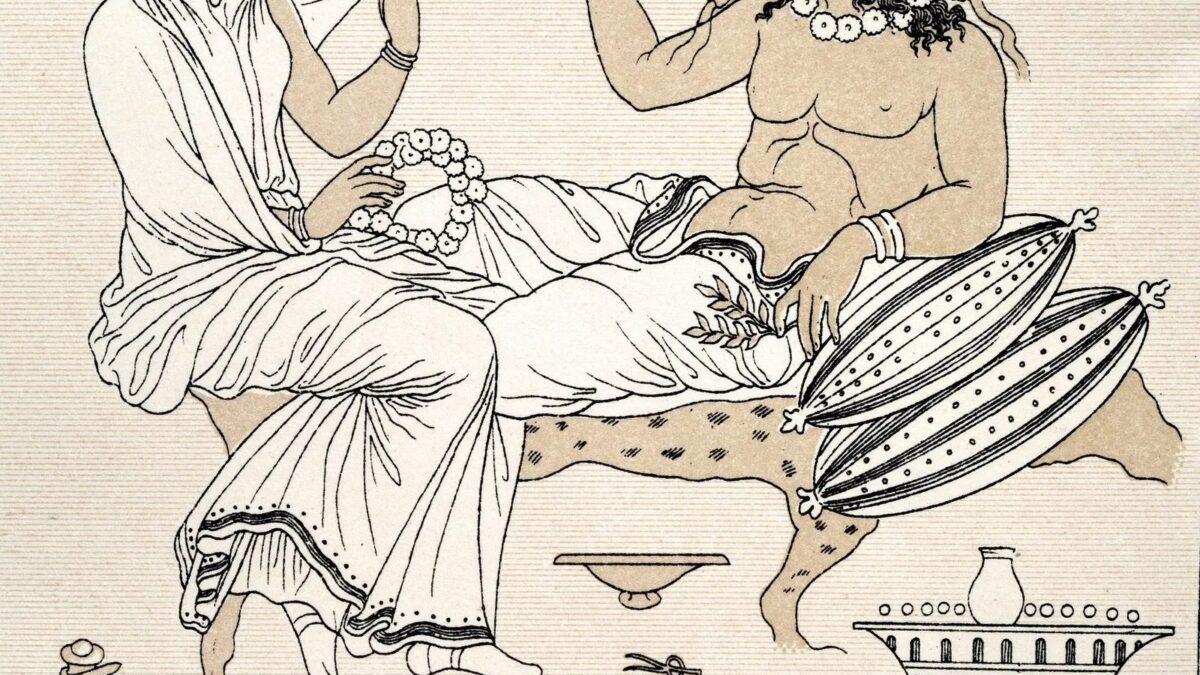
With the arrival of Christopher Nolan‘s highly anticipated The Odyssey in theaters, there's a strong risk that the more concrete side of Homer's epic—the search for food—will be swallowed up by special effects. Yet, scraping away the whims of fate and the proverbial wrath of Poseidon, we quickly realize that Odysseus‘s journey to Ithaca is also driven by the stomach, described in a long and gripping chronicle of perpetually hungry people.
In ancient Greece, sitting at the table was like displaying an identity card, the most direct means of communicating your social standing to the world. Tell me what you chew, how you cook it, and above all, how you serve it, and I'll tell you whether you're a man or a barbarian. In a world where the use of cutlery was still a distant prospect, every conclusion of the work inevitably revolves around food. A meal offered, denied, taken away, or enchanted thus becomes the definitive dividing line between those who belong to the civilized world and those who thrive in the wild.
Before getting to the heart of the matter, however, it is worth putting the events back in order, because the poem begins almost at the end of the story. When the curtain rises, Ithaca is already occupied by the Suitors, and the very first verses are arranged on a set table: Telemachus, son of Ulysses, refreshes a guest who has just disembarked, unaware that the goddess Athena is hidden beneath those clothes. Then the boy sets sail hopefully in search of news of his father, who has been languishing for years on the island of Calypso. The adventures we all know, from the Lotus-Eaters to the cows of the Sun, are recounted by the protagonist himself in a long flashback, comfortably seated at the banquet of the Phaeacians who have just rescued him shipwrecked. In short, the most famous story in the West begins at the table, between one course and the next, and here we retrace it in the order in which Ulysses sets it out for his hosts.
Why The Greeks Called Themselves "Bread Eaters"
In the Odyssey, human nature is revealed in Canto VIII through an unequivocal declaration: the Greeks proudly define themselves as bread-eaters, an expression that becomes emblematic of civilized life. Bread-making presupposes the presence of plowed fields, an organization, and tools such as millstones and ovens operated by individuals who cooperate with each other.
Returning to the story, every time the fleet reaches an unfamiliar shore, Ulysses' primary obsession remains the same: to discover whether the natives knead flour or not. However, it's amusing to see Matt Damon's typically Hollywood irony in insisting on a strict gluten-free diet during the Italian filming of the film, precisely to play the most famous bread-eater in classical antiquity.
Was Polyphemus a Monster or A Cheesemaker?
The Cyclops's lair represents the most iconic and brutal gastronomic setting in the entire work. If we merely looked at his pantry, Polyphemus would appear to be a seasoned cheesemaker. In that cave, Odysseus encounters racks groaning under the weight of cheeses, buckets overflowing with fresh milk, and flocks of lambs meticulously separated by age. The illusion of being a farmer quickly evaporates, however, as the monster is ignorant of the rudiments of farming, drinks only unpasteurized liquids, and considers unexpected guests a source of alternative protein.
Fortunately, the outcome of the slaughter was reversed by the very dark, thick wine that Maron, a priest of Apollo, had gifted to the Ithacan hero during their stop at Ismarus. It was a liquid so high in alcohol that it required monumental dilution (twenty parts water to one part wine). If, according to Hellenic sensibilities, downing pure alcohol was considered the supreme outrage of the barbarians, the giant downed it like soda pop, collapsing into an alcoholic coma that paved the way for the infamous red-hot stake.

What Was Really in Circe's Drink?
When sailors venture into Circe‘s domain, the hostess welcomes them by serving them food and a concoction called kykeon, which means "mixture." The recipe, precisely detailed in Canto X, describes a preparation based on grated goat's cheese, barley flour, and honey, all dissolved in Pramnian wine. The list of ingredients also includes pharmaka, the drugs that the sorceress adds to transform the sailors into swine, guilty of having thrown themselves on the buffet with intolerable greed.
While the idea of dipping cheese flakes in alcohol might rankle us today, in ancient times it was considered an infallible tonic; the cultural significance of this concoction finds solid support even in funerary archaeology, given the discovery of ancient graters buried in the tombs of the Etruscan aristocracy.

Why The Cows of The Sun Were Untouchable
Having left Circe and survived the descent into Hades, the song of the Sirens, and the deadly grip between Scylla and Charybdis, the crew finally lands in Trinacria, a territory that has been superimposed on Sicily since ancient times. Its prairies are home to the sacred herds of the Sun God, divided into seven herds of fifty cattle and as many flocks of sheep, watched over by two nymphs.
Ulysses, familiar with the prophecies concerning those animals, would like to continue straight on without even pulling over, but his exhausted companions demand a stop. To understand the gravity of what follows, a preliminary remark is necessary. In the rigid Greek social architecture, beef was a dizzying luxury, inextricably linked to thysia, the sacrificial rite offered to the gods. Impromptu barbecues for pure pleasure were out of the question, let alone slaughtering a god's personal livestock.
Isolated for weeks by adverse winds and worn out by hunger, Odysseus's companions are reduced first to fishing with curved hooks for anything they can get their hands on, in an epic where the heroes never touch fish, considered the food of the poor. Then they succumb to madness and attempt an improvised sacrifice: they kill and cook the forbidden animals, replacing the traditional white barley and libation wine with oak leaves and plain water.
The pantheon's reaction is immediate, and the fields transform into a theater of horror, with the skins of flayed animals beginning to drag on the ground and the cuts of meat beginning to bellow ominously from the fiery spits. The outrage, which continues for six grotesque days of binge eating, culminates in a total punishment from which only the crafty Odysseus, the only one who wisely chose abstinence, is saved. The ensuing shipwreck hurls him, now alone, onto the beach of Ogygia, where Calypso will hold him for seven long years.
What Does Xenía Mean, And Why Was This Banquet Sacred?
The moral framework upon which the entire narrative rests rests on xenía, the inviolable and extremely strict law of hospitality guaranteed by Zeus himself. Ancient protocol tolerated no exceptions: the host was obliged to welcome the guest, provide him with food, a full cup, a warm bath, and a bed. This was because behind the rags of a chilled traveler, a hidden god could easily be hiding, as Telemachus experiences firsthand from the very first canto. The welcoming banquet had its own liturgy: the libation of wine opened and closed the meal, and carving the meat in front of the guests was an honor the host rarely delegated.
The poem offers examples of impeccable hospitality, beginning with King Alcinous's Phaeacians, the last port of call before Ithaca. Princess Nausicaa is the first to come to the aid of shipwrecked Odysseus, armed with a basket of food, a wineskin, and a flask filled with body oil; at court, banquets overflowing with pears, apples, figs, pomegranates, and grapes await him. The moment of absolute grace is reached thanks to Eumaeus, the slave in charge of tending the pigs, who, despite living in conditions of genuine poverty and unaware that he is in the presence of his sovereign disguised as a beggar, instantly sacrifices a piglet and serves it alongside barley bread.
At the opposite end of the ethical spectrum, the Proci camp out, the personification of textbook parasitism: a hundred or so unauthorized suitors who, sprawled on ox and sheepskins, infest the royal palace, systematically devouring the livestock and draining the master's cellars. The final showdown between the protagonist and the invaders will also explode at a lavishly laid table, since violating the rules of shared dining remained a crime to be atoned for, necessarily with blood.
If, upon leaving the theater, you feel like dusting off the original work, we suggest starting with Canto IX to enjoy the impressive literary sequence shot that intertwines, in the space of a few pages, the giant cheeses and the fateful wine. Perhaps do so while sitting in the kitchen, keeping in mind that the bread and wine that accompanied Odysseus's ten-year pilgrimage are precisely the same raw materials that inhabit our pantries almost three thousand years later.
;Resize,width=767;)
