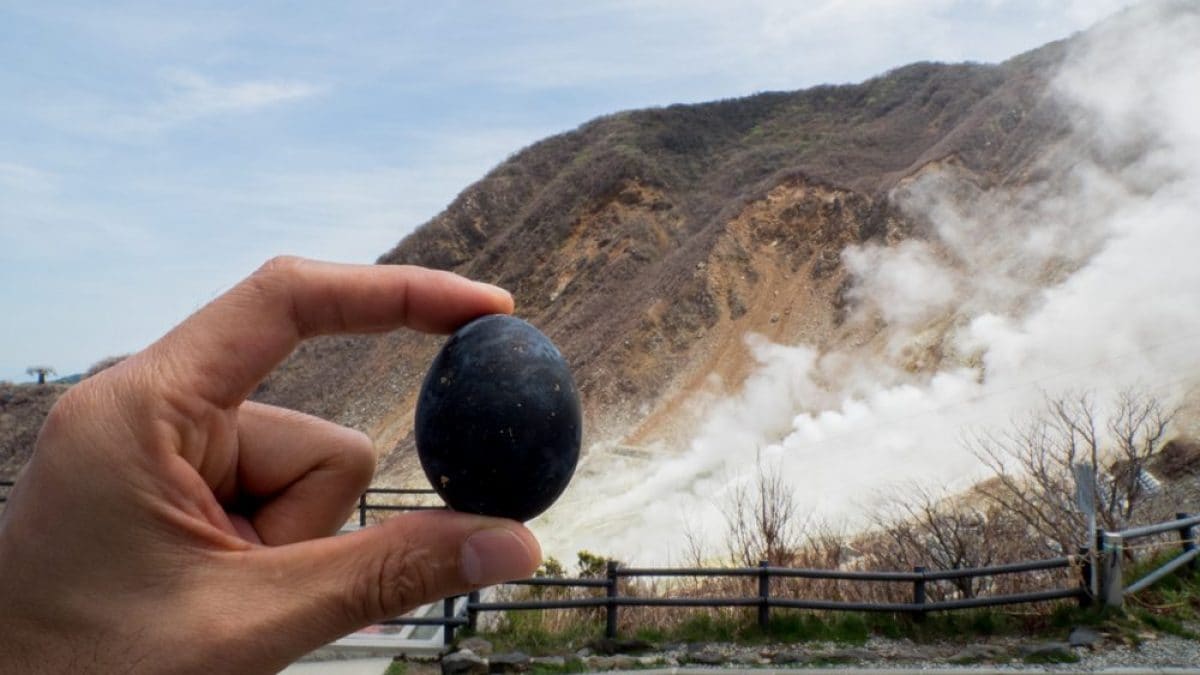
Those who come to Hakone often do so to admire Mount Fuji, relax in the onsen, or explore the volcanic landscapes of the Owakudani Valley: the town is a renowned hot spring resort and natural area in Japan, located less than 100 km from Tokyo, in Kanagawa Prefecture. And right in the heart of Japan's volcanic mountains, a place where the landscape seems to belong to another world, you can stumble upon one of Japan's most famous and photographed gastronomic curiosities: strange eggs with completely black shells, sold still warm amid the sulfurous vapors of the mountain.
Having become a symbol of tradition, superstition, and folk tales, Hakone eggs might seem like a simple tourist attraction, one of those unusual foods that attract attention primarily for their bizarre appearance. However, behind these dark eggs lies much more. Their history is intertwined with the area's volcanic activity, with ancient beliefs related to good fortune and longevity, but also with Japan's profound connection with nature and its most extreme phenomena. In a place where the earth literally boils beneath your feet, even food ends up telling a story about the land and its people. Let's embark on a journey to discover Hakone eggs.
What Are Hakone Eggs and Where Are They Prepared?
Hakone black eggs, known in Japan as kuro-tamago, are one of the most famous specialties linked to the Owakudani volcanic area. It's an extraordinary area, formed over 3,000 years ago after an eruption of Mount Hakone and still today one of the most active geothermal areas in Japan. What makes the eggs from this area so famous? Their shell is completely black, like coal, while inside the egg remains identical to a normal hard-boiled egg. At first glance, they seem almost artificial due to their dark shell, but it all comes down to the way the eggs are cooked: they are immersed directly in the sulfur– and iron-rich hot spring waters typical of the area, and a chemical reaction blackens the shell, creating their unmistakable appearance.
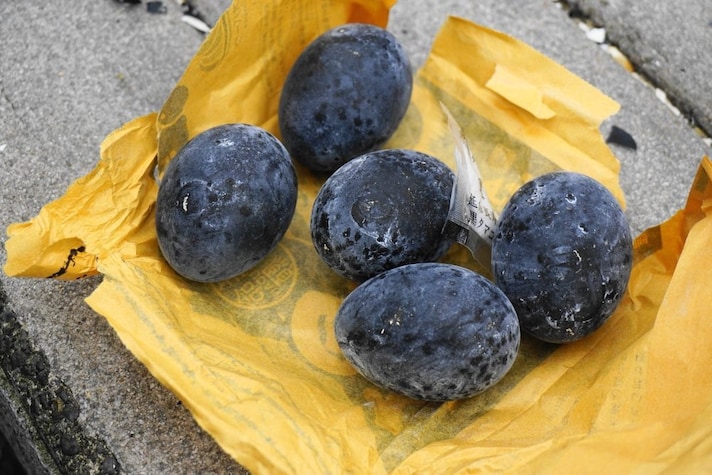
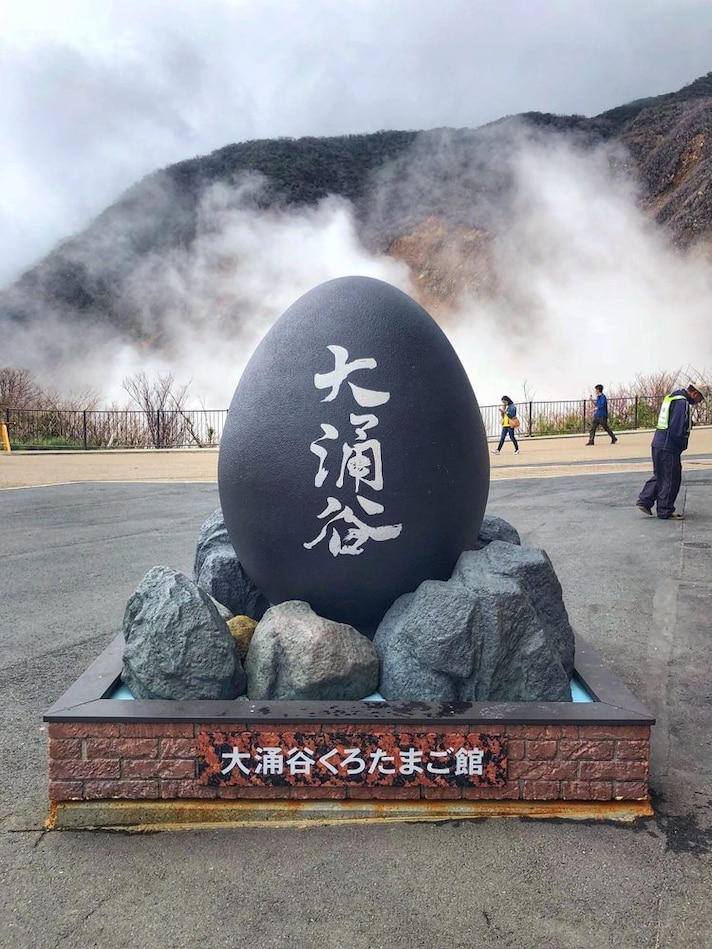
The phenomenon is completely natural and doesn't actually alter the inside of the egg, but it helps make it a symbol of the valley. It's no coincidence that Hakone eggs have become a curious snack offered to tourists. The only way to eat them, in fact, is to visit Owakudani, take the historic cable car that crosses the valley (Hakone Ropeway) and "fly" across the almost unreal landscape of sulfurous vapors, barren rocks and active fumaroles. Once you arrive at your destination, right next to the cable car's arrival station, kuro-tamago, the famous eggs cooked in volcanic springs, are sold. The cable car ride thus becomes an integral part of the experience, a sort of immersive journey that leads directly to the heart of the natural phenomenon that gives rise to this curious gastronomic specialty.
Why Do Hakone Eggs Turn Black?
The distinctive black color of Hakone eggs is a direct result of the unique geothermal conditions found in the Owakudani volcanic valley and, more importantly, the chemical composition of its hot springs. The eggs are immersed in waters naturally heated by underground volcanic activity, rich in sulfur and other dissolved minerals. During cooking, the porous shell of the egg comes into contact with the sulfur gases and minerals present in the hot spring water, triggering a chemical reaction that completely transforms the egg's external appearance.
Specifically, sulfur reacts with the iron naturally present in the water and on the surface of the shell, producing ferrous sulfur compounds responsible for the characteristic black color. This is not an artificial dye or a heat-induced burn, but a true surface mineralization process due to the volcanic environment. This phenomenon is also favored by the extremely high temperatures of the Owakudani springs, which can exceed 175 degrees Fahrenheit (80°C), and the constant presence of vapors laden with hydrogen sulfide, the gas that gives the area its characteristic pungent odor, similar to that of rotten eggs. The eggs are left to soak in these volcanic waters for an hour, then transferred to a steamer to be steamed at approximately 212°F/100°C for about 15 minutes.
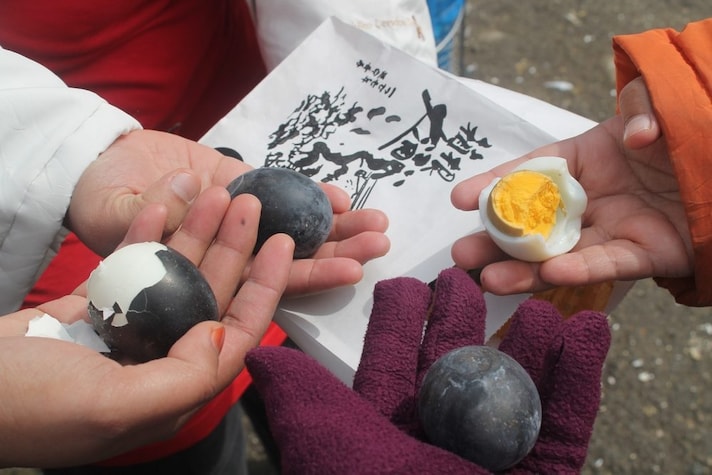
Although the shell turns completely black and slightly rough to the touch, the inside of the egg remains essentially unchanged. The chromatic transformation of the kuro-tamago is a fascinating example of how volcanic activity can directly influence a food, transforming an extremely simple preparation into a unique symbol of local gastronomic culture. In this sense, the black eggs of Hakone represent not only a culinary curiosity, but also a concrete manifestation of the profound connection between Japan's nature and its food traditions.
What do Hakone Eggs Taste Like?
Despite their unusual appearance, Hakone black eggs are identical inside to ordinary hard-boiled eggs: the transformation occurs only on the shell, while the white and yolk retain their natural color. This is because the shell acts as a barrier and protects the internal components from direct contact with the substances present in the sulfurous waters. Even the smell, despite the surrounding environment characterized by the strong sulfur aroma typical of geothermal areas, remains very similar to that of a normal hard-boiled egg. The white maintains a firm and delicate consistency, while the yolk is creamy and slightly drier depending on the cooking time.
The flavor of Hakone black eggs is essentially similar to that of traditional hard-boiled eggs, although some visitors notice subtle differences when eating them. Some visitors, in fact, describe a slightly richer and earthier taste, sometimes sweetish, with light mineral notes, especially noticeable when the egg is still warm, but without radically altering the original flavor. The real difference, therefore, is not so much in the taste as in the overall experience: eating a kuro tamago means consuming a food prepared directly using the natural heat of the earth, in one of Japan's most famous volcanic landscapes. It is precisely this connection to the territory that helps make black eggs a unique gastronomic product, where the symbolic and cultural value outweighs the culinary one.
Hakone Eggs' Curiosities and Legends
Over time, a rich collection of legends, superstitions, and curiosities has developed around the black eggs of Hakone, transforming them from a simple local specialty into a true cultural emblem of the Owakudani Valley. The most famous belief holds that eating a kuro-tamago grants longevity: according to local folklore, you can gain seven extra years of life for every black egg you eat. The beneficial power of the eggs is thought to derive directly from the volcanic energy and the almost "sacred" properties of the area's hot springs, which for centuries have been considered places associated with purification and well-being.
The legend is so deeply rooted that many visitors buy the eggs not only out of gastronomic curiosity, but also as a symbolic gesture of good luck and long life. However, there's also a curious detail: tradition suggests eating no more than two at a time, as exceeding this amount would upset the balance of good fortune associated with eggs. While obviously a folk belief with no scientific basis, the myth of longevity has become one of the most important elements of Hakone's tourist identity.
Alongside this famous legend, the Hakone kuro-tamago are surrounded by small folk tales born from the mysterious atmosphere of Owakudani. One popular legend speaks of a "black hen" that lives among the sulfurous vapors of the valley and lays eggs that are already dark. Of course, this is just fantasy, yet the myth well reflects the almost supernatural allure of the place itself. Owakudani, with its white vapors, intense smell of sulfur, and steaming earth, has long been associated in Japanese folklore with places inhabited by spirits, demons (oni), and supernatural creatures. In such a context, imagining a "magical" hen capable of producing black eggs has become almost natural.
Some popular versions also say that the eggs are "blessed" by the volcanic mountain and that their black color symbolizes the ability to absorb bad luck or negative energy. This connects to a theme very present in Japanese culture: black is not only the color of darkness, but can also represent protection, mystery, and transformation. In this scenario suspended between science and legend, black eggs have become not only a gastronomic specialty, but also a symbol of the volcanic mystery of Hakone.
;Resize,width=767;)
