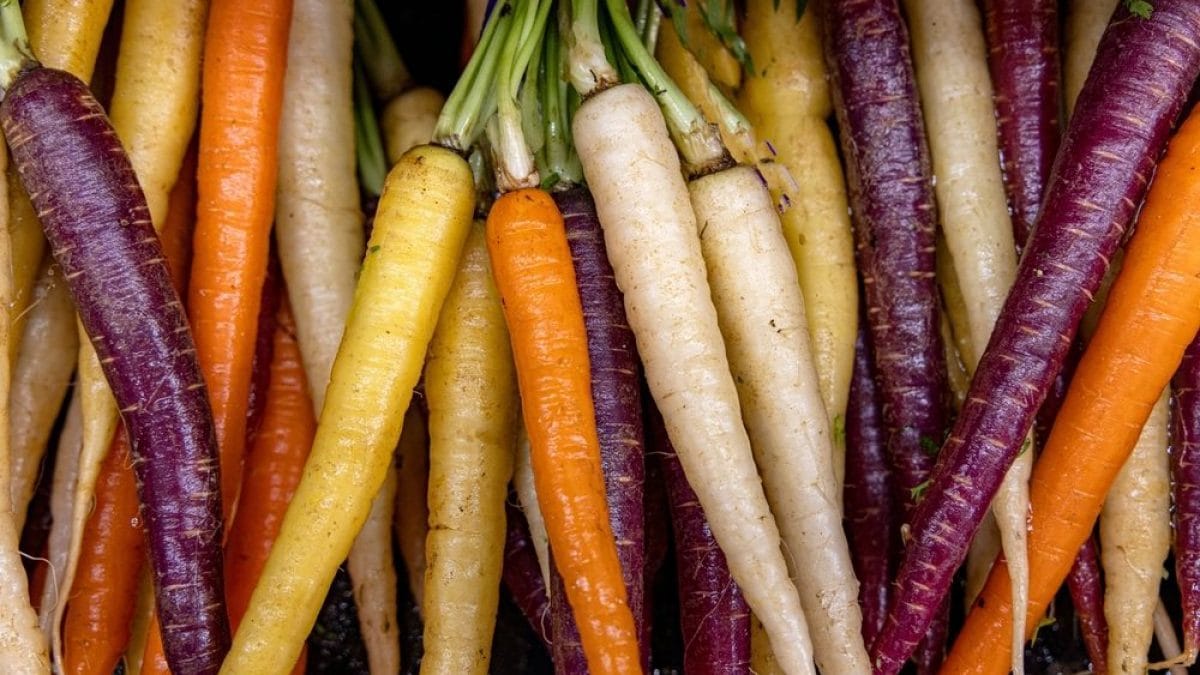
If we were to list the distinctive characteristics of carrots, the orange color would probably be at the top of the list. Historically, however, this wasn't always the case: the first carrots were purple, yellow, and white, and remained so for a long time. Orange arrived later, as early as the 17th century, thanks to the Dutch, who crossed the vegetable until they achieved the ideal color, apparently in honor of the founder of their royal house, William of Orange. This variety achieved great success and stood out from the others due to its sweetish flavor, whereas until then carrots had been bitter, so much so that they were used as a natural remedy and as livestock feed rather than as an ingredient. More and more frequently, however, it is possible to find carrots of different hues on sale, including white ones: let's see why they are different from orange ones, which other vegetables they can be confused with, and how to enhance them in the kitchen.
What Are White Carrots and Where Do They Come From?
White carrots are the descendants of an ancient variety of Daucus carota, a plant that grew wild in Europe, Asia, and North Africa before being domesticated in the Afghan area around 5,000 years ago. We know that there are references to white carrots as early as the Roman Empire, although in texts they are often confused with another plant, the parsnip (Pastinaca sativa): it is a root that has the same elongated shape as the carrot, but has an aromatic, almost spicy flavor, and was widely used in the past, slowly losing its popularity. Also beware of daikon, which is a particular Asian cultivar of the common radish, with the appearance of a large white carrot: it is juicier and crunchier, pleasantly spicy in the mouth, and is particularly found in sashimi dishes, cut into very thin strips.
What Does the White Color Depend On?
In white carrots, what is less present is that natural pigment that gives the typical red and orange hues to many vegetables, including pumpkins, sweet potatoes, oranges, apricots: this is beta-carotene, part of the carotenoid family, and is a powerful antioxidant, precursor of vitamin A. White carrots that come from afar and belong to historical varieties are the Blanche des Vosges, originally from France, and the Küttiger, typical of the Swiss municipality of the same name, both rustic and rare, (almost) fallen into oblivion and rediscovered thanks to an ever-increasing interest in less standardized traditional crops, while among the more recently developed types appear the White Satin, smooth and uniform, and the Lunar White, which is often present in the seeds of colored carrot mixes, easy to purchase even online.

White Carrots Vs. Orange Carrots
Obviously, the most eye-catching detail is the color: but precisely their paleness, with cream or ivory hues, makes these carrots different from orange ones in terms of nutritional value. What's lacking is, in fact, the amount of bioactive compounds, meaning that the vitamin A and antioxidant content is much lower than all other colored carrots. This, however, doesn't mean that white carrots have a worse profile: they are equally low in calories, a source of fiber and minerals, a food that should be included in a varied and balanced diet. The flavor also changes: the different chemical composition, in fact, gives them a more delicate and subtle flavor.
How to Use White Carrots in Cooking
White carrots lend themselves to many of the same uses as traditional carrots: before using them in various preparations, they should be washed and, if necessary, peeled, then cut into rounds, julienned, diced, or grated. Raw, they can be used in salads and dips to enhance their crunchiness, while cooked, they lend themselves to being sautéed with aromatic herbs and spices for added flavor, made into creamy and velvety soups, or as a substitute for the common ones used in soffritto. You can try them in rösti, as a variation on the classic potato recipe, glazed in a pan, or pickled in oil. Without a doubt, they are less visually appealing and delicious, so it's best not to use them in desserts or dishes where the color of this vegetable plays a key role.
;Resize,width=767;)
