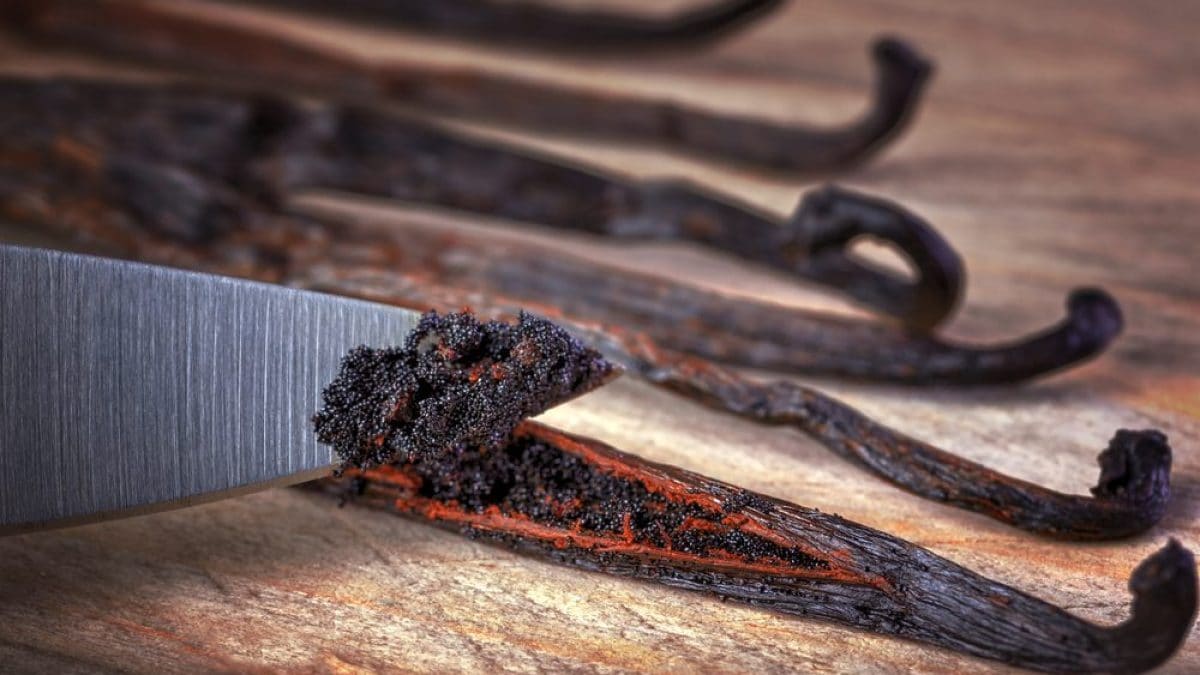
It's hard to remain indifferent to its warm, velvety, and enveloping aroma: vanilla is one of the most beloved spices, especially in pastry making, where it adds a delicious yet refined touch to many preparations. The most noble and natural form in which it is found on the market is the berry or pod, easily recognizable by its dark color, tapered shape, and its price, which certainly doesn't go unnoticed. Let's see why we are faced with a true "desirable ingredient" and how to best enhance it.
What Is a Vanilla Bean and Where Does It Come From?
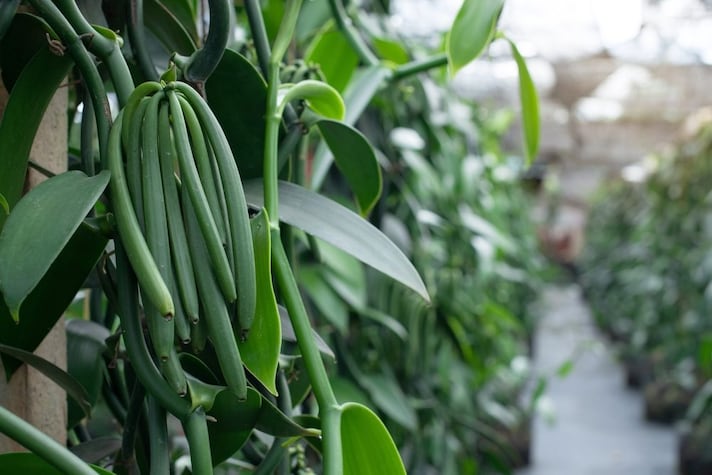
What we commonly call a vanilla bean is actually the fruit of a tropical orchid belonging to the Orchidaceae family. It is a climbing plant native to Central America, specifically Mexico, and is grown mainly in Madagascar, Indonesia, Réunion, Tahiti, Uganda, Papua New Guinea, and the Tonga Islands. The most common species is Vanilla Planifolia, but there are also subspecies that give rise to different varieties that can be found commercially, such as the prized Vanilla tahitensis, typical of French Polynesia, and Vanilla Pompona, of lower quality and intended for cosmetic and industrial use.
How to Recognize Quality Vanilla Bean
The vanilla pod as we know it is obtained through a long processing called curing, which can last between 3 and 6 months, and which allows the complex aromatic bouquet to develop: when still on the plant, the pod, similar in appearance to a green bean, is green, with the ends turning yellow and must not be picked unripe, because once detached it stops ripening. Initially, each flower is pollinated individually by hand and the fruit develops in 9 months. It is easy to understand, therefore, why vanilla is one of the most expensive spices in the world, second only to saffron.
How can you tell if you're dealing with a quality product? The pod is elongated, intact, dark, and slightly shiny, with a very intense brown color that almost reaches black. The surface resembles that of tree bark and is slightly oily to the touch, while the consistency is flexible: if it appears dry, wrinkled, and rigid (it breaks), it means it is too old or has been stored improperly. Inside, it contains its precious seeds, also improperly called "pulp" due to their moist, compact texture: it is precisely these that contain most of the aroma and give preparations the typical dotted effect that is clearly visible, for example, in creams or artisanal ice creams.
How to Use Vanilla Bean Without Wasting It
Since it's a decidedly expensive spice (average prices per kg range between 400 and 750 dollars), the key to using vanilla is to waste nothing. The best way to make the most of the pod, therefore, is to remove the seeds and then use the emptied husk as well. Here's how.
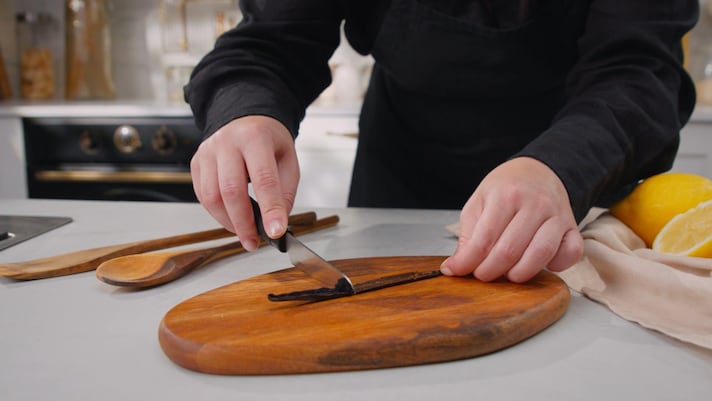
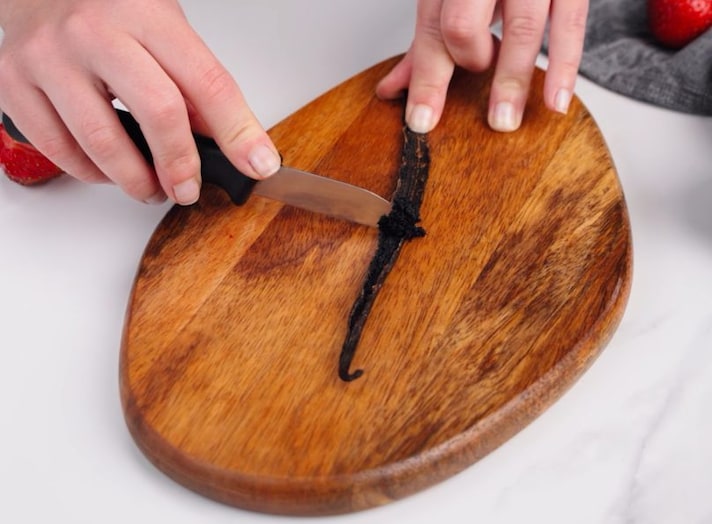
The process is simple: first, place the berry on a cutting board and, using the tip of a sharp knife, make a lengthwise incision. You don't need to cut it completely in half, just open it like a book. Then, using the back of the knife, scrape out the entire contents, collecting the seeds.
How to Use The Seeds
The advice is to do this when you're ready to add them directly to the mixture, without leaving them exposed to air, so as to preserve the full intensity of their aroma. They're perfect for adding that characteristic warm and enveloping note to custard, crème anglaise, panna cotta mixtures, puddings, semifreddos, and cake mixes, both baked (including shortcrust pastry for tarts and biscuits) and unbaked.
How to Use The Empty Pod
Don't throw away the pod, as it's an excellent ingredient for flavoring hot milk or cream (use one pod per liter), letting it steep for a few minutes and then removing it. Or, you can add sugar (such as vanilla powdered sugar) to the jar. If you're saving several vanilla pods, a creative way to recycle them is to dry them at a low temperature in the oven and blend them to obtain a very fine powder that lends a touch of extra flavor to desserts.
How to Store Vanilla Beans to Make Them Last Longer
Like all spices, vanilla needs to be stored properly to preserve its aroma. When purchased, the pods are often hermetically sealed inside a tall, narrow, cylindrical jar (similar to a test tube or vial), thus maximally concentrating the aroma in a small space. This is the ideal container: keep it closed, away from light, air, humidity, and heat sources. A typical kitchen pantry is the best place: vanilla can last for several months (up to a year), but the longer it stays, the more it tends to lose its fragrance and the pulp to dry out. For unopened packages, check the expiration date: it's recommended to keep it within two or three weeks of purchase.
Vanilla extract and vanillin are also available on the shelves, cheaper alternatives to the pod—which, remember, is the purest form of this spice—but they are not equivalent. A quick refresher may be helpful.
- Vanilla extract is a natural product with a viscous consistency and an amber color, obtained by macerating several pods in an alcoholic solution (it can also be made at home). It therefore contains the aromas of the spice and is often used in pastry making because it is practical and easy to measure.
- Vanillin, on the other hand, is the single molecule that reproduces the main aroma of vanilla. The clear liquid version found in supermarkets is synthetic (which is why it ‘s convenient), given that the demand for vanilla far exceeds the availability of pods: the result is a standard aroma, less nuanced and profound, which can become a good ally for baked goods, such as plum cakes, muffins, or soft cakes.
;Resize,width=767;)
