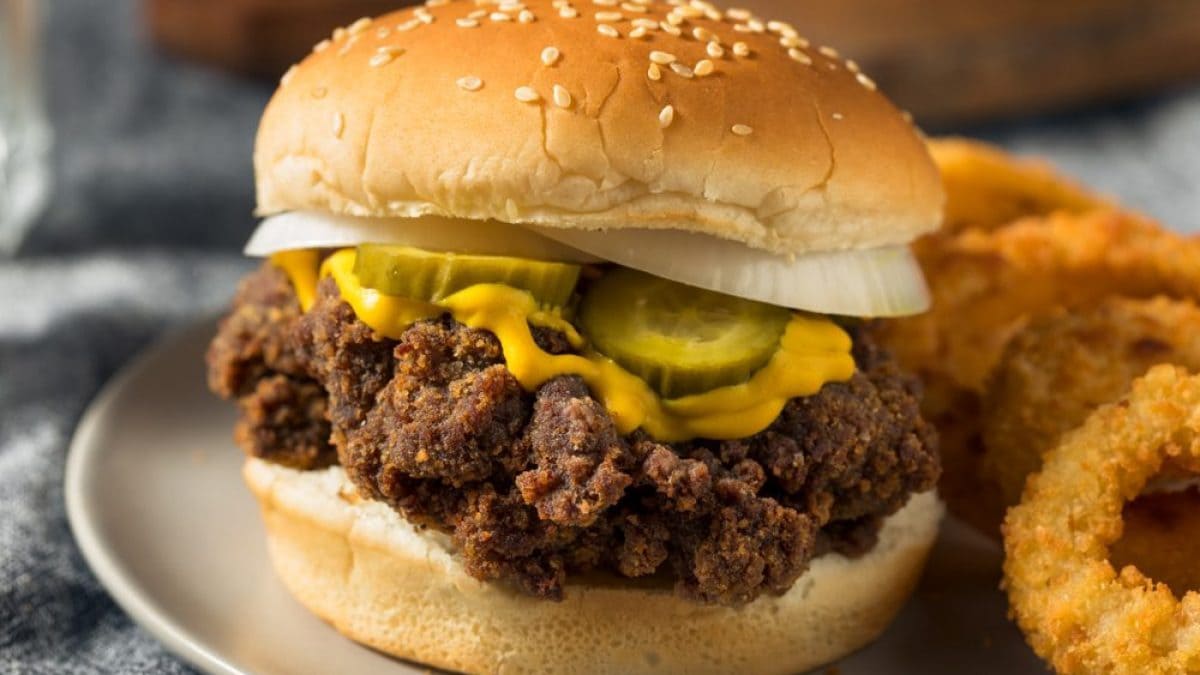
If you speak any English, you should know that "slug" means snail. Therefore, it wouldn't be wrong if, without knowing the slightest bit about what we're about to discuss, you thought a slugburger was a hamburger made with snails. As bizarre as it might seem—and perhaps super tasty for our French friends—slugburgers, unfortunately, have nothing to do with snails. In fact, they're a typical sandwich from Mississippi, in the Southern United States.
No Snails, But Lots of American History
The slugburger is deeply rooted in the hard times of the 1920s in America, the years that have gone down in history as the Great Depression. It actually originated at the beginning of the last century, but it was precisely during that period that it began to gain fame and celebrity. The curious name doesn't refer to the slimy, slithering creature itself; "slug" was slang for a five-cent coin, the so-called nickel, which was the original price of the sandwich.

Its invention is attributed to John Weeks, who, in 1917, brought his own recipe from Chicago to Corinth. This product was created to "stretch" meat when it was a precious luxury and few could afford it. Weeks asked local butchers, who wanted to reproduce his product, to mix potato flakes with ground beef. This created a mixture that could feed more people while using less meat. Initially called "Weeksburger," it quickly evolved into the slugburger, especially after the recipe became widespread and lost its direct connection to its creator's surname.
From a gastronomic perspective, the slugburger establishes itself as a practical solution: a smart way to spend less and feed more. The technique of meat-extending was not unique to Mississippi, but it found fertile ground here, becoming an integral part of local cuisines. Typical cooking is by frying, which is not a detail, but the heart of the recipe. The contrast with the modern hamburger is clear. While today the idea of the tall, juicy, and expensive bun dominates, the slugburger is the opposite: thin, basic, unpretentious. It doesn't focus entirely on the meat, but on the balance between texture and frying.
From The Drugstore Counter to Local Pop Culture
Over time, the slugburger has gone from being a simple, inexpensive meal to becoming a symbol of community identity. Since the late 1980s, the Slugburger Festival has been held every July in Corinth, celebrating this product with eating contests, street events, and appearances by local chefs. Today, however, this sandwich is a niche product compared to the (gastronomically epic) history of cheeseburgers and smash burgers. It can be found in small American diners, those 1950s-style restaurants, along the Tennessee Valley, especially in northeastern Mississippi, but also in neighboring areas of Alabama and Tennessee. The recipe can vary slightly: some use pork, others a blend of soy flour or nutritious grains, making it a vegan product much more similar to a croquette than a burger. Outside of the United States, it's primarily appreciated by aficionados of regional American cuisines or food history buffs.

