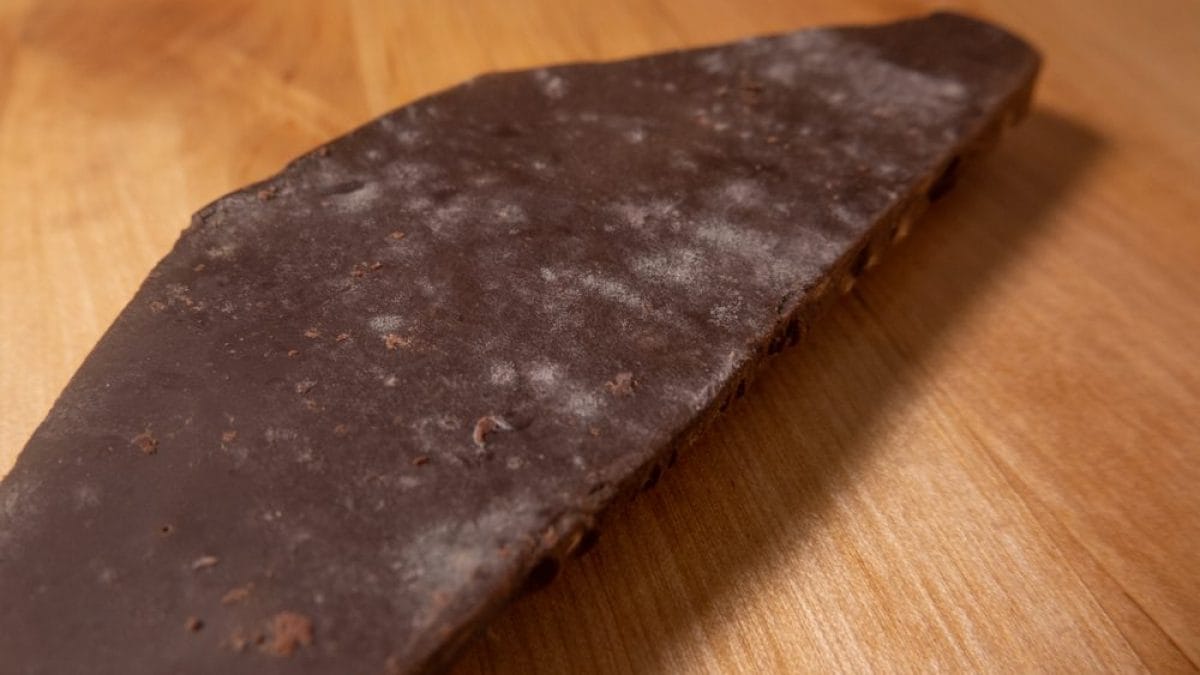
The correct term for it is bloom, and it manifests as a white-gray patina on the chocolate that at first glance may look like mold, but fortunately, it isn't. Our product is still perfectly edible and not dangerous to health: structurally, it has suffered damage that has resulted in an unattractive appearance. The shiny surface has become opaque, and in some cases, the consistency has also changed, tending towards grainy. Two basic ingredients of chocolate are affected — fats and sugars —present in every type, from bars to pralines. Let's see why this happens and how to avoid it.
Is It Safe to Eat Chocolate That Has Bloomed?
Sooner or later, it happens to everyone: you open a bar of chocolate you'd been putting aside and notice that the surface has become opaque, as if covered with a whitish patina that almost looks powdery. The effect is certainly not the most inviting, and the question immediately arises: is it still edible? The answer is yes: that change is not caused by mold. This alteration, which affects the structure of the chocolate and not its safety, is called bloom. It therefore leads to a product that is less aesthetically pleasing, slightly different in texture and flavor when eaten as is. Bloomed chocolate loses its natural shine and typical melt-in-your-mouth quality: you can consume it without any problems, preferring preparations in which it can be melted, such as creams and ganaches.
Why Does Chocolate Bloom?
Probably not everyone knows that the so-called white patina is actually not all the same, but rather two different phenomena can be distinguished based on their origin.
The most common is fat bloom, the "flowering" of fats, which occurs in particular when cocoa butter, the natural fat contained in chocolate, rises to the surface. The reasons can be many, but it happens above all when the chocolate undergoes sudden changes in temperature that separate its components. Similarly, other fatty parts such as those contained in hazelnut or other dried fruit fillings also give rise to the same migration towards the surface, forming the greyish-white patina. Furthermore, incorrect tempering during processing can cause fat bloom after just a few hours.
The second "blossoming," on the other hand, is that of the sugars, the sugar bloom, which is more closely linked to humidity. It occurs when chocolate stored in a cold, humid environment (for example, the refrigerator) comes into contact with a small amount of water that settles on the surface and dissolves the sugars present. When the chocolate returns to room temperature, the water evaporates and the sugars recrystallize, forming a rough, grainy patina. In this case, in addition to the opaque appearance, you may perceive an overall sandier sensation to the touch and taste.

Temperatures' Importance for Good Chocolate
Those with a keen memory (and passionate fans) will remember the "chocolate challenge" between Iginio Massari and Ernst Knam, which pitted the two masters against each other in their respective tempering techniques. Among the disagreements was the temperature at which the chocolate should be at the start of the process: 80/27 for the former and 71/22 for the latter. A difference of about 9-5 degrees which, however, would lead to opposite results. This is to say that the temperature in reference to chocolate is not a detail at all, but one of the main factors that determine the quality of the final product. Heating and cooling affect its structure: it is no coincidence, in fact, that tempering carried out according to the rules makes the chocolate crunchier and shinier, thanks to the crystallization of the cocoa butter, which becomes stable.
Once you've purchased chocolate, the best conditions for storing it are between 57°F/14°C and 64°F/18°C, and with humidity no higher than 50-55%. When the temperature rises above 68°F/20°C, the chocolate gradually begins to soften, with the melting point of cocoa butter falling between 86°F/30°C and 95°F/35°C, and it begins to deform. Cold temperatures also create problems: in the refrigerator (average humidity between 35-46°F/2-8°C), the humidity is high, and chocolate, being hygroscopic, tends to absorb it. When it returns to room temperature, condensation easily forms on the surface, with the effects seen previously in terms of sugar bloom.

How to Avoid Chocolate Bloom
From this we can understand that chocolate is a very delicate food and its preservation plays a key role. We have seen that the temperature is a detail that should not be underestimated: ideally it should remain stable between 57°F/14°C and 64°F/18°C. It must be stored away from sources of heat and direct light, preferably in a cupboard in the living room (and not in the kitchen, where temperature changes often occur between the oven and the stove), protected in its original packaging or in sealed plastic or glass containers, as chocolate tends to absorb external odors as well: keep it away from the air, but avoid wrapping it in materials that retain humidity, such as cling film. And in summer? How best to preserve it? In the heat, the refrigerator may become the only option, although it is not recommended: make sure it is well wrapped and when you take it out, let it acclimatize without opening it immediately. With these little precautions, the chocolate will maintain all its qualities for longer.
;Resize,width=767;)
