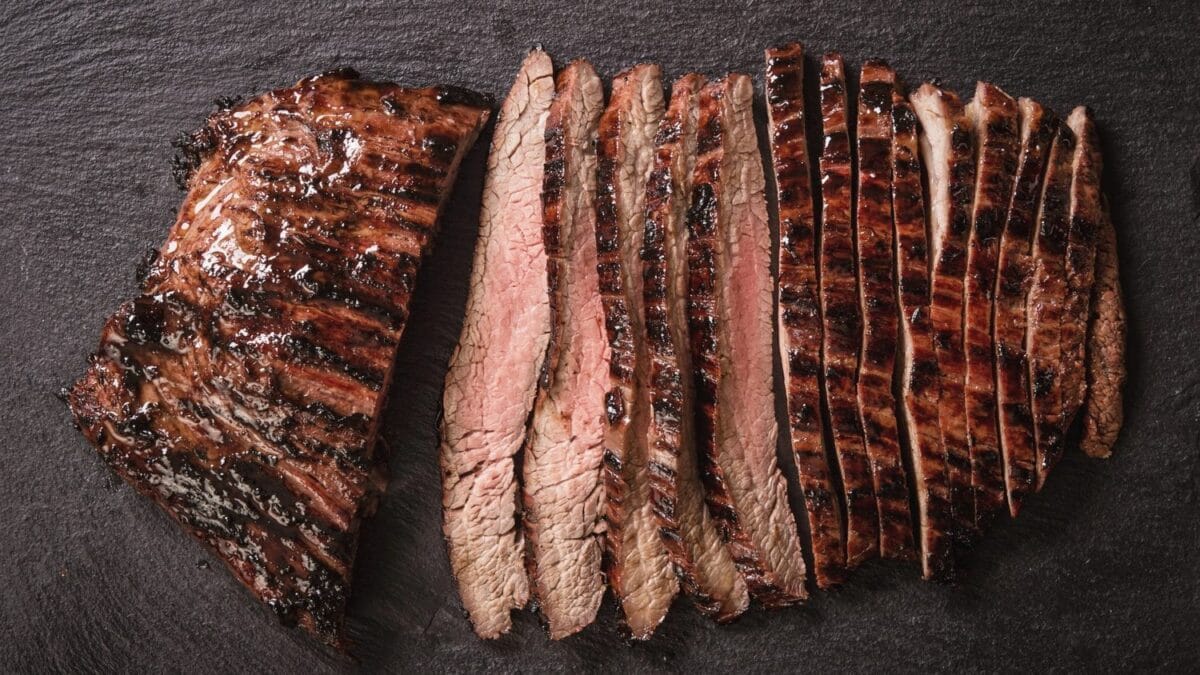
Flank steak has long been considered a second-best cut, better for the pot than for prominently displaying on a plate. Tradition dictates that it be opened out like a book and then stuffed, like a pocket, or rolled into a roulade and braised for hours, always hidden under something else. Over the years, we've added all the fat and seasoning it lacked, convinced that on its own it wasn't worth much.
In reality, it is a versatile and economical cut that, when cooked over a high flame and cut carefully, brings out a beef flavor so full it beats steaks costing three times as much.
It's true, flank has a rough edge because it's lean, comes from the lower part of the cow, and has very little fat to act as a safety net. But its weaknesses become strengths by applying three simple, always the same, steps: high heat, a few minutes on the stove, and cutting the right way. Once these steps are done, it becomes tender, juicy, and surprisingly fragrant.
Before lighting the barbecue, however, it's a good idea to know what we're buying: what this cut looks like, what part of the animal it comes from, and how to best cook it.
Where is Flank Steak Found and How Is It Made?
Flank comes from the abdominal region of the bovine, the area that supports the animal's viscera. It's a hard-working muscle, a condition that determines two main characteristics: intense flavor and a certain underlying toughness. At the counter, you can immediately recognize it because it's long, flat, and paddle-shaped, with a very pronounced grain: the fibers run clearly visible along the entire length of the piece, all parallel. That striation, however, isn't just an aesthetic detail, but the most valuable clue the cut offers, as it reveals the direction in which it should be sliced once cooked.

As for its texture, this is a lean meat: the marbling (fat infiltration into the muscle fibers) is minimal compared to back cuts, and juiciness depends almost entirely on the cook's skill. It contains a good amount of collagen (the protein that makes up connective tissue and holds muscle bundles together), which, when cooked quickly, doesn't have time to dissolve into gelatin, making the meat difficult to chew. The solution, as we'll see, isn't lengthy cooking but rather thin slices cut perpendicular to the grain.
One last thing about color: flank tends to be a darker, more intense red because it's a muscle that works hard. The more active muscles are richer in myoglobin, the pigment that gives meat its color.
Our "American-style" flank steak doesn't exist in the rest of the world: it's a cut common in Anglo-Saxon countries, where butchers cut the sides —that is, the two halves—following a completely different diagram than our artisans.
The most useful difference to know is between large bavette and low bavette (bavette de flanchet, belly flap in the French school). Large bavette corresponds to flap meat, which is taken from the hindquarter and is wider with a softer, more yielding grain; in France it's called bavette d'aloyau, in Latin America vacío. Low bavette, on the other hand, corresponds to flank steak, which is narrower and has a long, well-defined grain. They are two similar cuts, cooked in a similar way and often mistaken for each other, but flap is more tender, while flank requires some further processing.

In English, it becomes simpler: this specific muscle section is called flank steak or jiffy steak (particularly in the Midwest and Southern United States).
Another misunderstanding concerns the names the cut goes by in Latin America. Mexicans call it arrachera, Argentinians entraña, but these two terms actually refer to skirt steak, which is a different cut. Bavetta is often used in fajitas (grilled strips of meat with peppers and onions rolled in tortillas), where flank replaces skirt because it is easier to find.
How to Cook Flank Steak
Here, high heat and short cooking times are required, along with a center that remains pink and, immediately after, a perfectly executed cut of the meat. Before even choosing the method, however, there are two tips that always apply and that make a difference to the final result.
The first: flank steak tastes best if brought to room temperature before cooking. The second, even more important, is to rely on a probe thermometer. It's a thin cut in some places, and judging by eye (or by time) is risky. Even relying on sight can be misleading: when first sliced, the meat may seem rawer than it is, because myoglobin quickly changes color when exposed to air.
Grilled With Teriyaki
The grill is the natural environment for flank, and the most classic preparation is teriyaki style, which combines marinating and finishing with the same sauce. The preferred technique is flip & brush, but before getting there, it's important to clarify what type of fire we're working with.
We're talking about direct cooking in a lidded grill: the meat sits on the grill directly above the heat source—the coals or a lit burner—and is hit by radiation, convection, and conduction, without any shields. It's important, however, to occasionally move the steak to indirect mode, where the meat sits to the side of the coals and heats in the convective air of the closed lid, like in an oven.
For a cut like flank, direct cooking is a must: you need an intense, immediate dose of heat that builds the crust before the inside is overdone. Arrange the fire in two zones: one side of the brazier with a thick, hot layer of embers, where the meat really cooks, and a cooler area, without embers underneath, to use as a refuge in case of flare-ups or to manage a piece that browns too quickly. With charcoal, aim for a very hot grill, with a surface temperature around 390-500°F/200–260°C: the reliable way to check this is with an infrared grill thermometer, much more effective than the old psychic test with your hand suspended over the grate.
Before lighting, take a minute to clean the piece. At the end of the muscle is a thin connective tissue membrane, the silverskin, which is best removed by sliding the blade just underneath.
As for the marinade, basic teriyaki has just three ingredients—soy sauce, mirin (a liquid seasoning made from fermented rice), and sugar—but you can enhance it with sake, grated ginger, and garlic. Make two versions: a more liquid one in which you soak the meat for a few hours, preferably overnight, and a finishing one, which you reduce over a low heat until it becomes syrupy and glossy.

When ready to cook, drain the flank, dry it thoroughly (a film of water on the surface slows the Maillard reaction, i.e., browning) and brush it with a drizzle of extra virgin olive oil. Place it on the hot grill and begin turning it frequently, approximately every thirty seconds. Constant flipping is not a whim: it keeps both sides at a more uniform temperature, prevents the heat gradient from concentrating all the contraction of the fibers on one side and causing the piece to warp, and distributes the browning evenly without the classic burnt streaks (grill marks).
The finishing sauce comes into play only after the surface has already developed color and a crust: from that point on, brush the teriyaki syrup on each turn. Stay alert because the sugars in the sauce caramelize at much lower temperatures than those reached by direct grilling, and go from amber to charred in a matter of seconds, releasing a bitter flavor. If you see any flames flare up, move the piece to the safety zone (as it's called in technical jargon) for a few seconds and then return it to the hot grill. Two or three brush strokes of sauce, constantly turning, are enough to obtain a dark, lacquered, and fragrant crust.
The degree of doneness remains the critical point. Like all thick-grained cuts, flank steak performs best within a narrow range, around 129-134°F/54-57°C at the core, between rare and medium. Below 129°F/54°C the fibers remain rubbery, above 140°F/60°C the muscular contraction squeezes out the juices and the meat dries out. On such a thin piece, it's easy to overcook, so work with an instant-read thermometer, insert the probe sideways to the geometric center and remove from the heat two or three degrees before the target, because the temperatures continue to rise even during the rest period.
In the Pan, at Home
A grill isn't essential: flank steak cooks very well in a pan, as long as it's very hot and not too crowded. There's a little trick to keep in mind, as the piece is quite long and tends to curl and be awkward to handle in the pan. It's best to divide it before cooking, following the grain (preferably into two or three more manageable pieces), and cook them one at a time.
Here too, high heat and short cooking times are key, with the meat dry and lightly oiled to encourage the formation of a "crust." If one end is thicker than the other, you can even it out by gently tapping it with a special tool or using the bottom of a heavy pan: a uniform thickness ensures even cooking and prevents one side from drying out while the other is still raw.
What The Marinade Really Does (And Alternatives to Teriyaki)
We've seen teriyaki in action, but it's worth clarifying what a marinade does (and doesn't) do for this cut, because there are a lot of half-truths floating around. Let's start with the basics: the primary purpose of a marinade is to flavor, not tenderize. The herbs, in fact, only penetrate the meat a few millimeters, even after a night in the refrigerator. And it's precisely the broad grain of the flank, with the spaces it leaves between the bundles, that retains the aromatic liquids well; hence the (correct) idea that this meat is made specifically for marinating.
And what about tenderness? A distinction must be made. The most common acidic marinades (those based on wine, for example) have very little effect on the structure of the meat, because their pH is not low enough and the action stops at the surface. The real tenderizers are the enzymes in certain fruits: bromelain from pineapple, papain from papaya, actinidin from kiwi, all substances capable of actually degrading collagen. Be careful, though, because they are also the most insidious: they work especially with heat (bromelain is truly activated only above 120/50 degrees, therefore during cooking) and if you overdo the doses or the times, you risk ending up with flaky meat , almost reduced to mush. It's also worth remembering that the effect is only achieved with fresh fruit: in pasteurized or canned juice, the enzymes are now inactive, deactivated by the heat of processing.
The rule of thumb, then, is simple: if your flank is good quality and well-aged, it doesn't need to be tenderized, and the marinade only adds flavor (even an hour is enough). In all other cases, don't marinate it too long, as you risk ruining it, especially if you use ingredients that are highly acidic and rich in enzymes.
How to Cut It
There's one rule with flank that allows no exceptions: it must be sliced thinly and perpendicular to the grain. Cutting against the grain shortens the muscle fibers and connective tissue, making them less durable when biting into. Instrumental tests have shown that the same flank, cut against the grain, requires about a quarter of the chewing force compared to one cut the wrong way. Thin slices, about half a centimeter thick, with the blade cutting through the grain at a right angle: prepared this way, flank truly rivals much more prestigious cuts. Before slicing, let it rest for a few minutes, long enough for the juices to redistribute and not spill onto the cutting board.

How to Serve It at The Table
In its teriyaki version, flank traditionally calls for a bed of rice, a generous dollop of salsa, some chopped fresh chili pepper, and spring onion. But its ideal terrain, with its direct flavor and the convenience of thin slices, is Tex-Mex cuisine: it becomes the ideal filling for tacos and fajitas, along with beans, lettuce, julienned raw bell pepper, and jalapeño pepper. If you prefer something more modest, a simple slice with salad or baked potatoes will also do justice to the cut.

Differences With Similar Cuts
Flank is part of the flank family of cuts, a group of thin, flavorful, long-fibered muscles that are often confused. Knowing the differences helps you choose the right one and avoid being caught unprepared at the counter.
The closest relative, as we've said, is the large bavetta, or flap meat. It comes from a different section of the side carcass, the hindquarter rather than the flank's abdomen, but the flavor is just as beefy, sweet and almost mineral, with a naturally softer and more yielding grain. It's broad and rough, ideal for holding marinades, and can withstand a slightly more cooked heart than the flank.
Skirt steak corresponds to diaphragm (or false diaphragm, depending on the portion). It's the fattiest and butteriest of the bunch, with an even coarser grain than flank steak and a particularly rich flavor. Precisely because of its fat content, it's the original choice for Mexican fajitas and holds up beautifully to extremely high temperatures for a very short time. Compared to flank steak, it's narrower and the grain runs crosswise: this is the easiest way to tell the two apart at a glance.

Hanger steak, also known as loin steak, isn't the outer layer of the diaphragm like the skirt, but the central pillar that anchors it to the spine, near the kidney: a part that works less and therefore remains more tender. It has a wide, visible grain, making it perfect for marinades, and an intensely beefy flavor , among the most robust you'll find. Its shape makes it a little more difficult to cook evenly, and it performs best when medium rare.
Bottom line: the skirt steak focuses on fat and a buttery note, the hanger steak on a deep, almost ferrous flavor, while the flank steak is the most balanced and lean of all. Cleaner, less greasy, with a broad, flat shape that makes it easy to slice and serve, it's also the easiest to handle.
How to Choose a Flank Steak From The Butcher
The yield of flank depends almost entirely on the quality of the cut and its aging: it's a lean meat, with little fat to protect it during cooking. Here's what to look for to choose the best one:
- Color: Bright, vibrant red, even quite intense given the nature of the muscle. Be wary of dull, grayish, or overly dark areas, which are a sign of poorly preserved meat.
- Grain. This is the cut's identifying feature: the grains should be long, parallel, and clearly visible along the entire length of the piece. Observing them raw is also useful later, as it predicts the direction in which the meat will be sliced after cooking.
- Fat. Since it's a lean cut, don't expect thick marbling. A few veins here and there, however, are a good sign, as they add flavor and juiciness. The more heavily marbled cuts, typical of prized breeds, are even better: on a lean meat like this, the extra fat is definitely noticeable.
- Aging. On such a lean and tough piece, aging is crucial, as it softens the fibers and concentrates the flavor. A poorly aged cut is obvious at first bite, so asking the butcher how many days the meat has been aged is always a good idea.
- Smell: Neutral and slightly ferrous, never acidic. Any pungent note is a warning sign.

It's also worth investigating the origin and breed, because on a lean cut like this, marbling makes a huge difference, much more so than on an already fatty cut. The breeds that produce a richer, juicier flank are those with dense marbling: Wagyu (Japanese beef, where the infiltrated fat can overflow the lean portion) first and foremost, followed by American and Australian Black Angus, selected specifically for their abundant marbling. On a fibrous cut like flank, they're often the most rewarding choice, as the internal fat offsets the leanness of the muscle.
Lean, flavorful breeds – the Chianina used for Florentine steak, the Piemontese with its pronounced muscular hypertrophy, or foreign breeds like the Hereford from Anglo-Saxon countries – instead offer a flank with a drier, more direct flavor, excellent when marinated and cooked rare or medium rare.
;Resize,width=767;)
