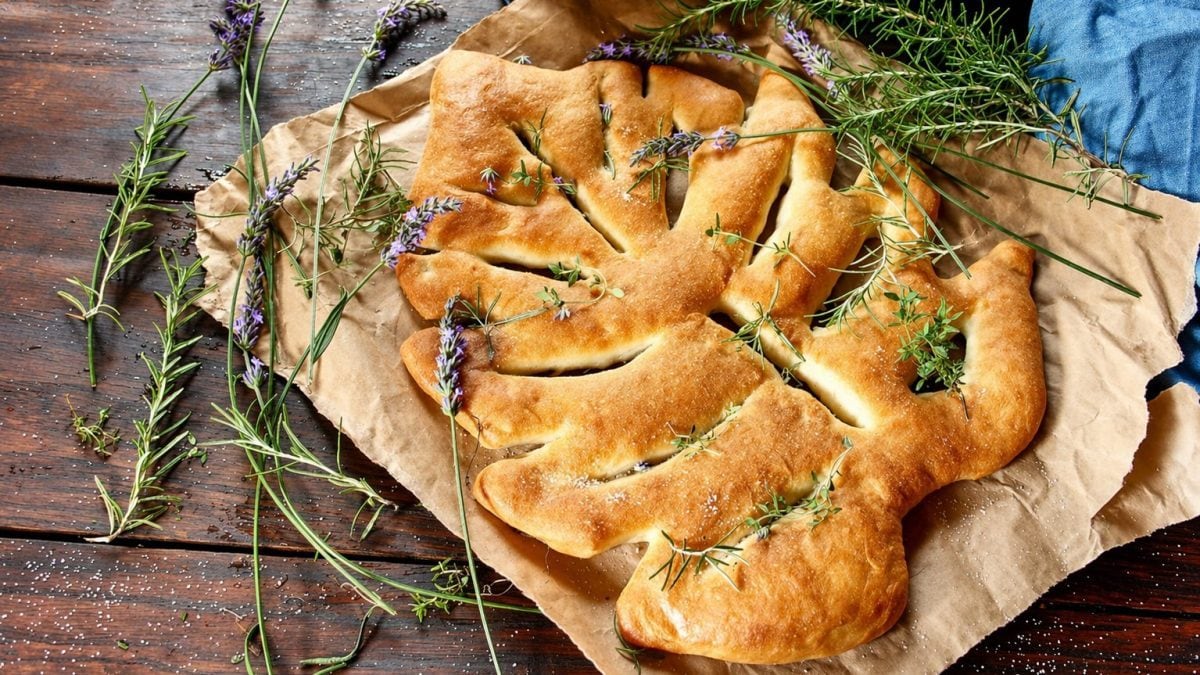
In the U.S., olive oil flatbread is a recipe deeply rooted in the local cuisine of many states. Yet, while the art of leavened products is a source of true pride for gastronomy, we are not the only ones to have transformed it into a cultural identity: France is a true master in the field of artisanal bread and leavened products, both sweet and savory. The art of French boulangerie is famous throughout the world with iconic products such as the baguette, croissants, and pain au chocolat, but it also boasts many other lesser-known but equally delicious preparations.
This is the case of fougasse, a leavened bread halfway between bread and focaccia, especially popular in Provence, where the original recipe originated. The distinctive feature of fougasse is the decorative motif adorning its shape, a series of cuts on the surface resembling a leaf or an ear of wheat. Today, it is offered in numerous variations, both savory and sweet, sometimes even stuffed. Let's learn more about fougasse, its origins, and its evolution.
What is Fougasse and Where Does It Come From?
Fougasse is a typical flatbread from Provence, in the south of France, similar in concept to the Italian focaccia: it's made from a dough made of flour, water, yeast, and olive oil. It's crispy on the outside and soft on the inside, but compared to our focaccia, which tends to be very thick and soft, it's thinner and crispier. The characteristic that most distinguishes fougasse from all other similar recipes is its shape, which resembles a leaf or an ear of wheat, obtained by making deep cuts in the leavened dough before baking.

Originally a test bread for bakers, this Provençal specialty served to test the oven temperature before baking the loaves that were then destined for sale. Over time, fougasse has become a recipe in its own right. Provençal tradition also attributes symbolic and ritual value to fougasse: in some festive variations, such as those for Christmas, it was shared by breaking it by hand, a gesture that represented community and prosperity. It is a convivial food, served as a table bread, as an appetizer, or as a snack, and for this very reason it has evolved into heavily stuffed versions, enriched with olives, lard, herbs, cheeses, or, in sweet versions, with flavors such as orange blossom.
Today it is considered one of the most representative expressions of Provençal gastronomic culture, so appreciated that it has spread well beyond the borders of Provence: it is quite common to find it also in the nearby Languedoc-Roussillon region, even if here in its dough they use duck “grattons”, that is, fried residues of fat and meat, but its presence reaches as far as the Pyrenees and even in Algeria, where it is served with a spiced filling based on vegetables and “ras el-hanout”, a mixture of around 30 different plants common throughout the Maghreb.
How is Fougasse Made
Technically speaking, fougasse is a leavened bread made with a simple dough composed primarily of soft wheat flour, water, yeast, salt, and extra virgin olive oil. The dough is kneaded until it reaches a smooth and elastic consistency, then left to rise for a long time to develop a soft yet slightly firm structure. Once ready, it is rolled out by hand without deflating it too much, maintaining a relatively thin thickness. It can be enriched directly in the dough or on top with typical Mediterranean ingredients such as olives, aromatic herbs, or anchovies.

The most distinctive element is its decorative shape: the fougasse is shaped to evoke a leaf or an ear of wheat, symbols linked to Mediterranean agricultural culture, and is scored with clean, deep cuts on the surface of the dough, arranged symmetrically along a central axis to accentuate the resemblance. The cuts undoubtedly have an aesthetic function, but they are also useful on a practical level: during leavening and baking, they open up, allowing heat to distribute evenly and creating the typical airy, crispy structure that characterizes focaccia. It is essential that the incisions are clear and well-spaced, because cuts that are too shallow tend to close up during leavening, compromising both the appearance and the final texture. The final result, once baked, is a focaccia with a golden, fragrant crust but a softer, fluffier interior, creating a pleasant contrast of textures when bitten into.
Sweet and Savory Variations of Fougasse
A popular and widely distributed recipe like fougasse could only have inspired the birth of countless variations. Over the years, many enriched versions of the Provençal focaccia have emerged, starting with the classic base and then varying with the addition of other ingredients, either incorporated into the dough or as a filling; there have even been special versions of sweet fougasse, less common but still found in some bakeries.

The most popular fougasse variation is enriched with Provençal olives and local aromatic herbs, especially rosemary, thyme, and oregano: the result is a focaccia with characteristic Mediterranean flavors, so delicious that it is now as popular as the original fougasse. A typical variation from coastal villages is fougasse with anchovies, where anchovy fillets are incorporated into the dough or arranged on top before baking, creating a contrast between saltiness and softness. Other versions include the addition of local cheeses, such as Gruyère or Tomme de Provence, or ingredients like caramelized onions, dried tomatoes, or bell peppers, which enhance both the flavor and color of the bread.
Sweet fougasse, though less well-known, have a long tradition, especially during the holidays or as a snack. Honey fougasse is one of the simplest versions, in which the lightly sweetened dough is brushed with honey or sugar before baking, while the almond or hazelnut fougasse is more elaborate, using chopped dried fruit in the dough or on top, sometimes further enriched with candied citrus peel. A very characteristic variation is the fruit fougasse, typical of Provençal villages, where the ear of corn or leaf decoration is completed with a sprinkling of sugar or small cuts that highlight the fruity filling. Also particularly popular is the sweet fougasse from Aigues-Mortes, a typical Christmas specialty flavored with orange blossom water and covered in butter and caramelized sugar.
In addition to the traditional versions and the more well-known variations, every village or family in Provence may have its own "secret recipe" for fougasse, so it's quite common to travel through the region's villages, enter a local boulangerie, and find a version of this focaccia unique to that particular context. Furthermore, in recent years, fougasse has also become a creative product in modern bakeries, where it's common to find it served with gourmet fillings like tapenade, mushrooms, or pesto, while still retaining its decorative leaf or ear-of-ear shape, a hallmark of its visual identity.

How to Prepare and Serve Fougasse
Making Provençal fougasse requires little effort, but a great deal of patience to ensure the leavening process is completed correctly and yields the best results. The first step is to dissolve the yeast in warm water and let it rest for about half an hour to activate it. Only then are flour, salt, and oil added. The dough is kneaded in a large bowl until it reaches a smooth and elastic consistency. It then needs to rest for at least two hours so it can rise and double in volume.
Once the leavening phase is complete, the dough is rolled out until quite thin, shaped into the characteristic decorative leaf or ear of wheat shape, and then scored with traditional cuts that allow the focaccia to take on its characteristic appearance, but also to develop during baking and take on its classic airy texture. Before baking, the surface can be brushed with olive oil and enriched with additional ingredients, depending on the chosen variant. Then it is baked: traditionally, it is done in a wood-fired oven, to achieve the perfect crust consistency, but alternatively, it can be baked in a preheated domestic oven at a high temperature.
Once ready, fougasse is eaten while still warm, broken up by hand as per Provençal tradition. It's an excellent table bread, but thanks to its versatility, it can be filled as a sandwich. It's also a delicious snack eaten on its own, and it's the ideal appetizer to serve as an aperitif, especially when paired with cured meats, cheeses, preserves, olives, and tomatoes in oil.

