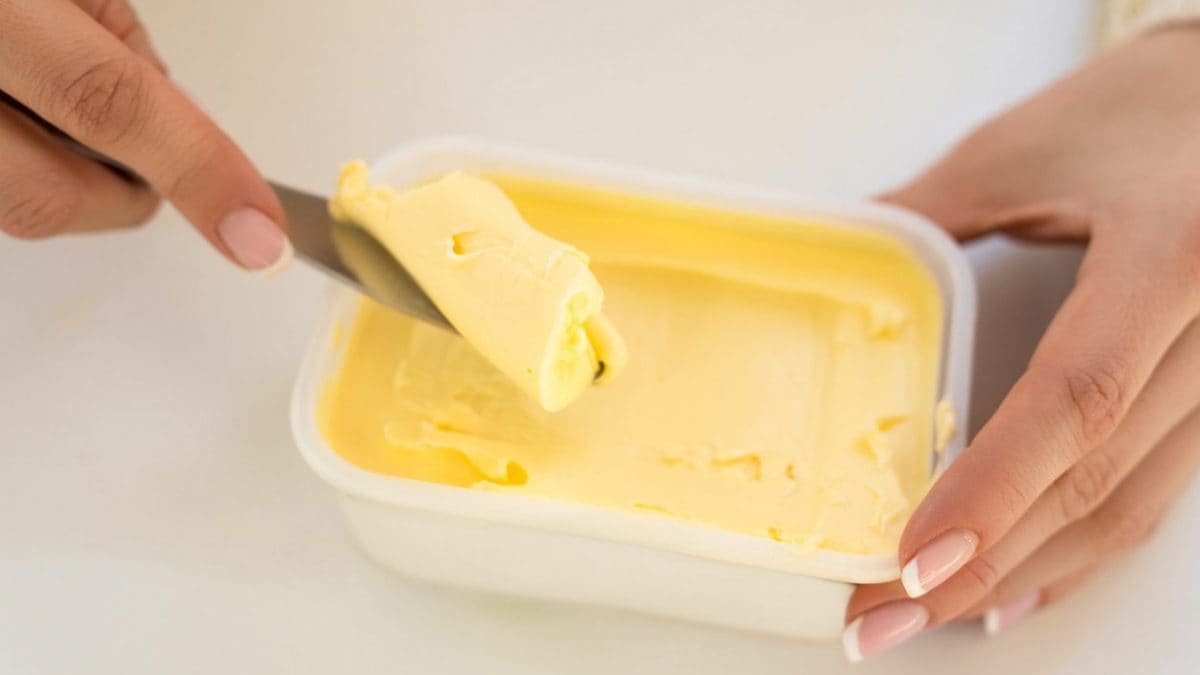
Margarine is a plant-based product used both in home cooking and in the food industry. It is a versatile food that is generally cheaper than butter, of which it is probably the best-known alternative among cooking fats. Its shelf life has seen mixed fortunes, with a period of great popularity in the 1980s and 1990s followed by a veritable demonization due to medical and scientific discoveries that demonstrated its potential health risks, particularly for the cardiovascular system. In recent years, thanks to a different processing method, margarine is once again gaining popularity in grocery stores, also thanks to the increased demand for foods that are not derived from animals. Let's take a look back and see what it is, how it is produced, and why it remains a choice to be carefully considered when purchasing.
What is Margarine and How is It Made?
Margarine is a solid emulsion composed primarily of vegetable oils and fats (they can be a mixture, or used individually, of sunflower, peanut, rapeseed, soybean, corn germ, coconut, shea, and other oils) and water. Additives are added to stabilize its consistency, impart its organoleptic properties, and ensure its long-lasting shelf life. It is not a natural food like butter, but is derived from an industrial chemical process that gives it its unique characteristics: creaminess, ease of spreading and incorporating into dough, affordability, and shelf life. Its invention dates back to the 19th century, when French pharmacist Hippolyte Mège-Mouriès developed it in response to a competition announced by Napoleon III to provide the French navy with a cheaper and more durable butter substitute.

Traditionally, margarine production involved a process called fat hydrogenation, patented in 1902 by German chemist Wilhelm Normann: unsaturated (liquid) fats were partially saturated, giving them a "buttery" consistency. The problem is that this led to the formation of so-called trans fats, which cause an increase in bad cholesterol (LDL) and a relative decrease in good cholesterol (HDL), responsible for the possible development of cardiovascular diseases, even serious ones. Nowadays, these types of margarines (almost) no longer exist, replaced by those obtained from the fractionation of vegetable oils: a physical process that involves the use of temperature, with a heating and then cooling phase, and pressing, in order to separate the liquid portion from the solid portion, eliminating chemicals such as hydrogen, which alter the very structure of the fats.
Properties and Uses in The Kitchen
In the culinary world, margarine is prized for its ability to lend softness to preparations. It is used in the production of biscuits, cakes, and croissants because it mixes easily with other ingredients and maintains a stable consistency at different temperatures. Being plant-based, it is cholesterol-free, a characteristic that initially made it popular as a "healthier" alternative to butter. But this is not the case: 100% plant-based margarines contain 84% fat, and a 10-gram serving contains a whopping 8 mg of sodium — salt intake should be limited —and negligible amounts of minerals and vitamins. Meanwhile, high-quality butter, on the other hand, absorbs the beneficial properties of the milk from which it is derived. Important: margarines are not the same, and there are commercially available versions enriched with fat-soluble vitamins, fiber, and omega-3 fats, additions that are often advertised on the packaging as improving the product.

Why It's Best to Avoid Margarine
The answer to this question is clear when it comes to margarines made through the hydrogenation of fats, as their harmfulness has been confirmed. Despite this, even non-hydrogenated varieties present some disadvantages due to the raw materials used and their processing: often, unhealthy oils are used that degrade further when subjected to high temperatures. The product you're looking at is therefore purely functional, but has no nutritional value. From this point of view, reading the label can be helpful, especially for those who suffer from gluten and lactose intolerance, since margarine can be subject to contamination during the production process: more frequently in margarine intended for industrial use, it is mixed with oils of animal origin, such as fish oil, making it an unfeasible option for those following a vegan or vegetarian diet.
;Resize,width=767;)
