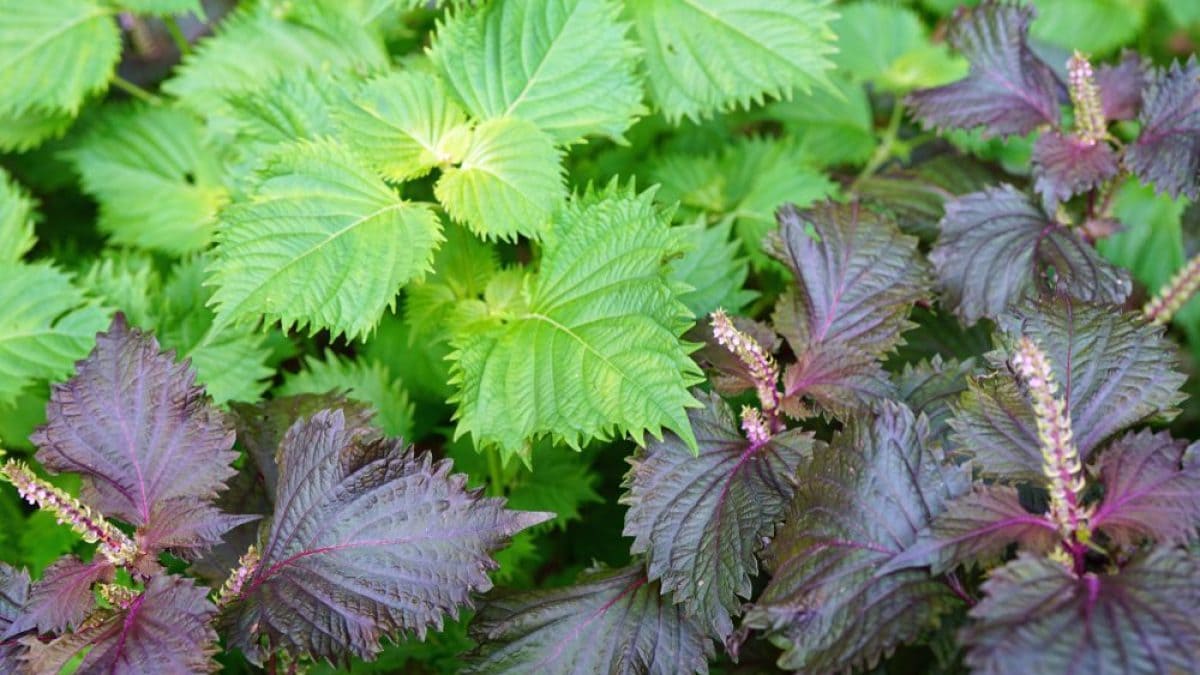
The world of medicinal plants is rich, varied, and never ceases to amaze us: in addition to the most widespread species, there are many typical of specific parts of the world that have not reached the West. One of the most surprising species is shiso, also known as "Chinese basil" or "Japanese basil." It is a unique medicinal plant native to East Asia with an intoxicating aroma and an extraordinary flavor, reminiscent of a mix of mint, anise, lemon balm, and cinnamon.
There are two main varieties of shiso used in cooking: green shiso, which has a fresher, lighter flavor, and red or purple shiso, which is slightly more bitter and often used as a natural coloring. Both varieties can add a special touch to many dishes and are also particularly beneficial, having been used for millennia in Chinese medicine as a natural remedy. Let's learn more about shiso, the characteristics of each variety, and the best ways to use it in cooking.
Origins and History of Shiso, "Chinese Basil"
Shiso, whose botanical name is Perilla frutescens (which is why it is often called “perilla”), is an annual aromatic herb native to East Asia, known as “Chinese basil” or “Japanese basil.” It is not actually a variety of basil, but it has several things in common with our beloved medicinal plant, starting with the family, Lamiaceae. Cultivated for millennia in China and Japan, but also in Korea, India, and Vietnam, shiso is one of the most characteristic aromatic herbs of East Asia. The history of shiso is much older than one might imagine. Scholars believe it is native to the mountainous regions of China and the Himalayan area, where it grew spontaneously thousands of years ago. Some archaeobotanical research suggests that it was cultivated at least 4,000-5,000 years ago, initially not so much as an aromatic herb as as an oil plant. Perilla seeds, in fact, are extremely rich in vegetable oil and were a valuable food source in East Asian agricultural societies. Even before being appreciated in cooking, the plant was used to obtain an oil for food, lighting, and the preparation of traditional medicines. For millennia, shiso has been a cornerstone of traditional Chinese medicine due to its numerous beneficial properties.

Over time, its cultivation spread from China to the Korean peninsula and Japan, following the same cultural paths that also brought rice, tea, and numerous other food plants. It was in Japan that shiso acquired the gastronomic role for which it is famous today, beyond the Japanese name by which it is primarily known. The term "shiso," in fact, derives from the Japanese pronunciation of the Chinese characters that indicated the medicinal plant. The plant began to be systematically cultivated in Japan as early as the 8th and 9th centuries, during the Heian period, and over the centuries, its use expanded until it became one of the fundamental flavors of Japanese cuisine. Shiso is also a very beautiful plant, which is why it is often planted in gardens, even for ornamental purposes. Between 50 centimeters and one meter tall, it develops large, serrated, and slightly crinkled leaves, very similar in shape to those of the nettle, but soft to the touch and free of stinging hairs. The shiso plant exists in two main varieties: the green-leaved variety, which is more delicate and fresh, and the red-purple-leaved variety, which has a more intense and spicy flavor.
What Does Shiso Taste Like?
What makes shiso so special is its truly unique aromatic composition, so varied that describing its flavor is difficult. The leaves contain numerous essential oils, including perillaldehyde, limonene, and other volatile compounds that vary significantly from one variety to another. It is precisely this blend of substances that creates an aroma and flavor that has no real equivalent in Western cuisine: fresh like mint, citrusy like bergamot, spicy like anise, and slightly peppery, but with an absolutely original personality.
Because of its great aromatic complexity, shiso is often compared to basil, mint, and anise: its leaves contain odorous molecules reminiscent of those found in these herbs, although they don't exactly match any of them. It recalls basil's herbaceous freshness and the aromatic character typical of plants from the Lamiaceae family, but while basil has a sweet, Mediterranean aroma, shiso is more pungent, citrusy, and spicy. It is associated with mint for the refreshing sensation it leaves in the mouth, but it has a more delicate, balsamic note than peppermint. It also recalls some sweet and slightly spicy nuances of anise, due to the presence of particular aromatic compounds, but it lacks the same strong licorice flavor.

Experts also recognize citrus notes in shiso, similar to lemon or mandarin, and a subtle hint of cinnamon, cumin, or pepper, especially in red varieties. For this reason, some describe shiso as a "multifaceted" herb, capable of changing slightly depending on the variety, the ripeness of the leaves, and even the way it is consumed (raw, fried, pickled, or dried).
Shiso's Different Varieties and Their Characteristics
Shiso is easily recognized by its large, oval or heart-shaped, serrated leaves: they somewhat resemble those of nettles and are quite thick and wrinkled. Shiso varieties are distinguished primarily by the color of their leaves, which influences not only the plant's appearance but also its aromatic profile and culinary uses. There are several types of shiso, but the most well-known and widespread are two: green shiso and red shiso. Both belong to the Perilla frutescens species but have different appearances and organoleptic properties.
Green shiso, known in Japan as aojiso, is the most common variety and the one most used in everyday cooking. Its leaves are bright green, soft, and slightly serrated. The flavor is fresh, lively, and complex: herbaceous notes reminiscent of basil emerge, along with a light balsamic freshness similar to mint and citrus nuances reminiscent of lemon or mandarin. Because of this light aroma, it is mainly consumed fresh, as an accompaniment to sashimi, in sushi, in salads, in tempura, or as a wrap for fish and meat. It is added to many dishes to refresh the palate and balance rich or fatty ingredients.

Red shiso, called akajiso, has purplish-red leaves due to the high concentration of anthocyanins, the same natural pigments found in berries, black grapes, and red cabbage. Its aroma is generally more intense than the green variety: it retains the herbaceous component, but develops spicier, slightly peppery nuances with a slightly bitter finish. The most famous use of red shiso is in the production of umeboshi, the traditional Japanese fermented plums: the leaves, added during fermentation, not only enrich the product with their aroma, but also release the anthocyanins that give the plums their characteristic deep red color. The same principle is exploited to naturally color pickles, flavored vinegars, beverages, and some traditional sweets.

There are also numerous local varieties and cultivars selected over the centuries, which differ in leaf size, intensity of fragrance, color, and essential oil content. In Korea, for example, cultivars with larger, thicker leaves are widespread, particularly suitable for stuffing or as a wrapping for rice and meat. Some varieties have bicolored leaves, green on the upper surface and reddish on the lower surface, or with intermediate purple hues. From a nutritional standpoint, all varieties of shiso share many of the same beneficial properties: it is a plant rich in vitamins (especially vitamin C), contains various mineral salts (especially iron), flavonoids, polyphenols, and essential oils. Specifically, red shiso contains higher quantities of anthocyanins, while green shiso tends to be richer in aromatic compounds. Because of all this, shiso is still used today in traditional Chinese medicine to aid digestion and provide relief from coughs, asthma, and sore throats due to its expectorant action.

How to Use Shiso in Cooking, From Japanese Gastronomy to Contemporary Dishes
Shiso, both green and red, is an essential ingredient in Japanese cuisine. Green shiso is the most common variety and, thanks to its fresh, balsamic flavor, is primarily used raw. Whole leaves, in addition to decorating dishes, are used as a natural divider and as an aromatic base on which to place fish in recipes like sushi and sashimi: chewing a leaf along with the rest of the ingredients helps refresh the palate and enhances the flavors of the sea. Finely chopped, shiso lends an irresistible aromatic note to the meat fillings of Chinese (jiaozi) or Japanese (gyoza) ravioli and chicken meatballs (tsukune), and is often added to cooked rice, seasoned with a drizzle of sesame oil and seeds, to be eaten as a side dish or to make classic onigiri. In Korea, where the plant is known as kkaennip, the leaves are eaten raw, marinated in soy sauce, grilled, or used to wrap rice and meat during meals.

Red shiso, on the other hand, is mainly used in preserved dishes. It is famous for its use in the production of umeboshi, fermented Japanese plums, to which it gives their characteristic deep red color and a spicy aroma. It is also used as a natural coloring agent to dye ginger, daikon, and other pickled vegetables (tsukemono), or the leaves are boiled with sugar and vinegar to create a refreshing, tart syrup, ideal for diluting with mineral water.

Over the past twenty years, shiso has also conquered Europe and North America, initially thanks to the spread of Japanese cuisine and, subsequently, through haute cuisine. Many chefs use it as an original alternative to basil or mint, taking advantage of its complex aromatic profile in fish dishes, tartare, salads, cocktails, and desserts. It's not yet a very common ingredient, but if you happen to have it on hand, you can use it in countless ways. For example, it's excellent in sauces, dressings, and pasta dishes: use it to create a sort of "fusion pesto" by crushing it together with pine nuts, parmesan, and olive oil. If you have red shiso, add it to the cooking water to naturally color risottos and pasta dishes, also lending a herbaceous aroma. Finely chopped, green shiso is excellent in fresh salads, paired with cheeses, as a garnish or wrap for tartare and carpaccio, especially fish, and added to omelette and meatball mixtures. Shiso is also delicious fried: for a unique and delicious appetizer, select the largest leaves, dip them whole in tempura batter, and fry them for a few seconds. They become crispy and delicious, perfect with soy-based sauces.

