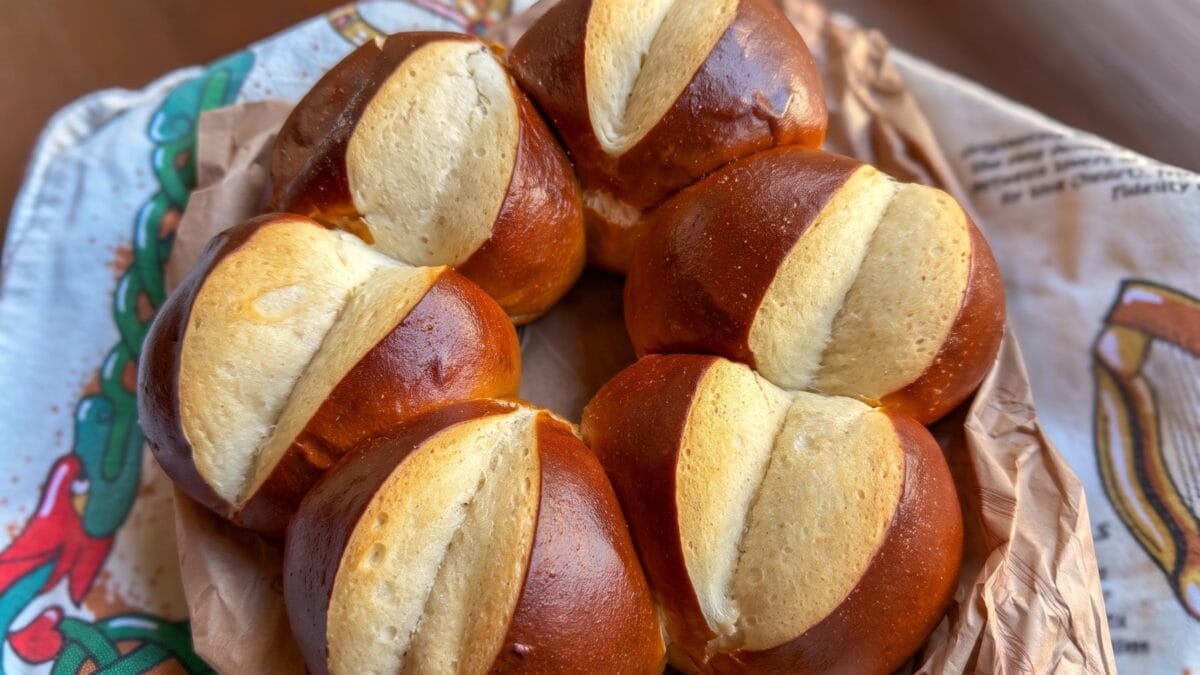
At first glance, it looks like a simple crown of rolls, but you only need to break one open to discover the uniqueness of this Swiss bread: a dark, shiny, and fragrant crust, reminiscent of a pretzel, encloses a soft, buttery center, with a delicate and irresistible flavor. It's the Silser Crown, a specialty found primarily in German-speaking Switzerland, but also popular throughout the rest of the country, where it's readily found on supermarket shelves and in bakery windows. Behind its distinctive shape and unmistakable flavor lies a unique preparation technique and a name whose origins are still uncertain. Let's find out where it comes from, what connects it to pretzels, and how to make it at home.
What is The Silser Crown?
The Silser Crown, or Silserkranz in German, is a leavened bread consisting of six rolls arranged in a ring. It is characterized by a thin, brown, shiny, and slightly crunchy crust, while the crumb remains soft and white, slightly moist, with a dense, compact air bubbles. It originates from German-speaking Switzerland (Zurich, Bern, Basel, Lucerne, etc.) and the Canton of Graubünden, but is also found in French-speaking Switzerland, the French-speaking part of the country, between Geneva, Neuchâtel, Vaud, and Fribourg, where it is known as Couronne de Sils. It is easy to find in both traditional bakeries and ordinary supermarkets.
It's made with a very simple dough made with flour, water, yeast, salt, and butter, all strictly Swiss (god forbid). The rolls are shaped, scored, and placed side by side: they stay together even during baking, but are easily separated by hand when ready to eat.
Thanks to its perfectly balanced sweet and savoury notes, Silser Crown is traditionally paired with simple ingredients such as butter and cheese, but is also suitable for cured meats and more elaborate fillings.
Why is It Called "Silser" Crown?
The origin of the name is uncertain, and two popular hypotheses exist: one refers to the preparation method, the other to a Swiss location. According to the first theory, the term derives from "s alse," a word related to the alkaline solution used to prepare these particular soda breads; over time, the pronunciation changed, becoming "s ilse." The second hypothesis instead links the name to Sils, a town in the Engadine region of the Canton of Graubünden; however, we do not have sufficient evidence to confirm that the bread originated there.
A Swiss Bread That Resembles Pretzels
The Silser crown is part of the "soda" bread category (Laugengebäck in German), which is especially common in Central Europe. Its closest relative, in fact, is the pretzel (or Bretzel), with which it shares its characteristic flavor. The most obvious difference from the traditional pretzel is its shape: the latter features a braid with crossed ends, while, as we have already mentioned, the crown is composed of individual rolls arranged in a circle, called Silserli.
What's special is the preparation method itself. After leavening and before baking, the dough is immersed for a few seconds in an alkaline solution: this process helps form a dark, slightly salty crust. Professional bread-making generally uses sodium hydroxide, while home-made recipes often use baking soda, which is much less dangerous to handle.
Other Types of Swiss Bread
The Swiss bread tradition encompasses numerous types, differing in ingredients, flavor, appearance, and texture, linked to the ingredients and culinary traditions of the different cantons. Among the varieties are braided breads, rustic loaves, rye breads, and milk rolls. Here are some of the most representative specialties:
- Zopf: a braided bread made with flour, milk, and butter, with a golden crust and soft crumb. It's traditionally eaten on Sundays for breakfast or brunch.
- Ticino bread: a specialty of the Canton of Ticino, it is a white bread made up of several portions joined together, which can be easily separated.
- Valais rye bread: as its name suggests, it is made with rye flour and has a strong flavor, with a firmer texture than white bread. It is a specialty protected by the PDO (Protected Designation of Origin) designation (AOP in French – Appellation d'Origine Protégée – and GUB in German – Geschützte Ursprungsbezeichnung).
- Basler Brot: this is the traditional bread of Basel, characterised by a crunchy crust and a honeycomb crumb.
- Bernerbrot: typical bread from Bern, with an elongated shape and a deep central incision that opens during baking.
- Ruchbrot: is a dark bread common in much of Switzerland, mainly prepared with Ruchmehl, a less refined flour than white flour.
- Weggli: a round milk roll with a distinctive incision on the surface. It's popular throughout Switzerland and is eaten for breakfast, as a snack, or as a filling.
- Cuchaule: saffron brioche bread typical of the Canton of Fribourg, traditionally associated with Bénichon, a popular festival in the region.
- Bauernbrot: the name literally means "farmer's bread" and indicates a type of rustic bread common in German-speaking areas, made mainly with wheat and rye flour.
- Bündner Roggenringbrot: commonly known in Italian as "Graubünden Rye Ring Bread" (or, in the local Poschiavo Valley variant, "Brasciadela" or "Poschiavo Ring Bread"). It is made with rye and a small amount of wheat flour.
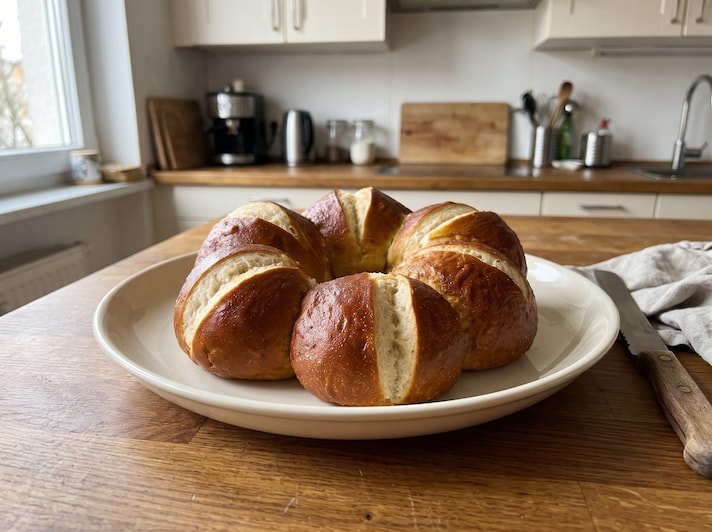
How to Make Silser Crown at Home
Silser crown can be made at home with simple, readily available ingredients. The recipe we propose calls for regular baking soda, not caustic soda. Sodium hydroxide is corrosive and can cause serious burns to skin and eyes. Using it in breadmaking requires a food-grade product, specific procedures, and adequate protection. Naturally, the final homemade bread may have a slightly different crust in color and flavor than bread made with baking soda.
Ingredients for 2 crowns of Sils
For the biga
- 3-5g of fresh brewer's yeast
- 50 ml of warm water
- 70g of flour
For the dough
- 400g of type 0 flour
- 175 ml of warm water
- 1 tsp barley malt or sugar
- 50g of soft centrifuged butter
- 5g of salt
For the bicarbonate bath
- 2 liters of water
- 160g of baking soda
- 3 tsps of salt
You also need
- Flour for the pastry board
To prepare the Sils crown, start with the biga: dissolve the brewer's yeast in warm water, then add the flour and quickly knead until it forms a ball. Place the ball in a bowl, cover with plastic wrap, and let it rise at room temperature for 4 hours.
After this time, break up the biga into a large bowl, then add 175 ml of warm water and the barley malt (or sugar). Mix the biga until it dissolves in the water. Then, add the flour and continue kneading until it has absorbed all the liquid.
Add the salt and, little by little, incorporate the softened butter, cut into pieces, until you obtain a smooth, elastic, and homogeneous dough. Place the dough in a bowl, cover it with plastic wrap, and let it rest for 2 hours at room temperature, then refrigerate it for 8 hours.
After the resting time, remove the dough from the refrigerator and divide it into 12 pieces of 60 grams each. Shape each piece into 12 balls, then join 6 of them together in a circle on a lightly floured surface to form the first crown. Repeat for the second crown and let both crowns rest for 2 hours at room temperature.
Now, pour the water, baking soda, and salt into a large pot. Bring to a boil, then carefully lower one crown at a time, cooking for about 30 seconds. Remove with a slotted spoon and place on a baking sheet lined with parchment paper.
Score the surface of the rolls with a knife, creating a clean, shallow cut. Finally, bake the crowns in a preheated oven at 200°C (390°F) for about 20-25 minutes, until the crust is a nice, dark brown and shiny.
Remove from the oven and let the crowns cool completely, then bring them to the table and enjoy them as you like.

