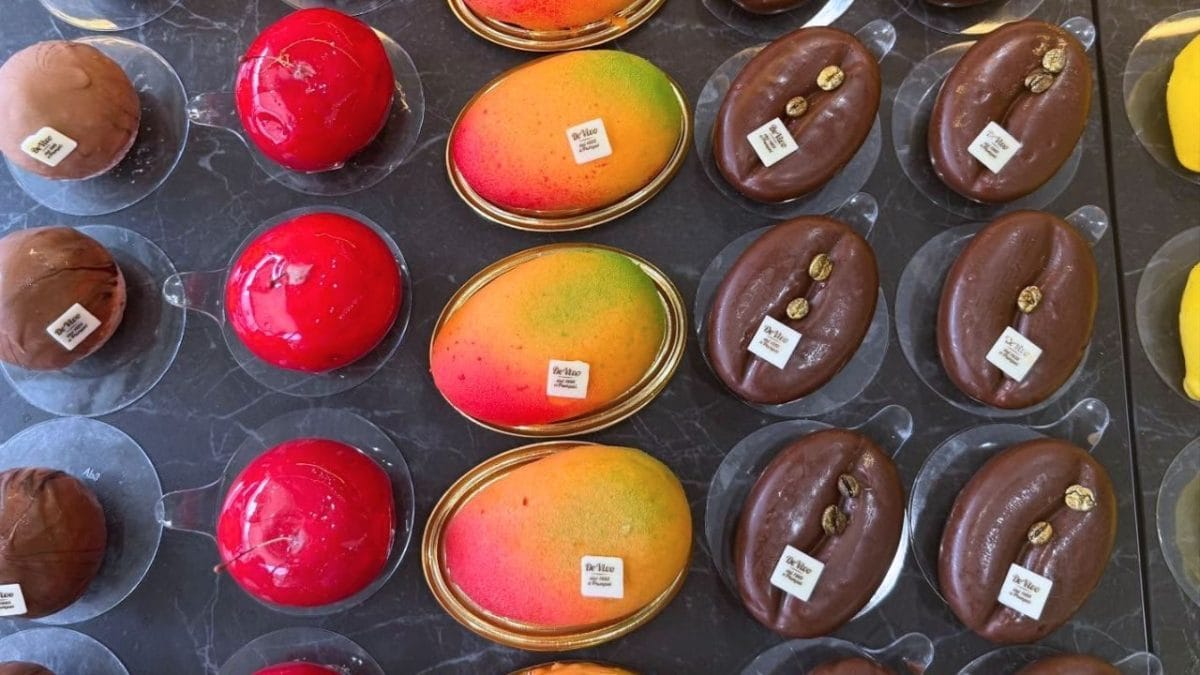
There's something truly surprising about the birth of trends: a product that's typically been on the market for years is suddenly launched on social media, and something happens, something goes off—or more often, a sound or a color —that creates a sort of collective madness. From that moment on—and for a very short time—that product becomes one of a person's greatest desires. And that's not an exaggeration: lately, we've all been witnessing the trend called "realistic fruit," which pushes people to line up for hours just to eat a dessert shaped like a fruit and, if you're lucky, even tasting like that fruit (wow). But realistic fruit isn't a last-minute invention: it's part of a technique called trompe-l'œil, born as an artistic technique several centuries ago and which has influenced some of the world's greatest cuisines and pastry shops.
What Really is Realistic Fruit?
A dessert shaped like a fruit: this is realistic fruit, simply explained. The reality, of course, is more complex: it's a technically sophisticated dessert, made up of different consistencies and designed to resemble the fruit it represents. Although today the phenomenon is linked to its virality on social networks, realistic fruit has been around for several years. The name it is most often associated with is that of the French pastry chef Cédric Grolet, one of the most well-known and influential internationally. His experiments began around 2014, when he tried his hand at reproducing a stone using chocolate. From there, it was a short step to fruit: apples, bananas, mangoes, pears, coconuts, and so on. From then on, realistic fruit has enjoyed ever-increasing success, to the point of becoming a veritable gastronomic trend.
In The Beginning It Was Trompe-l'œil
The technique, however, is not new and was not invented by Grolet. The idea of creating a dish that looks like one thing but is actually something else is known as trompe-l'œil, a French expression that literally means "fool's eye." Dishes created with this technique have the very characteristic of appearing different from what they actually are. Among the most famous examples are Heston Blumenthal‘s Meat Fruit, prepared with goose and chicken liver that takes the shape of a mandarin orange, or René Redzepi‘s Scarab Beetle, which, at first glance, looks like an insect, but is actually a preparation made from blackberries and edible Danish flowers.

In the case of realistic fruit, there's a real consistency between sight and taste: an apple tastes like an apple and a banana tastes like a banana. What changes is the nature of the product: it's not real fruit but a dessert made of mousse, jellies, biscuits, and glazes. A similar example, in Italy, is the famous frutta martorana, a typical Sicilian dessert made with almond paste that is molded and decorated to perfectly imitate fruit.
How Is Realistic Fruit Made
The fact that it's a dessert reminiscent of something seemingly simple like fruit can be misleading and lead one to believe it's easy to make. In reality, when done properly, it's a rather complex product, combining various preparations to create a truly interesting interplay of textures. It all usually begins with a silicone mold that reproduces the shape of the fruit: inside, a layered structure composed of mousse, jelly, or creamy inserts is built, designed to recall the original flavor and reinterpret it.
The most distinctive element – and the most striking – is the external coating, often obtained with a mixture of cocoa butter and chocolate, then coated in a neutral glaze for a satin or wet effect and finished with food coloring sprayed with an airbrush: this allows you to replicate all the nuances and shadows, as well as the opacity and irregularities typical of the peel. The result is an extremely realistic surface capable of deceiving the eye until the moment of cutting.

How Much Does Realistic Fruit Cost?
The result is a small jewel of contemporary pastry making, generally sold in single portions at a price between 15 and 25 dollars. A rather high price for a dessert, but justified by the complexity of the process, the use of specialized equipment, and the quality of the ingredients. The current problem —which, in reality, we witness every time a trend emerges—is not so much the value of the product but its indiscriminate diffusion.
Of course, there are many valid products of this kind, but often the virality that leads anyone to replicate what works at the moment isn't always synonymous with quality: creating realistic fruit requires time, technique, and the right tools that, rightly, not everyone possesses. What is created, however, is a vicious cycle that everyone wants to enter, producers and consumers alike, in the name of popularity as an end in itself, whose sole goal is to satisfy the desires of those who spend endless hours waiting to "live an experience." An experience, however, that often ends in bitter disappointment, in an apple, a banana, or a mango that, rather than resembling fruit, are a cheap concentrate of sweeteners, industrial preparations, and low-quality products. And all that's left is a 20-second ASMR-style video with a decidedly unrealistic crunch given by the cutting that shows the true and shocking nature of the dessert: that of being a dessert.
;Resize,width=767;)
