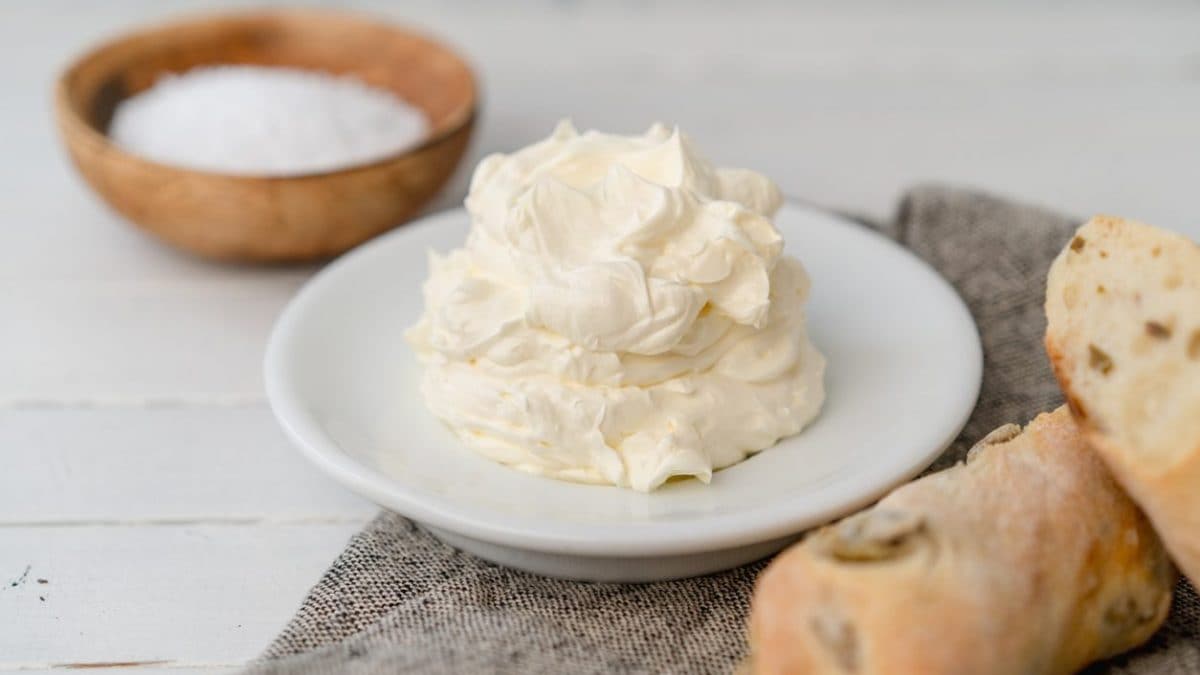
When you watch great chefs at work, you're often struck by their creations, which feature just a few simple ingredients used or combined in unconventional ways, resulting in creations that have a wow factor. Fortunately, certain tricks aren't just the preserve of professionals; they can be borrowed to create surprising yet easy recipes. Whipped butter is one of these little "magic tricks" that transforms a simple butter spread on a slice of bread into a delight. Let's see how it's made and how to use it to always impress.
What is Whipped Butter?
Whipped butter is not a different type of butter than the traditional one used in cooking, but rather a preparation that changes its consistency, making it creamy and airy, like a kind of foam that spreads easily. Its softness makes it different from the classic block, which, on the contrary, is compact, but it remains the starting point for making this delicious and versatile variation, which can include the addition of cold or sparkling water to make it even lighter and, depending on taste and use, a pinch of salt, to create a salted whipped butter. Of course, it can also be flavored to taste with citrus zest, fresh herbs and spices, or for a sweeter twist, for example with honey and cinnamon.
The Technique to Make Whipped Butter
The good news is that preparing this specialty is really simple: it's not, in fact, a recipe as such, but a technique for incorporating air into the butter, thus making it lighter and more voluminous. What you need is a high-quality raw material, because it is the absolute protagonist, and ordinary sparkling water (calculate 70 grams of liquid for 250 grams of butter). Use both at room temperature because the butter must be easily malleable: take it out of the refrigerator about 15-30 minutes before starting to work. Once the butter has softened, work it with a fork or a spatula, thus giving it a creamy consistency and then begin whipping it with an electric whisk or in a stand mixer, adding a little sparkling water at a time, to gradually incorporate it. If you prefer, you can also whip the butter without adding liquid: it will be less voluminous but still creamy and soft. For the savory version, add a pinch of salt and then the sparkling water. The result is a frothy, velvety mixture, free of lumps.

How to Use Whipped Butter
Your whipped butter is ready: but how do you use it? This preparation is perfect for crostini, canapés, and appetizers. A classic accompaniment is with anchovies: spread the soft butter on a slice of rye or sourdough bread and top with a few anchovy fillets for a simple, tasty, and refined dish. Smoked salmon is also a must-have garnish. Whipped butter enriched with fresh herbs and grated orange or lemon zest also becomes an elegant condiment for delicate fish dishes, such as sole or sea bass. Served sweet, with a drizzle of honey or maple syrup, it replaces the knob of butter atop the iconic pancake tower. Be careful not to confuse whipped butter with creamed butter (beurre pommade): the latter is left to soften for an hour (or more) outside the refrigerator, acquiring a very soft consistency (similar to that of a cream) which makes it particularly suitable for being whipped together with sugar and other ingredients, to be used in basic pastry doughs such as whipped shortcrust pastry.

The Most Common Mistakes to Avoid
As is well known, simple recipes often hide a few pitfalls precisely because they don't allow for shortcuts. To obtain perfectly whipped butter, the first thing not to underestimate is the raw material: choose a high-quality, fragrant product with a fat percentage around 85% (by law, it is forbidden to go below 82%), so as to obtain a mixture that is almost impalpable, yet well-structured, and that does not deflate. The room temperature of the butter also facilitates the processing: if it is too cold, it risks breaking, resulting in a lumpy mixture. Furthermore, the water must always be added gradually, never all at once, to regulate the whipping. Finally, to fully enjoy the texture and flavor of this spreadable butter, it's best to prepare it just before serving (it only takes a few minutes) and, if possible, consume it within the same day, as it's perishable. Furthermore, the combination of water and fat is known to be unstable, with the two elements tending to separate quickly. Store it in the refrigerator in an airtight container and leave it out for 5-10 minutes before using.
;Resize,width=767;)
