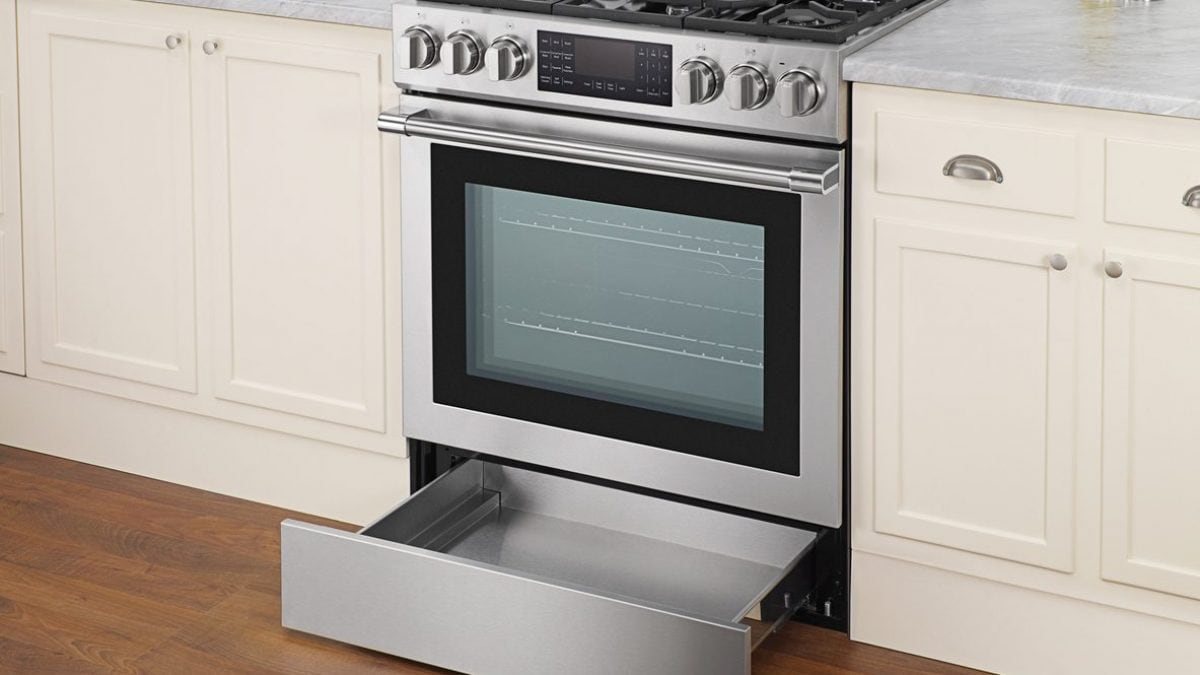
You may have noticed a peculiar accessory under your oven, or even have it in your home without really knowing why it's there or what it's for. You've probably ended up using it as a regular drawer for storing baking trays, pots, pans, and miscellaneous items you don't know where to keep, but in reality, it's a much more useful tool than just a storage space. The drawer under the oven, in fact, is designed with a specific function, so much so that it's also sold as a real appliance, not just as part of an oven.
What's it for? Mainly as a food warmer, but it also has other useful features that can simplify certain tasks in the kitchen, such as helping with dough rising or preheating pots and pans. So let's explore the drawer under the oven to find out all the ways you can use it.
What's The Drawer Under The Oven For?
The drawer under the door of some oven models isn't just a simple piece of furniture, but a truly useful tool: it's primarily designed to serve as a food warmer, which is why its location isn't random. It's located directly underneath the oven, allowing it to harness the heat emitted by the appliance to keep uneaten food warm, without overheating it and ruining it. This is a very useful feature, especially when you're cooking multiple dishes at once and need to keep the cooked ones warm. This is why the warming drawer is now also available as a separate appliance, not necessarily with an oven. Keeping food warm isn't the only way the drawer can help.
For example, it is very useful for preheating dishes, a functional practice for serving food while keeping it at the desired temperature, avoiding the thermal shock of contact between hot food and cold dishes, but it also helps you gently thaw frozen foods using a warm but delicate and controlled temperature.
By the same principle—that of a warm environment, but not heated by a direct heat source—the drawer under the oven is also ideal for letting dough rise, since leavening requires precisely this type of environment to be at its best.

Warming drawers can be used to melt chocolate if they maintain a low, constant temperature (around 105-122°F/40–50°C). This is the ideal temperature for melting it without burning it. Some mid- to high-end models also have precise temperature control and are specifically designed for functions such as melting, leavening, or keeping warm.
Drying nuts or spices is also possible, but only if the drawer can reach and maintain low temperatures for extended periods (around 105-140°F/40–60°C for several hours). However, not all models have such fine ventilation or temperature control, so this function is not guaranteed.
Some high-end oven models even allow for slow cooking of tender or already browned meats at low temperatures —but only if the temperature can reach 175-212°F/80–100°C and remain stable for hours.
Things You Should Never Put In The Drawer Under The Oven
Now you know the true purpose of the drawer under the oven, but that doesn't mean it can't be a convenient storage space for improving kitchen organization when you're not using it as a warming drawer. The key is to use it wisely and store the right items, those that are most heat-resistant, inside. You might find yourself needing it for food warming purposes and storing various items while the oven is in use.
You can store baking trays, pots, pans, and utensils of any kind in the drawer under the oven, as long as they're made of heat-resistant materials. This way, if the oven is on and the items are stored in the drawer, they won't be damaged or become dangerous due to the heat. Avoid storing anything made of wood, ceramic, or glass, and especially avoid plastic, whether containers or plastic wrap: the heat could melt or warp them, rendering them unusable.

Because of the heat, it's best not to store bottles of detergents and household products in the drawer under the oven, many of which contain highly flammable substances. Spirits, for the same reason, are also best avoided. Any type of oil, as temperature fluctuations tend to alter the flavor, and any type of canned food, as excessive heat or temperature fluctuations can accelerate their spoilage, even though they are products with a long shelf life. Also avoid storing uncooked flour, pasta, rice, and any similar products in this space, as the heat ruins them, encouraging the appearance of annoying "moths".
;Resize,width=767;)
