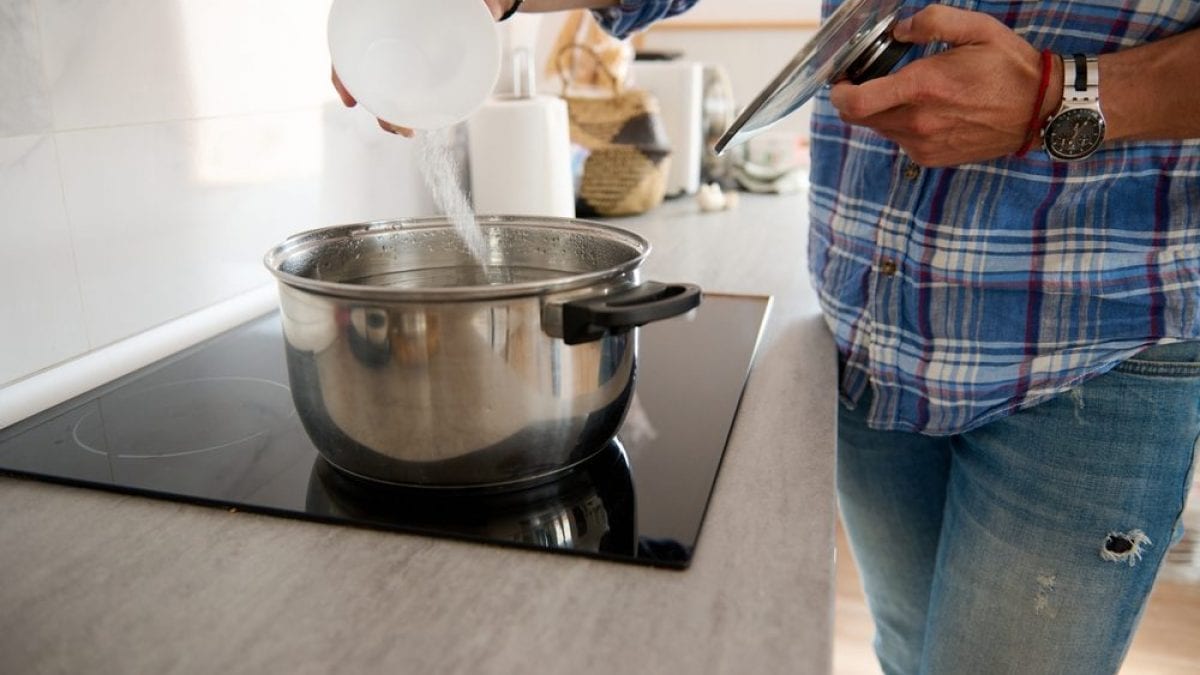
Sometimes we're surprised by the number of Hamlet-like doubts that can arise in the kitchen: they don't just concern the choice of ingredients or their preservation, but dilemmas also arise at the very moment in which we perform some of the most common tasks, such as, for example, cooking pasta. In this case, the question that "spontaneously" arises and that most torments is: when should we add salt? The schools of thought are well-known: there are those who maintain that it's best to add it immediately, while the water is still cold, thus avoiding the embarrassment, and those who maintain that it's best to add it once the water has reached a boil, otherwise it will slow down the cooking process. When put to the test, it actually seems that no one is entirely right, but that the most deeply rooted custom, namely the second, is also the most practical. Let's see why.
You Should Add Salt to Water After It Has Boiled
Let's get this straight: the widespread belief that adding salt first slows the boiling of water is actually a bit misleading. From a scientific standpoint, it's true that sodium chloride, when combined with water, slightly raises the boiling point (set at 212°F/100°C) compared to when the water is "pure," but the consequences aren't such a significant delay as to cause a waste of energy. In fact, we're not talking about minutes or even seconds, but nanoseconds. According to chemistry, when water (H₂O) comes into contact with salt (NaCl), its molecules have a harder time separating from those of the latter, thus remaining in the liquid state for longer instead of evaporating. Yes, but how long? The calculations are clear: the boiling point would reach 212.306°F/100.17°C, increasing by only 32.306°F/0.17°C, which corresponds, precisely, to a few nanoseconds.

This means there's no significant difference between adding salt before or after. So why opt for the latter? These are essentially practical reasons: when the water is already hot, salt dissolves more quickly, avoiding settling on the bottom and potentially ruining the pot in the long run. Secondly, linking the timing to the salting can help you remember it.
How Much Salt Should You Put in Pasta Water?
Once you've established the "when," all that's left to do is clarify the "how much." The classic rule is to use 10 grams of salt for every liter of water and 100 grams of dry pasta, according to the ratio of 1:10:100.
Coarse salt is the preferred choice, as it's easier to measure and also cheaper, but of course the amount can vary depending on many factors, including the type of salt and pasta, as well as the seasoning, for example, whether it's already salty. Our tip? Adding is definitely easier than taking away: as they say in the trade, if you're unsure, you can adjust later by tasting the pasta halfway through cooking.
;Resize,width=767;)
