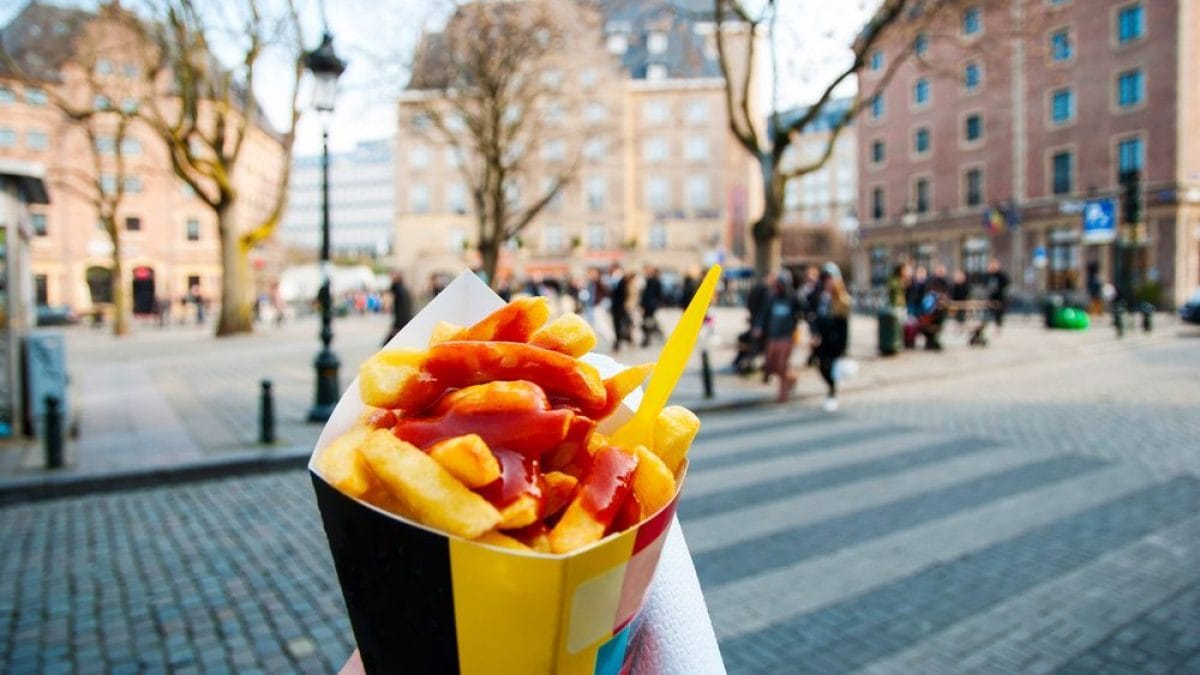
In the kingdom of chocolate, beer, and waffles, there's another gastronomic product capable of inflaming the spirits of Belgians: frites, or French fries, crispy on the outside and soft on the inside, served in paper cones and accompanied by generous amounts of sauce. This tradition finds its place both in brasseries, as in the classic mules-frites dish, which pairs them with mussels, and at street stalls, of which there are approximately 5,000 throughout the country. Let's discover this typical street food and what makes it so special.
A Bit of Belgian Fries' History
It should be said right away that their origin is disputed with France, with the French claiming to be the inventor of French fries: if you go to Belgium, avoid calling them that, because here the only term is frites, which implicitly refers to pommes frites, aka fried potatoes. According to the most accredited theory, it all began in the Wallonia region, in the south of the country, between the 17th and 18th centuries: the inhabitants of the villages that arose along the Meuse used to fry small freshwater fish, but during the harsh winters, with the river frozen, the alternative became potatoes, which after the discovery of America had spread, especially in northern Europe, as a poor and nutritious food.
Over time, fries have assumed an increasingly important status in Belgian culture, to the point of becoming a sign of national identity, so much so that in Brussels and Bruges you can visit the Friet Museum, entirely dedicated to fries. Furthermore, in 2014, Belgium, through a petition, asked UNESCO to recognize fries as an intangible heritage of humanity without (yet) a positive outcome.

The place of choice for Belgian fries is the fritkot, the kiosk where they are prepared and served for takeout. These businesses are often family-run, passed down from generation to generation, each with their own secret for the oil, the cooking time, the perfect sauce. In short, a symbol of culinary democracy that is part of everyday life, where students, commuters, professionals, and tourists of all walks of life line up.
How Are Frites Made?
What makes Belgian fries different from regular fries? Let's start with the raw material: not all potatoes are suitable for this preparation. Belgian fries are made with Bintje, a variety selected by the Dutch in the first decade of the 20th century, but which has been enthusiastically adopted by Belgian growers. It is a yellow-fleshed variety with floury flesh, ideal for mashing, casseroles, and frying. The tubers, after being carefully washed and peeled, are cut into slices and then into sticks about a centimeter thick and 5 to 8 cm long.
Now comes the time for frying, which is characterized by being double and, generally, at different temperatures. After being fried for the first time at 320°F/160°C, the chips are left to cool and then fried again between 340°F/170°C and 355°F/180°C: this way they will have a soft consistency on the inside and crunchy on the outside. They can also be done in two different times, keeping them in the fridge or freezing them. And the oil? This too is not an insignificant detail: while vegetable oil (such as peanut oil) has increasingly become the preferred choice for reasons of cost and health, traditionally animal fat was used, not lard which comes from pork, but from beef: a famous brand in Belgium is Blanc de bœuf, which writes on its packaging the slogan “le vrai goût des frites”, just to leave no room for interpretation.

Of course, sauces are a must, including mayonnaise, ketchup and andalouse, with peppers, mayonnaise, tomato paste and, in some versions, the addition of chilli pepper, which gives a pleasantly spicy note.
The Downside of Belgian's Tradition
Never tell a Belgian that fries are French. In recent years, however, the great economic boom centered around fries has had side effects, especially in terms of environmental and labor sustainability. In 2021, an article published in the magazine Politico highlighted the protests of the residents of Frameries, who reportedly saw a potato processing plant built on the outskirts of the Walloon town, resulting in unpleasant odors, pollution, and precarious working conditions. The complaint is that the global trade in fries and their industrialization have nothing to do with their romantic allure and the authenticity of what is truly an iconic dish of gastronomic heritage.
;Resize,width=767;)
