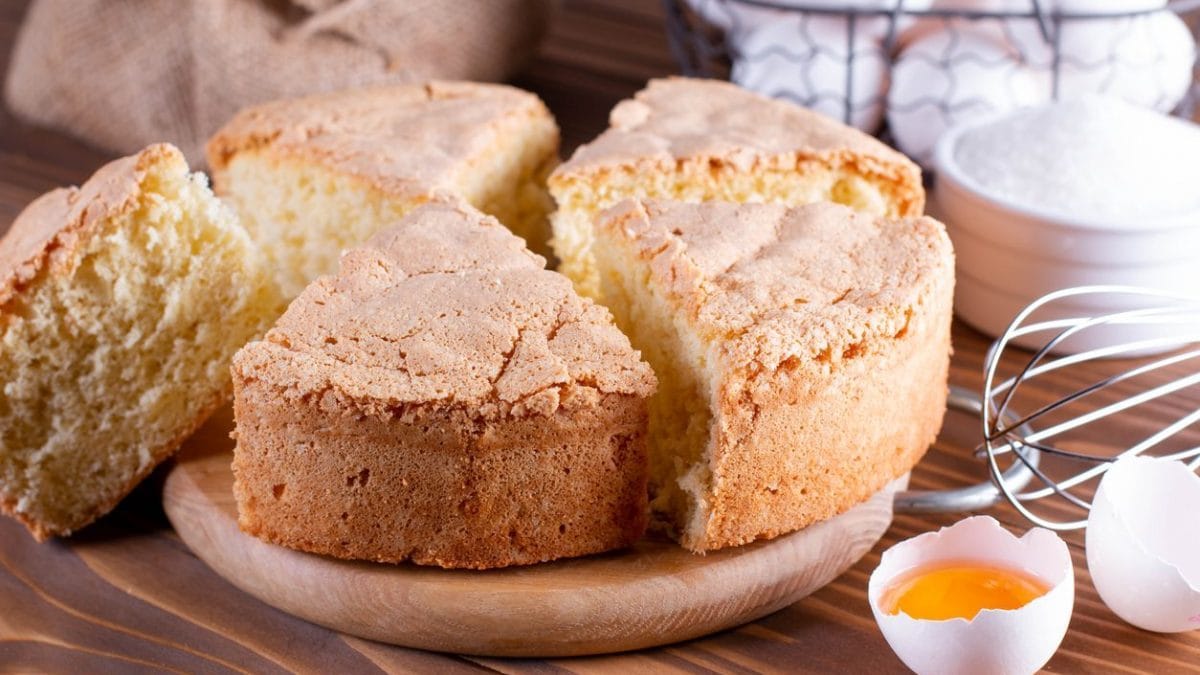
Sponge cake is a fundamental recipe in pastry making: with just a few simple ingredients (sugar, eggs, flour, potato starch), you get a neutral, soft, and spongy base, perfect for customizing—like the cocoa version —and for accommodating syrups and fillings without becoming soggy and crumbling. In fact, it's usually the star of spectacular cakes, composed of multiple layers and topped with generous amounts of cream: for this very reason, it must be sturdy yet light. We know that baking powder is not an option in sponge cake, and that (almost) all the credit for its consistency goes to the eggs — very fresh, whisked thoroughly with the sugar until frothy — and, as is often the case in pastry making, the detail not to be overlooked is their temperature: cold is a no-no, room temperature or "warm" is better. Let's see what this means and why.
Why is Egg Temperature so Important?
Let's start with a quick introduction: temperature is a key factor in desserts, a variable not to be underestimated in eggs, as well as in butter or cream, depending on their different uses. Specifically, in sponge cake, the moment in which the eggs are whipped together with the sugar is particularly crucial for the success of the entire recipe, with the right amount of air incorporated thanks to the proteins in the egg white and the emulsifiers in the yolk, which contribute to the increase in volume. When they are too cold, eggs whip worse, because these elements are more rigid and less reactive, thus incorporating less air and more slowly, with the final mixture being unstable and tending to deflate easily when the flour and starch are added. On the contrary, eggs at room temperature or warm (actually lukewarm) mix better with the other ingredients, ensuring smooth and voluminous doughs, but not only that: the advantage is also in baking, which will be more homogeneous, with the sponge cake rising tall and evenly.
Cold and Hot Methods: What They Are and How to Make Them
Moving from theory to practice, when talking about sponge cake, two preparation techniques come into play which differ in the temperature of the eggs and, consequently, in their processing: the cold method and the hot method.
- In the first case, despite the name, the eggs are used at room temperature (which conventionally ranges between 64°F/18°C and 68°F/20°C) and are whipped directly with the sugar: this is the classic home method. The suggestion is to take the eggs out of the refrigerator at least half an hour before you plan to use them.
- The second option is the professional laboratory one, adopted, among others, by Luca Montersino: the eggs and sugar are heated together to 113-122°F/45-50°C (no higher) before being whipped. There is no risk of the eggs curdling because the sugar acts as an anticoagulant, so they cool without risking cooking: it can be done in the microwave , stirring in short 20-second intervals until it reaches 113°F/45°C, or in a bain-marie or in a saucepan over low heat, stirring constantly. The important thing is to check the temperatures, using a thermometer or with your fingers: when you touch it, the mixture should be lukewarm. Only then is it whipped, with a whisk or a stand mixer.
Both choices ensure a stable and soft sponge cake, with the hot method being more safe in this regard, even though it may be more laborious at home.
;Resize,width=767;)
