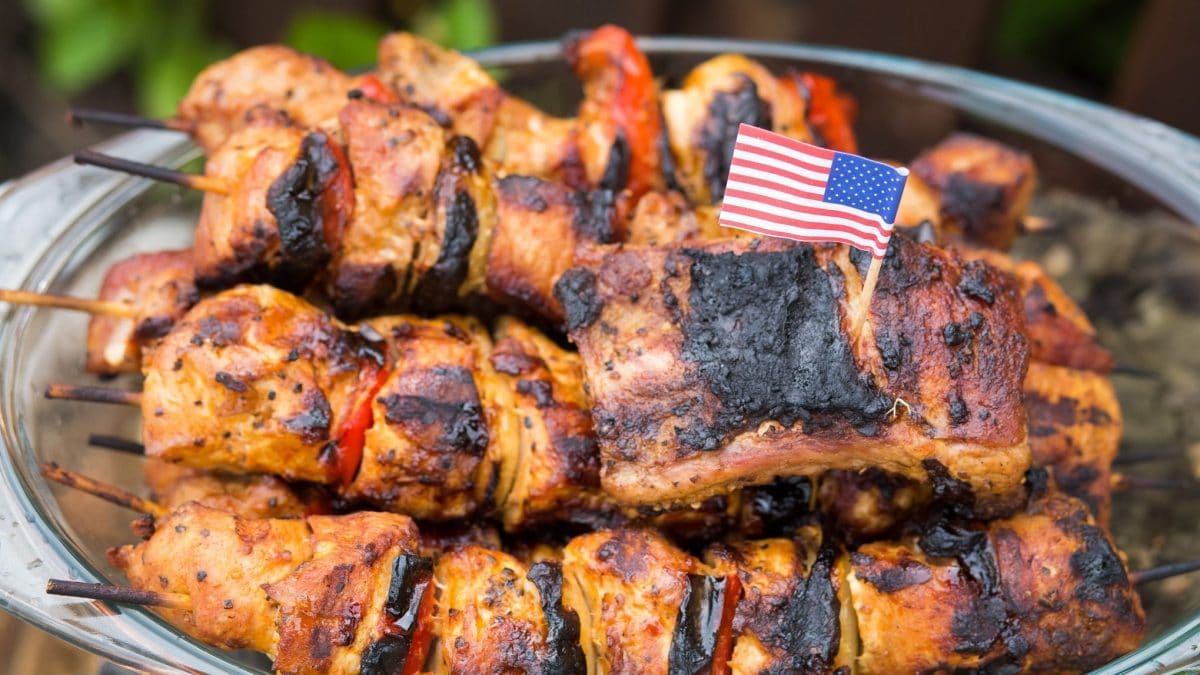
The word "barbecue", abbreviated to BBQ, is part of everyday language but its history is shrouded in legend and inextricably linked to two mysteries:
- The first concerns the conquistadors and their relationship with the Taino, a Caribbean tribe. It seems these people used a very unique technique, unknown to Europeans. Arrange the meat on a grill suspended over a brazier to ensure slow cooking and keep the food away from the fire. The Taino call this grill "barbacoa."
- The second version is of French origin: the French claim that, at the time of the explorations, another tribe with an unknown name cooked a whole goat on a grill "from beard to tail", giving rise to the word "barbecue".
Whatever it is, BBQ has become a symbol of the United States, celebrated by the entire nation on the 4th of July, Independence Day, which, together with Thanksgiving and the Superbowl, is the symbolic holiday of the United States of America.
The Relationship Between the Fourth of July and American Barbecue
When we talk about American food culture, Europeans tend to sneer, misplaced by a sense of superiority that doesn't exist. American gastronomic tradition has ancient roots and a series of stories that make it incredibly fascinating. Barbecue is a prime example because, although it's currently enjoying a revival as a cooking method thanks to great chefs like Victor Arguinzoniz and Rodney Scott, its origins are almost mystical.

With the discovery of fire, humans became a community and began cooking their own food, their own prey. We've been using fire in cooking for hundreds of thousands of years, but the technique has remained more or less unchanged: meat, open flame, that's it. Today we get lost in extreme nitpicking, but, when all is said and done, it's all quite simple.
In the United States, this cooking method is sacred, and the Fourth of July is the day when barbecue is "celebrated" nationwide because Independence Day is one of the few moments when all of America stops. Celebrating independence is fundamental to American culture, and this holiday was "predicted" even before the signing of the decree that emancipated the nation. Consider that John Adams, future president of the United States and the only signatory of the Declaration of Independence along with Thomas Jefferson, wrote to his wife:
"July 2, 1776, will be the most memorable event in the history of America. I am led to believe that it will be celebrated by future generations as a great commemorative holiday. It should be celebrated as the day of deliverance, by solemn acts of devotion to Almighty God. It should be celebrated with pomp and parade, with shows, games, sports, guns, bells, bonfires and illuminations, from one end of this continent to the other, this day and forever."
Adams would have been wrong only about the day, not the 2nd but the 4th of July, because in America they celebrate the day on which the Declaration of Independence is first publicly displayed, rather than the signing of the resolution.

Since then, certain rituals have remained constant: everything is colored white, red, and blue; people gather on beaches, in parks, or in gardens to celebrate with feasts and picnics; at midday, they perform the "Salute to the Union" at military bases, with the national anthem and the firing of as many shots as there are states in the country (in 240 years, the number has gone from 13 to 50); there are hot dog eating contests and fireworks. Barbecues have been a regular feature since the first Independence Day celebrations, becoming over the years a formal gathering where civic ideals are reinforced around a good piece of meat.
"Barbecue Brings People Together"
Before delving into American culture, it's worth noting that American barbecue is a style of cooking that undoubtedly originated in the Caribbean, later developing in South and North America. Christopher Columbus‘s writings contain references to this cooking method: indirect flame, a wooden grate that serves to keep the meat away from the heat while simultaneously flavoring it through smoking, one of the oldest methods of preservation. This technique developed first in the South, and in fact the famous Argentine asado is a direct descendant of Caribbean techniques. Immigrants also brought this technique north, especially to the countries of the Union, which is why barbecue is so deeply rooted in states like Texas, Virginia, and Louisiana.

As they explored the southern United States, the first settlers also brought their cooking methods with them. Historian Don Doycle says that as early as 1540, near present-day Tupelo, Mississippi, the Cicksaw tribe, along with explorer Hernando de Soto, were preparing banquets based on very slow-cooked pork. Over the centuries, the technique spread throughout the colonies, first from Virginia northward, and then throughout the southern United States.
These explorations created the so-called "Barbecue Belt," an area stretching from the Gulf of Texas to the Atlantic, with corresponding outposts in Austin and Kansas City. In this strip of land, there are four distinct barbecue traditions: Carolina, Texas, Memphis, and Kansas City.

Traditions are very diverse, and since "every world is the same," misunderstandings often arise. For example, according to Jim Villas, an American journalist and gastronome, beef barbecue or mutton barbecue from Texas and Kentucky are not authentic BBQ. To achieve a pure barbecue, the meat must be exclusively pork because the original pit masters (those in charge of cooking and responsible for the success of a barbecue) in the Southern colonies could only afford pork, a meat with an incredible symbolic value.
The relationship between the Southern states and pork strengthened even further during the years of the Civil War: the Confederates were totally dependent on pork, eating on average 3 pounds of pork for every pound of beef. During the conflict, Southerners refused to export their meat, making pork a point of patriotism. They took the issue so seriously that pre- and post-concession pig farming was completely different: the war improved them, and the farmers took greater care of the animals, the well-being, and the food for the pigs. In 1860, before the outbreak of the war, the hog trade was double that of cotton and around half a billion dollars; an astronomical figure for the time, which today is equivalent to around 130 billion dollars. Until 1900, most of the pigs in the United States were raised by Confederate residents, a practice that contributed significantly to the economic well-being of the South, providing funds to cope with the four years of civil conflict.

The Southern states' penchant for pork extends far beyond the Civil War: to understand it, we must look beyond America's borders, observing the influence of immigrants, settlers, and slaves. It seems that in the United States, the "original barbecue" was the vinegar-based whole hog from Virginia and North Carolina: the technique is English and involves adding a sauce during cooking to caramelize and preserve the juices within the meat. At the same time, immigrants from the Caribbean taught settlers the technique of barbecue, and slaves from Ghana, Sierra Leone, Guinea, Liberia, and South Africa brought the culture of conviviality and the use of marinating with spices to America. The role of slaves goes far beyond teaching a technique: braais are informal gatherings of family and friends, typical of East and South Africa, who gather around a fire for any occasion and in any location, to enjoy grilled meat. The act of gathering around a grill harks back to generations past who would gather around open fires after a hunt, cementing the importance of the braai to tradition. We're talking about something lost in the mists of time, almost ancestral.

But how did slaves have this influence on a slave-owning and racist community? When there's a big party in the tobacco fields, it's traditional to call the eldest slave to cook almost everything, partly because, after all, he's a slave, and partly because the masters are well aware of the role of the grill in African culture.
The issue was addressed by anthropologist Michael Polland in Cooked. He says that "even before the integration of slaves, barbecues were closely linked to the tobacco harvest. When tobacco was harvested, it was a very intense activity and everyone worked, white and black, slaves and non-slaves alike. It had to be done very quickly, at the best time for the harvest, and the leaves had to be dried well, then a big fire was built. When there were all those embers, with so many people around, it was natural to roast a pig. That was the only time, in that phase of Southern life, when whites and blacks ate together. People would be more united if they understood that we are all equal, and barbecues have this effect: they bring people together."
;Resize,width=767;)
