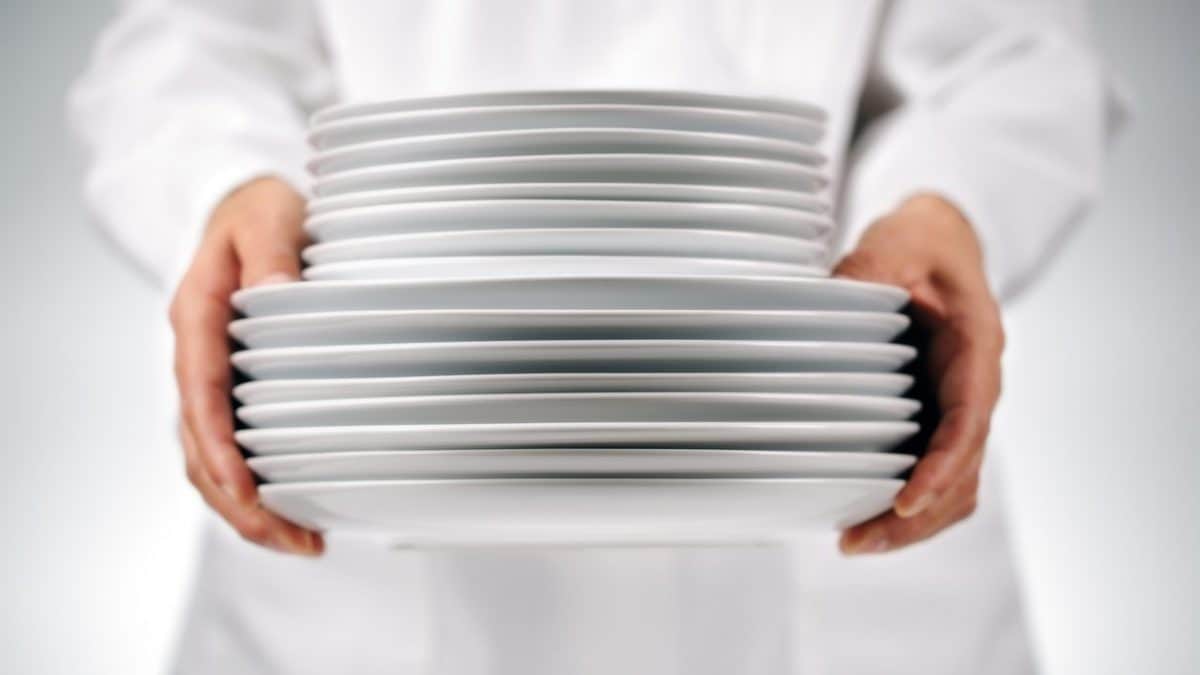
What's the most iconic sound in a restaurant kitchen? Even if you've never been in one, you only need to have seen The Bear or Hell's Kitchen to answer: beyond the pans on the stove and the food cooking, you can hear a deafening clatter of dishes, on the countertop, in the sink, everywhere. Then you go out into the dining room and you find the same sound: plates clashing or cutlery clattering on the edge. Noises that are completely normal for those who work in the restaurant industry, but what if they disappeared, or at least were reduced? Thanks to a French startup, now it's possible: it's called Quiet and it's created dishes that don't make any noise.
The Advantage of Tempered Glass… But Without The Noise
Perhaps for some it is underestimated, for others it may even be pleasant, but the noise produced by dishes is one of the main sources of stress for those who work in the catering industry: it has been estimated that in environments such as canteens or professional kitchens, the noise level can even exceed 85 decibels – a threshold already considered risky for hearing, especially if exposed on a daily basis.
Thus, a French startup saw the problem and created a solution: a silent plate capable of significantly reducing the sound produced by dishes. The company Quiet – thanks to its collaboration with the National Institute of Applied Sciences in Lyon (INSA) and the CNRS – has been able to create a range of plates capable of reducing noise in kitchens by up to 85%. A revolutionary idea that combines the advantages of a tempered glass plate, on top, with the silence provided by an external silicone coating: a plate composed of a double material, which maintains the appearance of a traditional one but with the ability to absorb sound vibrations. And the gain is not only in terms of silence: thanks to the material it is made of, the plate is non-slip, more resistant to impacts and has reduced thermal conductivity, making it safer to handle and avoiding burns.
An Expanding Project
The tableware, launched on the market in mid-2022, has not yet achieved great commercial success. For now, the project has been tested in school cafeterias in France, such as the Collège Louise Weiss in the city of Roanne, where around 600 plates have been installed. The result has been an 85% reduction in noise, significantly improving working conditions and increasing safety for children.
The startup has stated its intention to increase production to reach a wider audience —including people in specific categories who could benefit from a more comfortable sound environment—and to develop suitable recycling methods for this type of material. As reported by El País, Sophie Moritel, the company's COO and co-founder, stated: "We know that chefs like to choose their own dishes. We've conducted some tests, and so far, commercial restaurants haven't shown much interest in us, except for a few hotel chains. Now we have more pressing challenges, such as introducing soup plates, recycling, and, above all, increasing our production. Perhaps then we'll be able to meet the demand from private individuals, where we hope to find a niche."
;Resize,width=767;)
