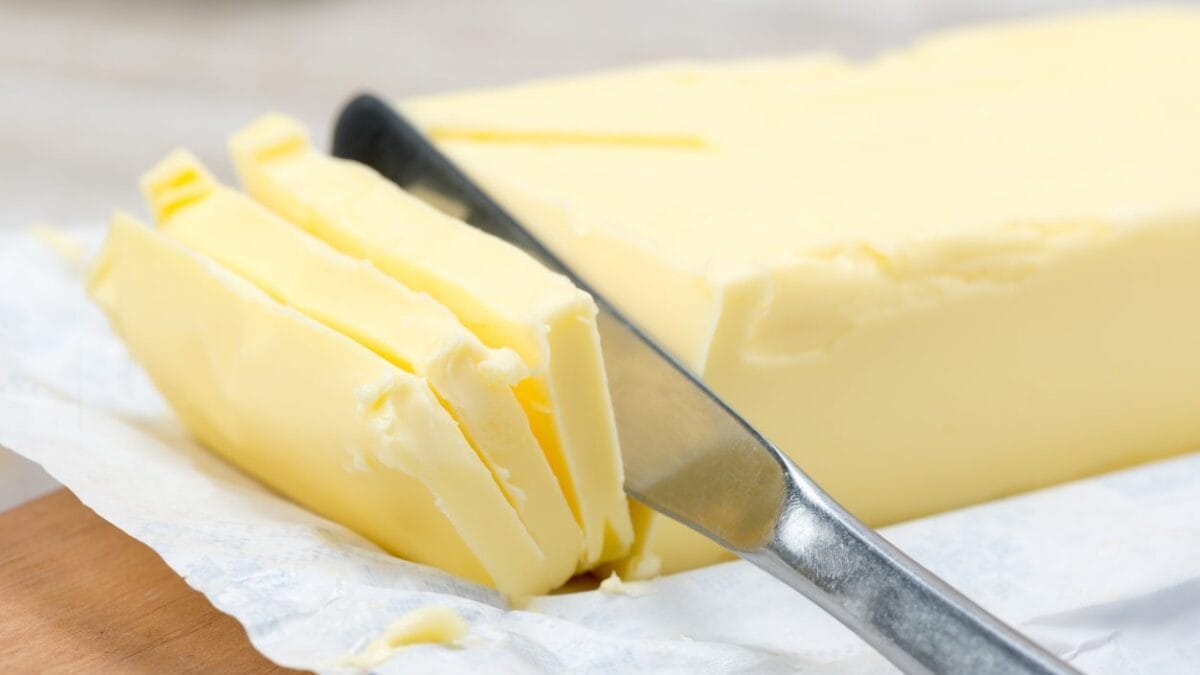
Butter is a fundamental ingredient in pastry making, the star of countless French recipes and a staple in some of gastronomy great classics, from Viennese cutlets to risotto. Yet it's also one of the foods most fraught with controversy: some avoid it because it's high in saturated fat, others consider it worse than oil, and yet others have completely reevaluated it in recent years. But what exactly is butter, how is it produced, and what are the differences between centrifugal, creamed, and clarified butter? And above all, what do we know today about its health benefits? Let's shed light on its characteristics, the different types, and the most common myths.
What is Butter and How Is It Made
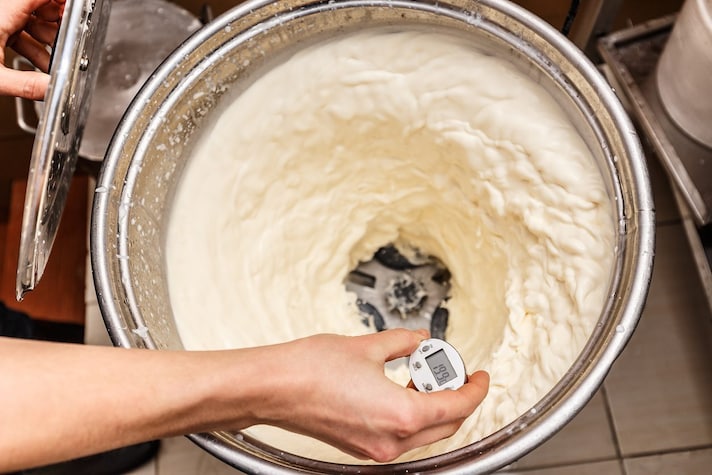
Butter is a product obtained from the fat component of milk, and its production generally begins with cream. Once separated from the milk, the cream is churned, a mechanical agitation that breaks the membranes surrounding the fat globules and allows them to aggregate. This results in what is technically called an emulsion inversion: in cream, the fat is dispersed in the aqueous phase, while in butter, the water is dispersed in the fat phase. During processing, a liquid portion, called buttermilk, is also separated, while the fat mass is further processed until the characteristic consistency of the product we know today is achieved.
In the United States, butter composition is regulated by the FDA under 21 CFR § 101.67 and the federal standard of identity for butter in 21 CFR § 133.9. To be sold simply as “butter,” a product must contain at least 80% milkfat; the remainder consists mainly of water and milk solids. It is therefore incorrect to assume that all butter contains at least 82% fat, as some European standards require a higher minimum. American butter can vary in fat content above the 80% threshold, while products marketed as European-style butter often contain around 82% to 85% milkfat. Butter remains an energy-dense food because its main component is fat.
An Ancient History, From The Churn to Modern Production
Butter has been a part of the human diet for thousands of years, and its origins are closely linked to the first societies dedicated to dairy farming and processing. It is likely that the discovery was made by observing what happened when milk or cream was churned for a long time: the fat component tended to clump together and separate from the liquid. For centuries, its production remained essentially artisanal, and one of the symbolic tools of this process was the churn, a container in which the cream was churned repeatedly until the fat separated.
The decisive step towards modern production came with industrialization and the widespread use of centrifugal separators in the late 19th century. These machines allowed cream to be separated from milk using centrifugal force, making the process much faster and more efficient than simple natural skimming. Since then, production techniques have become progressively more controlled, while maintaining the same fundamental principle: separating the milk fat and processing it until it turns into butter.
Centrifugal Vs. Creamed Vs. Clarified Vs. Ghee Butter
When talking about "types of butter," it's easy to get confused, because some names refer to the way the cream is obtained, others to the amount of fat, and still others to a subsequent processing of the product. An important distinction is between cream obtained by skimming and centrifugal cream.
- In the case of surfacing, the milk is left to rest for several hours so that the fat rises spontaneously to the surface: during this period, the cream tends to acidify and, if the process is not perfectly controlled, characteristics can develop that negatively impact the organoleptic profile of the butter.
- With centrifugation, on the other hand, the cream is rapidly separated from the fresh milk through centrifugal force, obtaining the so-called "sweet cream", that is, a less acidic product and not affected by the spontaneous fermentations that can occur during the long rising process.
Centrifuged cream produces a butter with a neutral, sweet, and fresh profile, characterized by a more stable and uniform physical structure that makes it ideal for fine pastry making and raw processing. Cream obtained from natural skimming (typical of the production chains of great PDO cheeses such as Parmigiano Reggiano), on the other hand, develops a light, controlled acidification that gives the butter a more complex aroma and nutty notes, perfect for enriching soffrittos, risottos , and dishes of fine gastronomic cuisine.
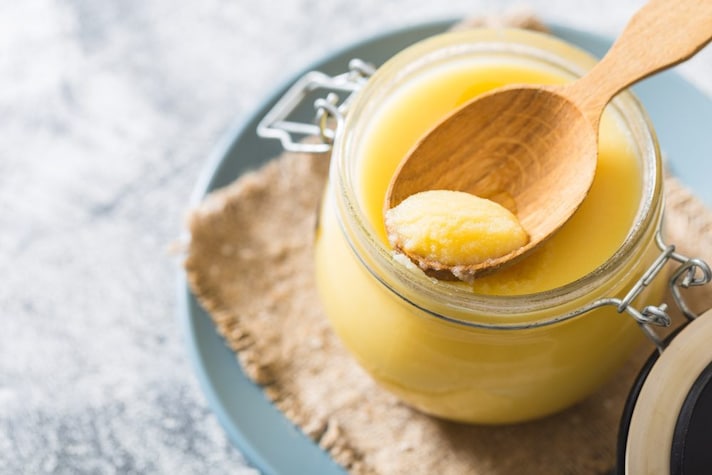
A different product is clarified butter, obtained by removing most of the water and non-fat milk components from butter. By removing the water and solid components (proteins and lactose, responsible for browning and premature burning), clarified butter raises its smoke point from around 266°F/130°C to over 445-280°F/230-250°C, allowing for high-temperature cooking and frying without the risk of burning. It is therefore particularly useful for frying or other preparations that require higher temperatures. Similar, but not necessarily identical, is ghee, a traditional product widely used in South Asian cuisine: in this case too, the butter is heated to remove water and milk solids, but the process can be longer and contribute to the development of its characteristic flavor profile.
In the United States, butter is generally defined by its minimum milkfat content of 80%, but lower-fat spreads are sold under different names rather than the European categories of “three-quarters butter” or “half-fat butter.” Products such as light butter, reduced-fat spreads, and butter-oil blends can contain varying amounts of fat and water, depending on their formulation. For this reason, there is no single fixed number of butter types in the American market: products can be classified according to fat content, ingredients, processing methods, or whether they are salted, unsalted, cultured, or European-style. These categories describe different characteristics, so they should not be treated as one universal classification system.
Not All Butter Comes From Cream
When we think of butter, we almost always imagine the kind made from cream, but that's not the only option: there's also whey butter, produced by recovering the fat in the whey left over from cheesemaking, and recombined butter, obtained by combining milk fat, water, and non-fat milk components. In any case, to be called butter, its fat must be of dairy origin: products made from vegetable fats cannot be marketed simply under this name.
How to Choose a Good Butter and Which One to Use in Cooking
So how do you choose quality butter? What parameters should you consider? Color isn't a sufficient indicator of butter quality: the hue can naturally range from creamy white to yellow and depends on several factors, including the animals' diet and the presence of pigments like beta-carotene in milk. To make an informed choice, it's therefore more useful to read the label, check the product name, ingredients, and any information on the production method. Once opened, butter should also have a uniform texture and a pleasant odor, without any rancid or unusual overtones.
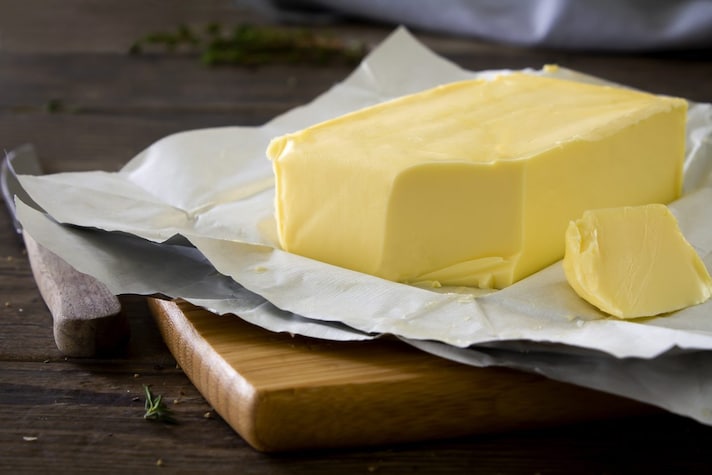
The choice of butter also depends on its intended use in cooking. Traditional butter, thanks to the presence of fat, water, and milk solids, not only adds flavor but can also contribute to the consistency and structure of preparations: it is essential, for example, in shortcrust pastry, biscuits, and puff pastry, where the way it is incorporated and the temperature at which it is worked directly affect the final result. In savory cooking, however, it is used for browning, creaming risottos and pastas, preparing sauces and emulsions, or simply finishing a dish. It is particularly important in French tradition, where it is the basis of preparations such as beurre blanc and hollandaise sauce, but also in Northern Italian cuisine, from creaming risotto to Milanese cutlet. For cooking that requires higher temperatures, clarified butter may be preferable: by eliminating much of the water and milk solids, it resists heat better than regular butter and tends to burn more easily.
Is Butter Bad For You?
One of the most common myths is attributing the ability of a single food to "make you fat." Butter is certainly high in calories, as it's mostly made up of fat, but weight gain depends on your overall energy balance over time: it therefore makes little sense to point to it in isolation as the cause of weight gain. This, however, doesn't mean that the quantities are irrelevant: precisely because of its high energy density and saturated fat content, it's a food that should be included in the overall diet.
It's important to remember that not all saturated fats in butter are the same: unlike other vegetable or animal fats, butter is rich in short- and medium- chain fatty acids (such as butyric acid), which are metabolized more quickly by the body. However, nutritional guidelines and the WHO recommend not exceeding 10% of your daily energy intake and suggest focusing primarily on unsaturated fats, found for example in vegetable oils, nuts, seeds, and fish.
The relationship between butter and cardiovascular disease is also more complex than statements like "butter is bad for your heart" or, at the other extreme, "butter is acquitted." A systematic review and meta-analysis published in 2016, which included over 636,000 participants, found overall small or neutral associations between butter consumption, mortality, and cardiovascular disease; for the latter, no statistically significant association emerged. However, this evidence came from observational studies, which do not allow for a direct cause-effect relationship or the conclusion that butter has protective effects.
Current nutritional recommendations therefore continue to recommend limiting overall saturated fat intake and favoring unsaturated fats. This doesn't mean butter should necessarily be eliminated: it can be part of a varied and balanced diet, considering quantity, frequency of consumption, and overall nutrition. Rather than simply calling it a "good" or "bad" food, it's more accurate to consider it for what it is: a dietary fat with specific characteristics, very useful in cooking and to be consumed while maintaining an overall balanced diet.

