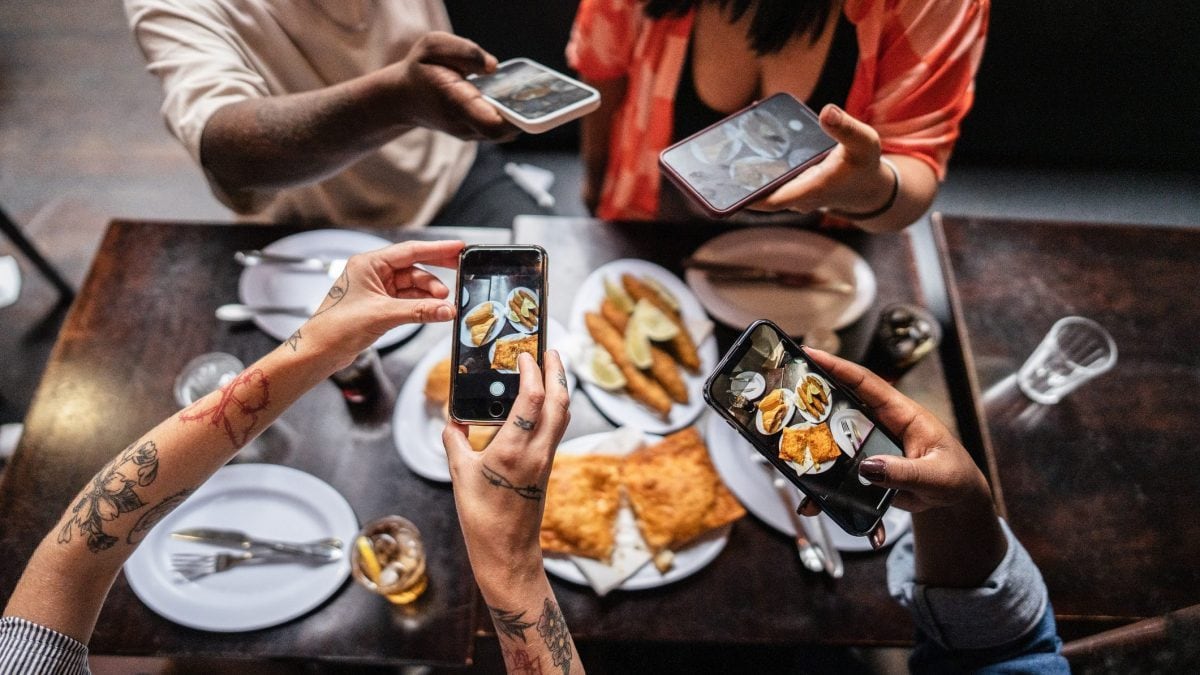
If Luke from "Gilmore Girls" had lived in these times, his diner, complete with a "no cell phones" sign, would probably have closed long ago. Because it seems impossible to tear ourselves away from a screen even for half an hour: yet there are those in the world of bars and restaurants who are trying and, almost strangely, with good results. The idea of banning smartphones inside establishments is not a new trend, but here in the U.S. it is increasingly spreading, with establishments that, in some cases, "confiscate" phones, which are then returned only at the end of the night. For some, it is excessive, but the aim is to rediscover real connection between people… and that's not so wrong.
The Importance of Connections… But in Real Life
The boom in social media and the sudden advent of smartphones have made us increasingly slaves to these small (and not so small) technological devices. But recently, a countertrend has begun to emerge, even among younger generations. The desire to return to being, as the Latins would say, qui et nunc, or "here and now": to re-establish connections that are not through a social network but through words, glances, and gestures. And in the United States, this desire is finding expression in some restaurants, such as Hush Harbor, the first restaurant in Washington to ban the use of phones, which is not only discouraged, but actually prohibited. Upon entry, in fact, cell phones are placed in a case, hermetically sealed and opened with a magnet only upon exiting. However, for owner Rahman "Rock" Harper —famous for founding Queen Mother's Kitchen in Arlington and winning the third season of Hell's Kitchen in 2007—this isn't an overly revolutionary choice or one destined to become a widespread trend. In fact, as reported by the Washington Post, he stated: "I'm not betting on a new trend. I'm betting on the fact that human beings want a space where they can connect with other human beings." No more calls, messages, distracted scrolling on some platform or photos of food to post on your social media stories: rediscover the pleasure of being together, of sharing your stories and, above all, of living in the moment —not just to show it to your followers, but to truly live it.

Although this trend is increasingly shared not only by professionals in the sector, but also by customers, there are still those who have complained, claiming the need to always remain online: to be available for their boss, for the babysitter or simply not to bear the idea of being unreachable even for just a couple of hours.
Although it is the first such establishment in Washington, D.C., it is a trend that has been going on in the rest of the country for a few years: the owner of Hearth in Manhattan specifically asks his customers to turn off their cell phones and put them in closed boxes on the table, while Caterina's in Fort Worth, Texas, promotes the elimination of the use of mobile devices not only to create a connection between diners, but to fully enjoy the dishes in front of them, focusing on every flavor and texture.
At Punk Royale in Stockholm, No Telephones are Allowed Except for Emergencies
The idea of banning, or at least limiting, smartphone use in bars and restaurants is gaining ground in some European cities. Punk Royale is one example: with locations in Copenhagen, Oslo, London, and Stockholm, it aims to offer customers a unique experience, not just in terms of food and drinks, but also in terms of the engaging atmosphere.

Precisely for this reason, only at the Stockholm location is it prohibited to make calls, send messages, or take photos with your smartphone, except for urgent reasons, as stated on their official website: "The use of phones is permitted in our restaurants in Copenhagen and Oslo. In Stockholm, phones are locked during dinner to allow you to fully enjoy the experience. Exceptions are always possible. If you have a valid reason for keeping your phone handy, please let us know in advance. Phones may only be used in emergencies. " This choice is fully in line with the here-and-now philosophy we mentioned at the beginning and is appreciated not only by chefs and restaurateurs, but also by diners and waiting staff, who, in this way, have the opportunity to interact more deeply with customers, making their service hours more enjoyable.
;Resize,width=767;)
