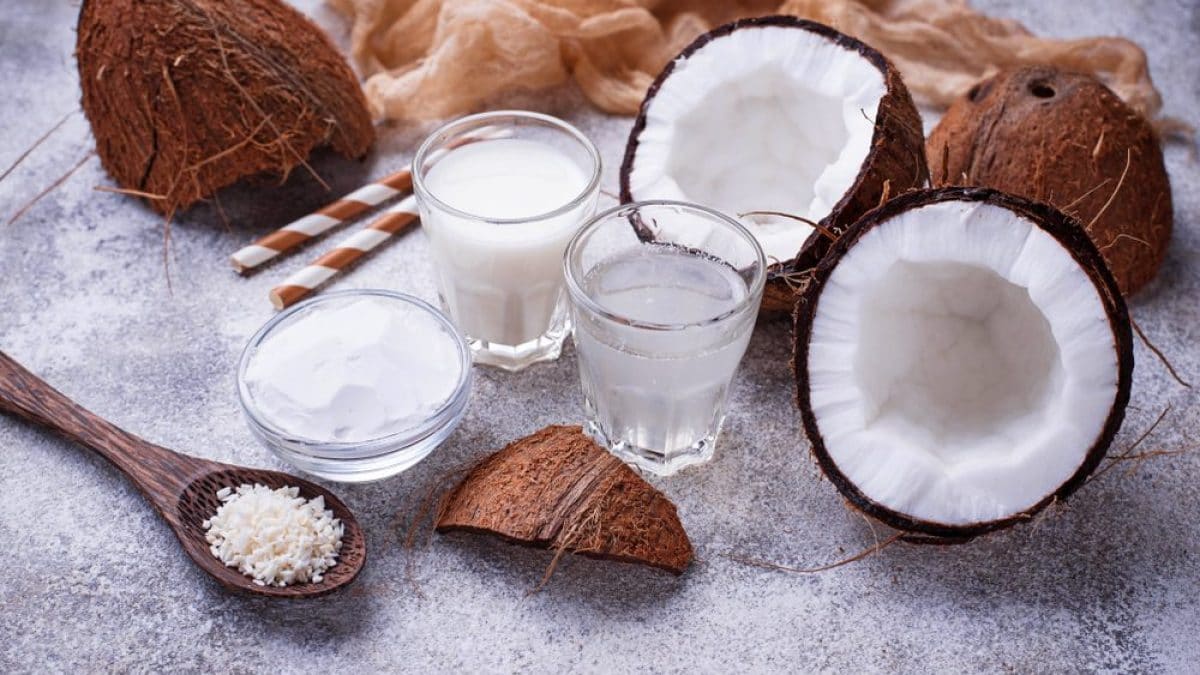
Coconut is a highly eclectic ingredient, capable of adapting to a wide variety of preparations. Native to the tropical regions of Southeast Asia and the Pacific islands, it is now cultivated in many warm climates, from India to Sri Lanka, passing through Thailand, Indonesia, the Philippines, and even the Caribbean and Latin America. Precisely because of this wide geographical distribution, it has become a fundamental element in numerous culinary traditions.
Each component—from the pulp to the liquid derivatives to the waste—has specific characteristics that make it valuable not only from a gastronomical perspective, but also from a nutritional and functional one. In Asian cuisines, for example, coconut milk is the basis of curries and soups; in the Caribbean, it is used to enrich rice, fish, and legume dishes; in Indian cuisine, it is used in many regional preparations, both sweet and savory. Coconut is also widely used in African and South American cuisine, often combined with spices, tubers, and meats.
Truly understanding it means knowing how to use each part consciously and creatively, enhancing its diverse applications. Botanically, coconut is a drupe, a fruit with a hard shell that protects an edible core. In the kitchen, however, this distinction is secondary: what matters is its extraordinary versatility.
1. Coconut Pulp

The pulp is the most well-known and used part of the coconut: rich in fiber and "good" fats, it has a crunchy texture when fresh and becomes more intense and concentrated after drying. Beyond its classic uses in pastry, such as biscuits and cakes, it can be used much more creatively: blended, for example, it becomes a perfect base for plant-based creams or dairy-free desserts, while toasted in a pan it develops a deeper aroma, with light caramelized notes. In savory dishes, the grated pulp can also be used as an alternative breading for meat or fish, creating a crispy and fragrant crust. It's important to be careful when toasting, however, as the natural sugars tend to darken quickly.
2. Coconut Water

Coconut water is the liquid contained in young coconuts and is distinguished by its delicate, slightly sweet flavor. It's highly prized as a natural beverage thanks to its mineral content, but it also finds its place in the kitchen. It can be used as a base for smoothies and juices, or used in cooking rice, especially aromatic varieties, for a more fragrant result. In the pan, added while cooking vegetables or white meats, it helps create a light glaze and mellow more intense flavors. It's also interesting to use in marinades, where it helps keep foods tender without overpowering their flavor.
3. Coconut Milk

Coconut milk is a preparation obtained by processing grated coconut pulp, mixing it with water and then filtering it. Unlike coconut water, which is naturally found inside the young fruit and is clear and light, coconut milk is a byproduct, richer, more opaque, and creamier thanks to the presence of fats from the pulp. This composition makes it one of the most versatile ingredients in tropical and Asian cuisines.
Its consistency can vary from quite runny to very thick, depending on the concentration, making it suitable for numerous uses. Coconut milk can be used in a wide variety of recipes: in savory dishes, it's perfect for curries, soups, and sauces, where it helps tone down spices and heat with its natural sweetness and fatty component. It can also be used to cream vegetable risottos, adding structure and roundness to the dish without resorting to dairy products. In sweet dishes, however, coconut milk is ideal for mousses, ice creams, and puddings, precisely because of its creamy texture. From a technical standpoint, it's best to avoid prolonged boiling, as excessive heat can cause the fat and liquid to separate.
4. Coconut Cream (Or Coconut Butter)
Coconut cream, often called coconut butter, is a product distinct from both milk and oil. It is made by finely blending the dried pulp into a thick, smooth paste that preserves all the components of the fruit, including fat and fiber. This is why it has a firm consistency at room temperature, which tends to soften or melt with heat. Unlike coconut milk, which is diluted with water, coconut cream is much more concentrated and flavorful. It should not be confused with coconut oil, which is composed exclusively of the fat; coconut butter, on the other hand, is a whole food.
In the kitchen, it can be used in a variety of ways: in desserts, it's perfect for making creams, fillings, and dairy-free desserts, or as a base for energy snacks and pralines. Melted, it can be added to hot drinks or smoothies to increase creaminess. In savory dishes, when used in small quantities, it enriches sauces and curries, adding body and a rounder note. From a technical standpoint, it's important to work it lightly when hot if you want a more fluid consistency, while when cold, it tends to firm up quickly.
5. Coconut Oil

Coconut oil is a very interesting fat for culinary use, both for its stability and its consistency. At room temperature, it tends to be solid, but it melts easily with heat, a characteristic that makes it useful in various cooking techniques. It can be used for baking, frying, or simply to grease baking sheets and pans. In desserts, it is a valid alternative to butter, especially in vegan preparations, also contributing to the structure of doughs. It is particularly useful in no-bake bases, where its ability to solidify helps bind the ingredients together. However, its aroma should be considered: the unrefined version is quite strong, while the refined version is more neutral and therefore more versatile.
6. Coconut Flour

Coconut flour is obtained from dried coconut pulp, which has subsequently been partially stripped of its fat, making it finer, drier, and particularly rich in fiber. It is naturally gluten-free and behaves very differently from traditional flours: it absorbs a high amount of liquid and tends to make doughs more compact, thus requiring careful balancing of recipes, often with the addition of more liquids or binding ingredients. In the kitchen, it can be used for baked goods such as pancakes, muffins, or low-carb cakes, but also to thicken creams and smoothies. Its naturally sweet flavor makes it particularly suitable for baking, as long as its ability to absorb liquids is taken into account.
It's important not to confuse it with grated coconut, which is dried and grated coconut pulp, still containing its fatty component and with a coarser consistency. Grated coconut is mainly used as an ingredient or decoration in sweets and desserts, while coconut flour has a more structural function in dough.
;Resize,width=767;)
