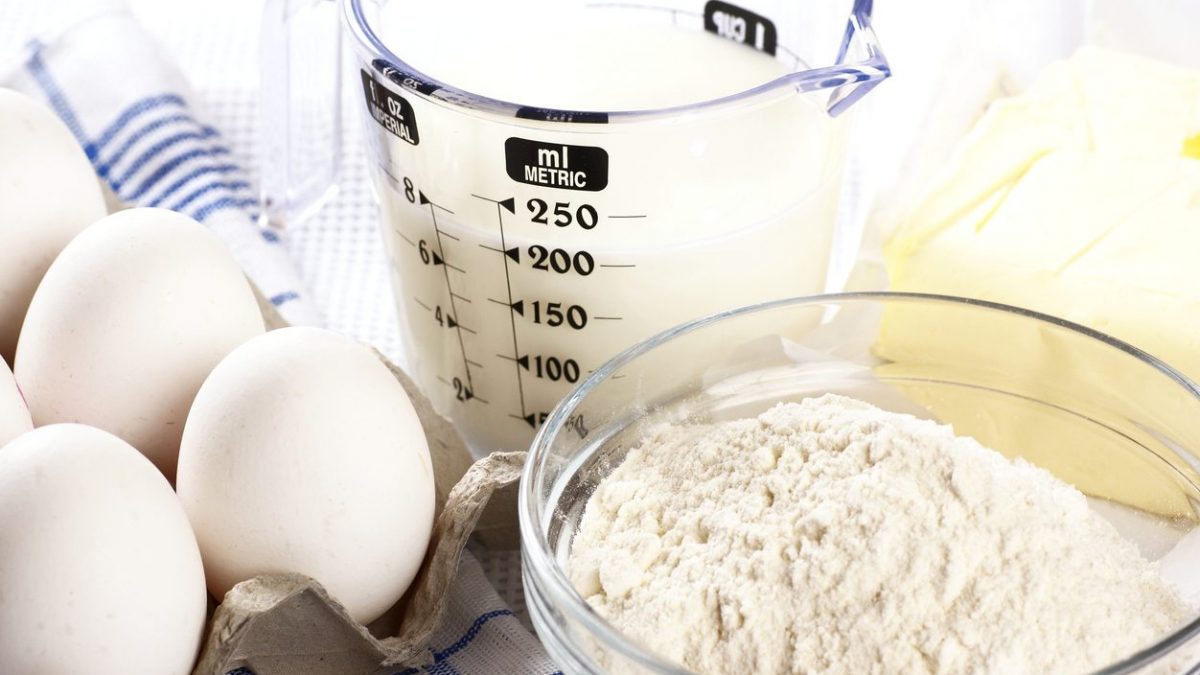
The scale is one of those accessories that is usually never missing in the kitchen: despite this, it can happen that you do not have it available for the most disparate reasons, including a sudden malfunction, and you find yourself a little disoriented.
There are preparations that can come in handy (who has never made a quick seven-jar cake, including a savory version, for convenience) or you can rely on equally common utensils in the pantry and drawers. A medium glass (about 200 ml) can come in handy for milk, cream, but also sugar, as can a cup (240 ml), a teaspoon (5g), and a tablespoon (15g), becoming alternative units of measurement that are also found in many home recipes or which, for example, are the basis of the Anglo-Saxon system (between cup, tablespoon, and teaspoon).
If you don't have a precision instrument available, here's how to weigh commonly used liquid and solid ingredients and how much they correspond to, based on a heaped (and not level) teaspoon and a full glass. The values we give are averages, and may obviously vary depending on the individual case, but they are especially useful in those recipes where a few grams less or more won't affect the result.
All Purpose Flour
Let's start with all-purpose flour, the most versatile of all: it can be used to make cakes and sauces, such as béchamel. A teaspoon corresponds to 8-10g, a tablespoon to 25g, a glass to 125-130g, a cup to 125g. You can consider these weights valid for 00 flour as well, since they have the same density.

Salt
Here's another versatile ingredient: salt. Here we're referring to fine salt: a teaspoon equals 5g, a tablespoon equals 20g, a glass equals 200g, and a cup equals 225g.
Granulated Sugar
This is classic white table sugar. A teaspoon equals 5g, a tablespoon equals 20g, a glass equals 200g, and a cup equals 225g.
Powdered Sugar and Cocoa
The consistency of powdered sugar is different from that of white sugar, and the quantities indicated can also be applied to foods that share the same almost impalpable texture, such as bitter cocoa powder, with very slight variations. On average, a teaspoon corresponds to 5-7g, a tablespoon to 15g, and a glass to 90-100g. Finally, a cup is 120g.

Potato Starch and Corn Starch
These are two of the best-known thickeners; for example, starch is one of the main ingredients in custard. The weights to use as a guide are: a teaspoon 8-9g, a tablespoon 20g, a glass 100-110g, and a cup 120-130g.
Milk
Let's move on to liquids, starting with milk, which is used in many sweet and savoury preparations: a teaspoon is equivalent to 6g of milk, a tablespoon to 12g, a glass to 210-220g and a cup to 245g.
Oil
As for extra virgin olive oil, we have the following values: a teaspoon corresponds to 5-6g, a tablespoon to 12g, a glass to 180g and a cup to 200g.

Cream
For fresh cream, the measurements are similar to those for milk: a teaspoon is equivalent to 5-6g, a tablespoon to 12-15g, a glass to 210-220g and a cup to 245-250g.
Water
Water has the advantage of having a density of 1 ml = 1 g, so on paper a teaspoon will be 5g, a tablespoon 15g, a glass 200g and a cup 240g.
Butter
We conclude with the butter, which to be measured precisely in the ways just explored must be melted: a spoon is equivalent to approximately 5-7g, a teaspoon between 12 and 15g while a cup is around 200-210g.
;Resize,width=767;)
