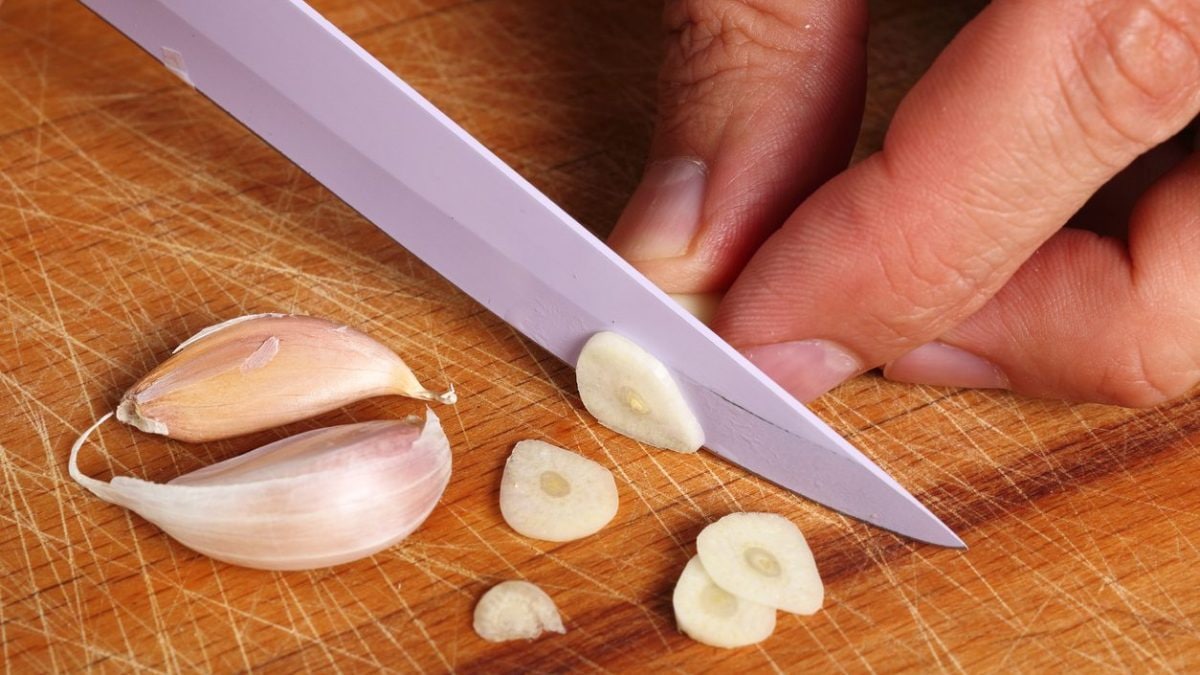
Noticing that garlic's aromatic and flavor intensity changes depending on how it's used in a dish is first and foremost an empirical fact: we've all noticed, while preparing a recipe, that a whole clove of garlic doesn't give off the same aroma as a chopped clove. What's more, depending on how much it's chopped, the smell and flavor become stronger, distinctively characterizing the dish. We know what happens, but probably not why: as often happens in the kitchen, that's where science comes in, specifically chemistry.
Why And How Garlic Changes Flavor When Cut
In the simplest possible way, we can say that the typical aroma of fresh garlic remains "dormant" in the intact bulb, but develops following the rupture of its cells (i.e., when they are damaged when cut). This is due to the presence within it of a sulfur-containing amino acid, alliin, and an enzyme, alliinase, which are activated when the structure of the plant is altered, thus giving rise to allicin, the molecule responsible for the pungent smell of garlic (the same happens in onions, with isoallinin that makes us cry). The greater the surface area exposed to the cut of the knife or grater, the faster and more significant the development of this volatile substance, which amplifies its flavor power. Therefore, on an increasing scale, we have:
- Whole clove: The delicate flavor is present, but not overpowering. Choose it for recipes where the aromatic note must remain subtle and emerge slowly, such as those cooked slowly, like tomato sauce, roasts, or soups.
- Sliced clove: The flavor is moderate, distinct but not overwhelming. Thin slices are typically used wisely in Asian cuisine, where garlic contributes its flavor without overpowering the rest: for example, they're ideal in stir-fries, such as vegetables, shellfish, and stir-fried noodles. Otherwise, choose them in marinades for meat and fish or to enhance sauces and gravies, such as soy sauce.
- Chopped clove: the flavor is strong, present, and well-defined. This is the quintessential cut of aromatic bases where garlic doesn't go unnoticed: it's good for sautéing (be careful not to burn it, or the pungent smell is irremediable) in sauces, stews, but also in cold condiments such as salmoriglio.
- Crushed clove: this creates a kind of garlic paste, with a predominant flavor that blends easily with the rest of the recipe. This almost creamy consistency can be created by making Genoese pesto with a mortar, but also by blending, or by grating it to make a classic garlic, oil, and chili pepper sauce.

Is Garlic Better With or Without Its Core?
Another often-discussed aspect concerns the presence of the germ, or greenish central part that develops inside the clove: it is commonly thought that removing it makes garlic more digestible, but this belief, in reality, is not supported by scientific evidence. Leaving the germ or not, however, turns out to be a factor linked to flavor, as it has a more pronounced taste: if the garlic is to be used raw, then it is preferable to remove it to obtain a softer aroma, while if it is cooked, it can instead contribute to adding depth.
;Resize,width=767;)
